Level 1 · The basics · 12 min
Four chords as arpeggios
By the end, you can sound C, G, A minor and E minor one string at a time.
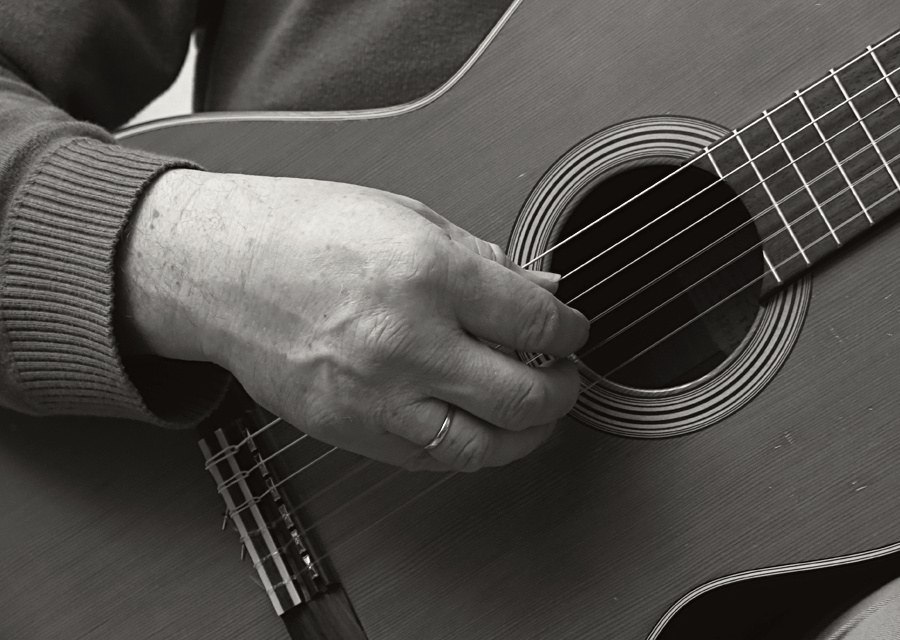
Before this lesson
Lesson steps
1 C major
Play the notes of the C chord in p-i-m-a order.
3 min · Quarter note = 48, 1 note per click


Check for · You hear C-G-C-E and all four strings keep ringing together.
More detail
A chord combines several notes. An arpeggio plays them one at a time. For these four strings, use the ring finger at fret 3 on string 5 and the index at fret 1 on string 2.
2 G major
Play the G arpeggio starting on string 6.
3 min · Quarter note = 48, 1 note per click


Check for · The first note is a low G. The last one is a high G.
More detail
Here the thumb plays G at fret 3 on string 6. Use your left little finger for G at fret 3 on string 1.
3 The two minor chords
Alternate A minor and E minor, one chord per bar.
3 min · Quarter note = 48, 1 note per click


Check for · You hear the notes A, C and E in the first chord and E, G and B in the second.
More detail
A minor starts on open string 5. This E minor voicing uses four open strings: 6, 3, 2 and 1.
4 Four sounds
Play C, G, A minor and E minor in that order.
3 min · Quarter note = 48, 1 note per click

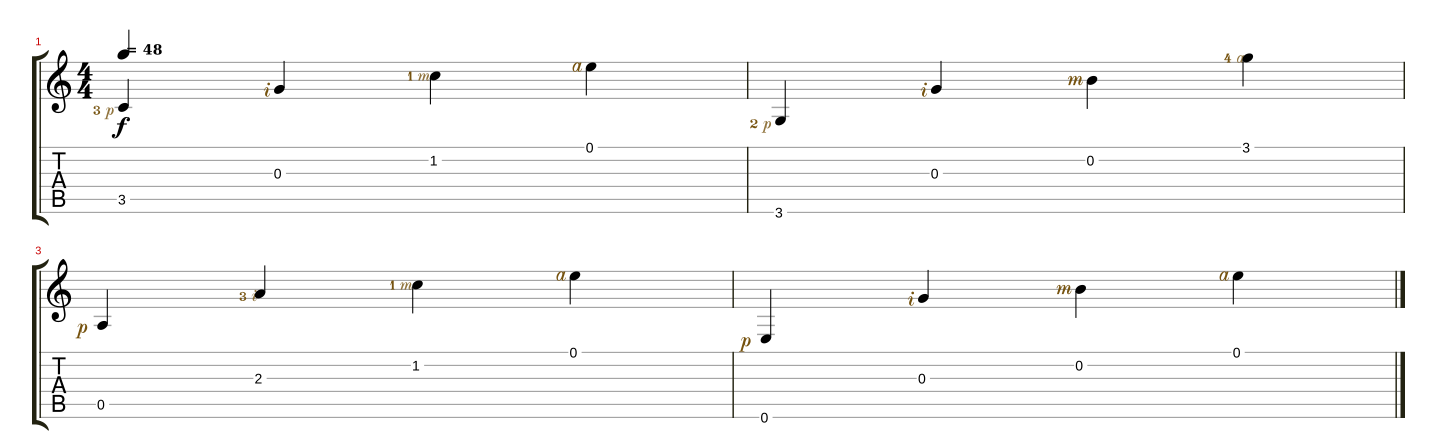
Check for · You change chord every four clicks without rushing the open notes.
More detail
Start with the first two bars if the change to G interrupts the pulse. After three steady loops, return to the whole sequence.
You can move on when…
You pass when you play all four chords twice, with four clear notes per chord at a steady pulse.
If a movement feels difficult
One treble string sounds dead.
Curve the left finger that brushes the neighbouring string.
I lose the beat when changing chords.
Repeat just the last note of the first chord and the bass of the next.