Week 1 · 12 min
Cover three strings
By the end, you can place a partial barre and check each string.
Lesson steps
1 How much to cover
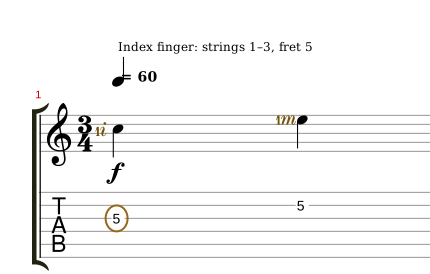
Lay your index across the three treble strings at fret 5.
3 min · 40 bpm · 1 note per click


Check for · 2 bars at 44 BPM — The required strings are covered without muting the others.
More detail
A barre frets several strings at the same fret with one finger. Here you only need three.
2 Each string on its own
Test strings 3, 2 and 1 of the first barre in turn.
3 min · 40 bpm · 1 note per click
Revisit the tablature · Step 1
Check for · 2 bars at 44 BPM — Each required string sounds clearly.
More detail
If one string buzzes, move the index slightly closer to the fret wire. Retest that string first.
3 Start again lightly
Release the pressure at every rest shown in the tab.
3 min · 40 bpm · 1 note per click


Check for · 2 bars at 44 BPM — You alternate useful pressure with release.
More detail
The practice time includes rests. Aim for the same sound when you form the barre again.
4 Move from V to VII
Release the pressure between bars and set the index down at fret 7.
3 min · 40 bpm · 1 note per click
Revisit the tablature · Step 1
Check for · 2 bars at 44 BPM — Strings 3, 2 and 1 ring at fret 7.
More detail
The index covers the same three strings in both positions. Listen to the first note after the shift.
You can move on when…
You pass when, over 2 bars at 44 BPM, strings 3, 2 and 1 ring at fret 7.
If a movement feels difficult
One string under the barre buzzes.
Check each string separately and move your index finger a little closer to the fret.
You barre more strings than necessary.
Return to the partial barre the passage needs.