Week 1 · 12 min
From line to fret
By the end, you can read a string and fret directly from tab.
Lesson steps
1 The lines
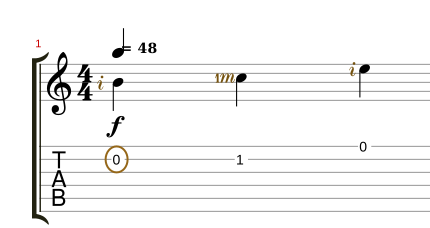
Point to the two strings used in the tab.
3 min · 40 bpm · 1 note per click


Check for · 2 bars at 44 BPM — You identify the first line at the top and the second just below it.
More detail
The six lines represent the strings. Read the numbers from left to right. Zero means open, and 1 means the first fret.
2 String 2
Play B-C-D-C on string 2.
3 min · 40 bpm · 1 note per click


Check for · 2 bars at 44 BPM — The tab reads 0-1-3-1. You hear the same C on clicks two and four.
More detail
In first position the index takes fret 1 and the ring finger takes fret 3. Keep the wrist near its resting position.
3 String 1
Move the same fret pattern to string 1.
3 min · 40 bpm · 1 note per click


Check for · 2 bars at 44 BPM — The pattern now sounds E-F-G-F, higher than on string 2.
More detail
To transpose is to move a pattern so it sounds higher or lower. Here the fret pattern stays 0-1-3-1.
4 Play what you read
Play both bars, following the numbers from left to right.
3 min · 40 bpm · 1 note per click
Revisit the tablature · Step 1
Check for · 2 bars at 44 BPM — The first bar has four attacks. The second fits six attacks into the same four clicks.
More detail
In bar 2 the notes come in pairs on beats 1 and 3. One note fills each of beats 2 and 4.
You can move on when…
You pass when, over 2 bars at 44 BPM, the first bar has four attacks. The second fits six attacks into the same four clicks.
If a movement feels difficult
I treat every 1 as a string number.
Find the line before reading the fret number.
I give each eighth note a whole click.
Speak both halves of the beat before playing bar 2 again.