Week 1 · 12 min
Sound the hammer-on
By the end, you can sound two pitches with one pluck and a hammer-on.
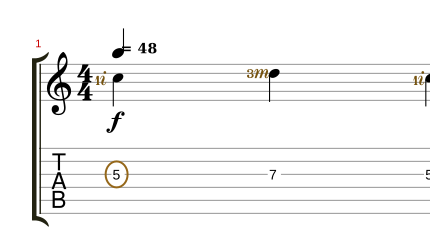
Lesson steps
1 The reference sound
Pluck both notes of each pair in the first bar.
3 min · 40 bpm · 1 note per click


Check for · 2 bars at 44 BPM — Frets 5 and 7 give two distinct notes on string 3.
More detail
An ascending slur sounds the higher note by bringing a left finger down, with no second right-hand attack.
2 Prepare the ring finger
Hover the left ring finger over fret 7 with the index at fret 5.
3 min · 40 bpm · 1 note per click
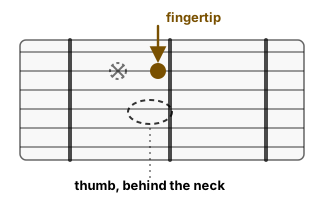
Revisit the tablature · Step 1
Check for · 2 bars at 44 BPM — The finger waits close to the string without touching it.
More detail
The speed of the movement sounds the note; a large movement is unnecessary.
3 One pluck
Sound fret 7 by dropping the ring finger after plucking fret 5.
3 min · 40 bpm · 1 note per click
Revisit the tablature · Step 1
Check for · 2 bars at 48 BPM — The second note sounds as clearly as the first.
More detail
In bar 2, pluck only the first note of each pair. The repeated right-hand letter in the slur identifies the starting finger. The left hand sounds the second note.
4 Two versions
Compare the plucked pair in bar 1 with the slurred pair in bar 2.
3 min · 44 bpm · 1 note per click
Revisit the tablature · Step 1
Check for · 4 bars at 48 BPM — The slurred pair keeps the rhythm and volume of the plucked pair.
More detail
Keep one click per note. The ring finger moves quickly even at this slow tempo.
You can move on when…
You pass when, over 4 bars at 48 BPM, the slurred pair keeps the rhythm and volume of the plucked pair.
If a movement feels difficult
The second note is weak.
Prepare the finger above the fret and shorten its hammer-on movement.
You rush the second note.
Compare the plucked pair with the slurred pair again, one pair per click.