Week 2 · 12 min
Keep one finger down
By the end, you can slur a pair while keeping another finger in contact.
Before this lesson
Lesson steps
1 Compare two attacks
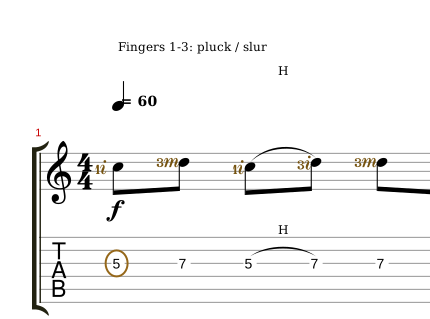
Play 5–7 on string 3 with two plucks, then as a slur.
3 min · 44 bpm · 2 notes per click

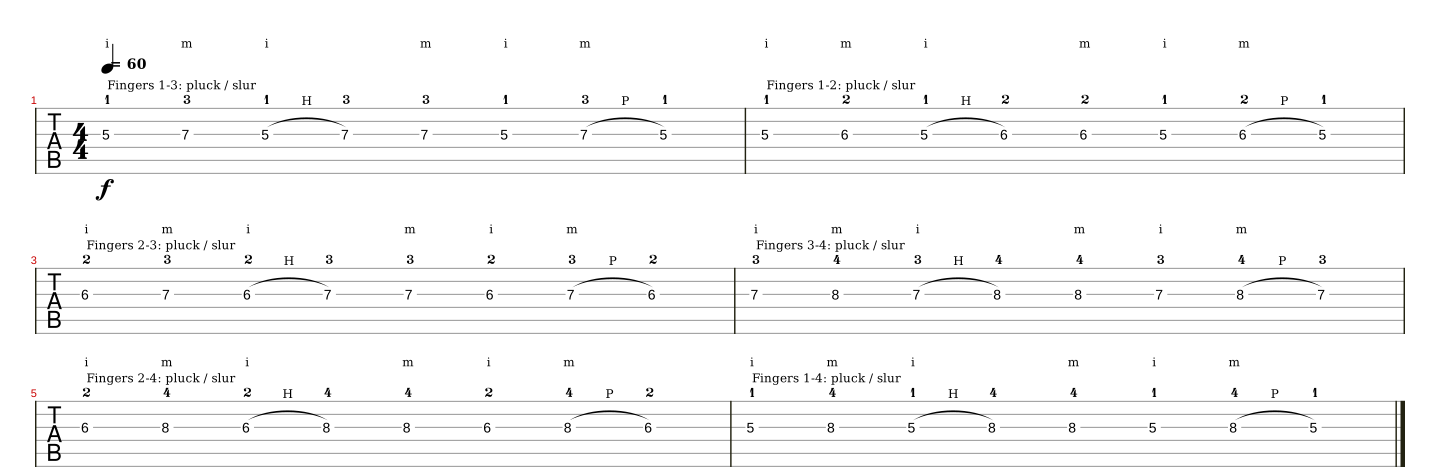
Check for · 2 bars at 48 BPM — The slurred pair keeps the rhythm and volume of the plucked pair.
More detail
Repeat bar one. Each pair takes one beat. Compare C at fret 5 with D at fret 7.
2 Prepare the hammer-on
Hover the next finger just above its fret. Drop it with a short movement just behind the fret wire.
3 min · 44 bpm · 2 notes per click
Revisit the tablature · Step 1
Check for · 2 bars at 48 BPM — The second note sounds as clearly as the first.
More detail
The speed of the movement sounds the note; a large movement is unnecessary.
3 Keep the lower finger down
Keep the lower finger down and lightly pluck the string with the finger you lift.
3 min · 44 bpm · 2 notes per click
Revisit the tablature · Step 1
Check for · 2 bars at 48 BPM — The destination note stays clear and in time.
More detail
The departing finger may finish against the next string towards the treble, like a left-hand rest stroke; adapt the movement on the first string.
4 Work with one fixed finger
Keep the left middle finger at fret 6 on string 3 and play the opening two bars.
3 min · 44 bpm · 2 notes per click

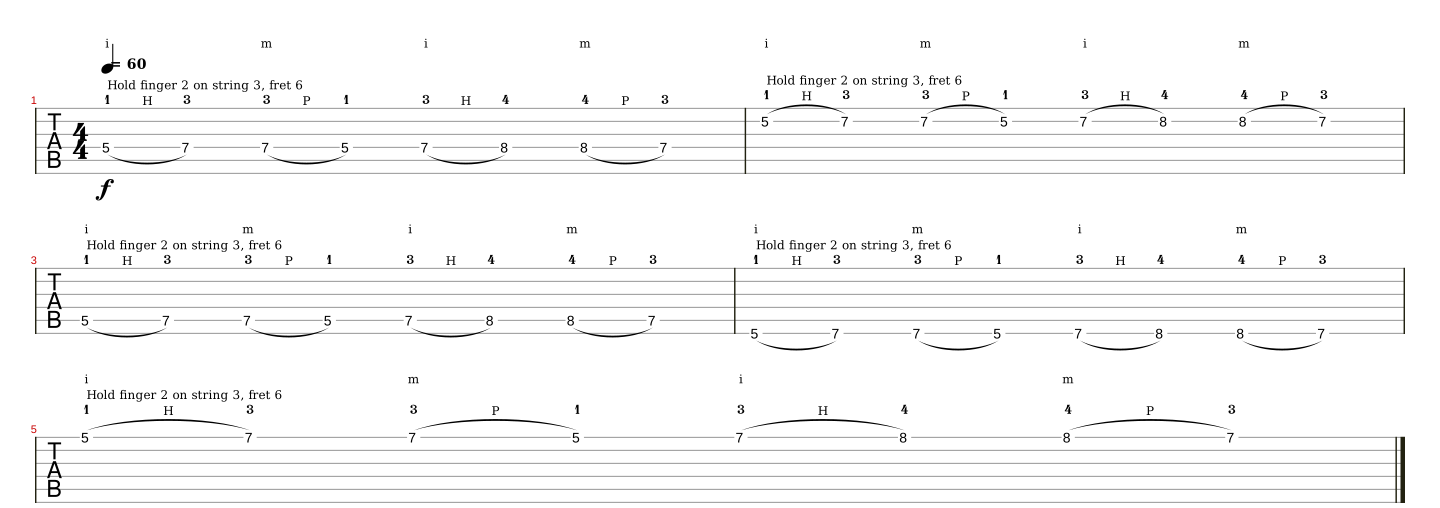
Check for · 2 bars at 50 BPM — The fixed finger stays in place without unnecessary pressure.
More detail
In bar one the other fingers play on string 4. In bar two they move to string 2. Keep the middle finger in place.
You can move on when…
You pass when, over 2 bars at 50 BPM, the fixed finger stays in place without unnecessary pressure.
If a movement feels difficult
The pull-off note is muted.
Keep the lower finger down while the other lightly plucks the string.
Your fingers lift too far.
Repeat the piston movement slowly, keeping your fingers hovering close to the string.