Week 3 · 12 min
Sustain the bass and sing out the top line
By the end, you can layer a sustained bass, a moving thumb and a melody on string 2.
Before this lesson
Lesson steps
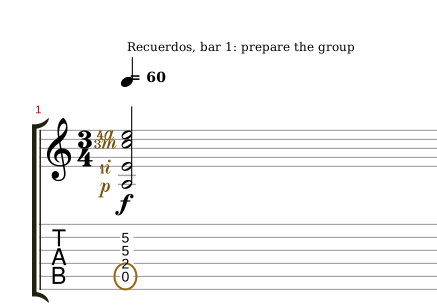
1 Prepare the chord shapes
Pluck each chord together and hold it for its written length.
3 min · 66 bpm · 1 note per click


Check for · 2 bars at 72 BPM — the first chord lasts two beats and the second lasts one.
More detail
This reduction has three beats per bar. Check the chords by ear. In the next step, each click represents an eighth note in the original score.
2 Listen for the low A
Let string 5 ring after the first thumb stroke of each bar.
3 min · 72 bpm · 4 notes per click


Check for · 2 bars at 78 BPM — the low A continues to ring under the following groups.
More detail
The low line in the tab lasts six clicks. Here each click equals an eighth note in Tárrega’s score.
3 Listen to the melodic shape
Follow frets 5 then 3 in the first bar, 1 then 3 in the second.
3 min · 72 bpm · 4 notes per click
Revisit the tablature · Step 2
Check for · 2 bars at 78 BPM — each change of pitch is audible on string 2.
More detail
The first four groups in each bar stay on one fret. The last two give the new pitch.
4 Bring the three lines together
Repeat the two bars with the melody clear above the basses.
3 min · 78 bpm · 4 notes per click
Revisit the tablature · Step 2
Check for · 4 bars at 84 BPM — both passes keep six groups per bar with the sustained bass audible.
More detail
Listen to the top line on the first pass and the low A on the second. Play both layers each time.
You can move on when…
You pass when you play bars 1 and 2 twice at 84 BPM while the low A rings.
If a movement feels difficult
The tune breaks at a fret change.
Locate the new fret before the last i. Fret the note during the next bass attack.
The thumb hesitates at the string change.
Play the thumb line alone for two bars before adding the three upper notes.
The thumb covers the melody.
Repeat one bar with a lighter bass. Keep listening for all three upper notes.