Level 2 · Working with both hands · 15 min
Three arpeggio patterns
By the end, you can change patterns without moving your whole right hand.
Before this lesson
Lesson steps
1 The ascending arpeggio
Play p-i-m-a on open strings 4-3-2-1.
3 min 45 s · Quarter note = 48, 1 note per click


Check for · Each attack starts on the correct string.
More detail
p = thumb, i = index, m = middle, a = ring finger; string 1 = high E. The strings stay open.
2 Back from the treble
Reverse the finger order after the bass by playing p-a-m-i.
3 min 45 s · Quarter note = 48, 1 note per click


Check for · The first note after the bass is the highest.
More detail
The three fingers keep their strings. Only the stroke order changes.
3 The index returns
Play p-i-m-i with the index close to string 3.
3 min 45 s · Quarter note = 48, 1 note per click


Check for · The fourth note lands on the click at the same pitch as the second.
More detail
Finger m plays string 2. Meanwhile i returns near string 3 without muting it.
4 Towards Giuliani No. 2
Play the bass at the start of each p-i-m group on the click.
3 min 45 s · Quarter note = 48, 1 note per click

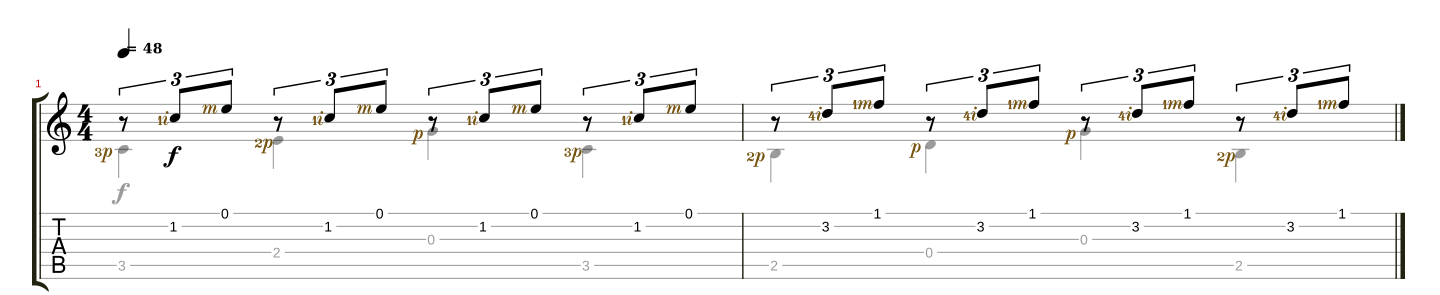
Check for · You hear three evenly spaced notes per click.
More detail
No. 2 of Giuliani’s first ten patterns alternates C and G7. A triplet divides a beat into three equal parts. Follow the moving bass.
You can move on when…
You pass when you play each pattern three times at the same tempo and every note can be heard.
If a movement feels difficult
You catch a neighbouring string.
Use full planting eight times per chord, then return to sequential planting.
Planting cuts the notes short.
Plant the next finger more gently and a little later; listen to the end of each note.