Level 3 · Classical technique · 20 min
The p-a-m-i tremolo
By the end you can sustain a line of three repeated sounds above a thumb bass.

Before this lesson
Lesson steps
1 Start on four strings
Separate the four fingers onto the four marked strings.
4 min · Quarter note = 44, 1 note per click


Check for · All four attacks have the same duration and volume.
More detail
Use the thumb on string 4, then a, m and i on strings 1, 2 and 3 respectively.
2 Bring the fingers onto one string
Bring a-m-i onto the first string after the bass.
4 min · Quarter note = 44, 1 note per click


Check for · No attack rushes or disappears.
More detail
Let the bass ring under the three attacks. Divide each block into short trials.
3 Prepare each attack
Prepare each finger near the string just before its attack.
4 min · Quarter note = 44, 1 note per click
Revisit the tablature · Step 2
Check for · The movement stays relaxed and the attacks are even.
More detail
Planting can shorten the preceding note; use this as a movement exercise, then recover continuity.
4 Move the accent
Move the long duration from p to a, then to m and i.
4 min · Quarter note = 44, 1 note per click

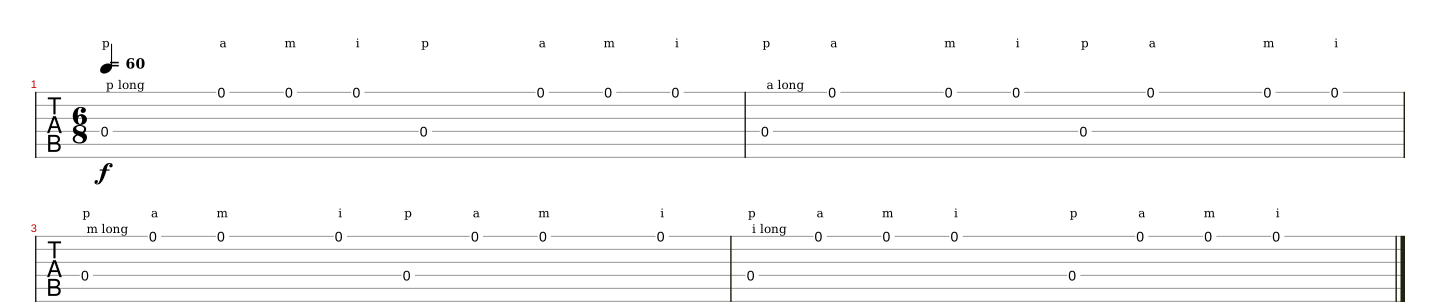
Check for · You can change the accent deliberately without tensing up.
More detail
These variations address unevenness; return to a steady rhythm afterwards.
5 Bring the fingers onto one string
Record eight even groups on a single treble string.
4 min · Quarter note = 48, 1 note per click
Revisit the tablature · Step 2
Check for · No attack rushes or disappears.
More detail
Listen to the gap between i and the next thumb: it equals the gaps between the other attacks.
You can move on when…
You pass when eight p-a-m-i groups keep the tempo without unwanted accents.
If a movement feels difficult
The rhythm is uneven.
Play the four strings slowly again and make the four attacks even.
The thumb overpowers the repeated notes.
Lighten p until it matches the volume of the other attacks.