Tremolo practice starts with four separate attacks you can hear: p, a, m and i. Before trying to make them sound continuous, learn to keep their order, spacing and balance dependable. A short group played clearly gives you more useful information than a long run that becomes uneven halfway through.
Follow the exercise’s string arrangement and listen for the finger that changes the pattern. It may arrive late, play too loudly or rush into the next thumb attack. Choose one feature for the next comparison. Keep the tempo slow enough that you can hear the difference rather than guessing from the feeling of the hand.
When the upper fingers share a string, prepare the next contact without stopping the previous note too early. Work on a simple left-hand shape before adding a position change. If the pattern breaks at that change, practise the shapes without tremolo and then add one group to each arrival.
Write down the number of attacks per click as well as the metronome setting. Finish with a short phrase from the piece you are preparing. Listen to the thumb’s line and the upper melody separately, then judge whether their combined sound remains balanced and rhythmically clear.
What this exercise helps you change
- Uneven tremolo
- Overpowering thumb
- Tense fingers
Your practice steps
1. Start on four strings
Play p-a-m-i with p on 4, a on 1, m on 2 and i on 3. At 60, fit four equal notes between two clicks.
Practice reference: 60 bpm · 4 attacks per click.
Your checkpoint: All four attacks have the same duration and volume.

Read the complete static tab · Download the alphaTex file

The player and its sounds load when you choose to use them.
2. Bring the fingers onto one string
Keep p on a bass string and play a-m-i on string 1. Slow down enough to relax each finger after its attack.
Practice reference: 60 bpm · 4 attacks per click.
Your checkpoint: No attack rushes or disappears.

Read the complete static tab · Download the alphaTex file

The player and its sounds load when you choose to use them.
Other versions to read

3. Prepare each attack
Plant a as p plays, then prepare m and i in turn. Listen to the evenness of the four attacks.
Planting can shorten the preceding note; use this as a movement exercise, then recover continuity.
Practice reference: 60 bpm · 4 attacks per click.
Your checkpoint: The movement stays relaxed and the attacks are even.
Read the complete static tab · Download the alphaTex file
The player and its sounds load when you choose to use them.
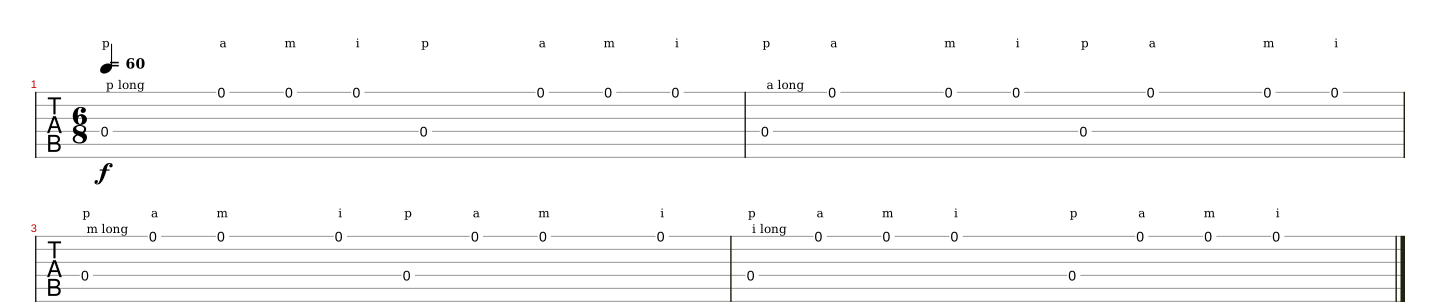
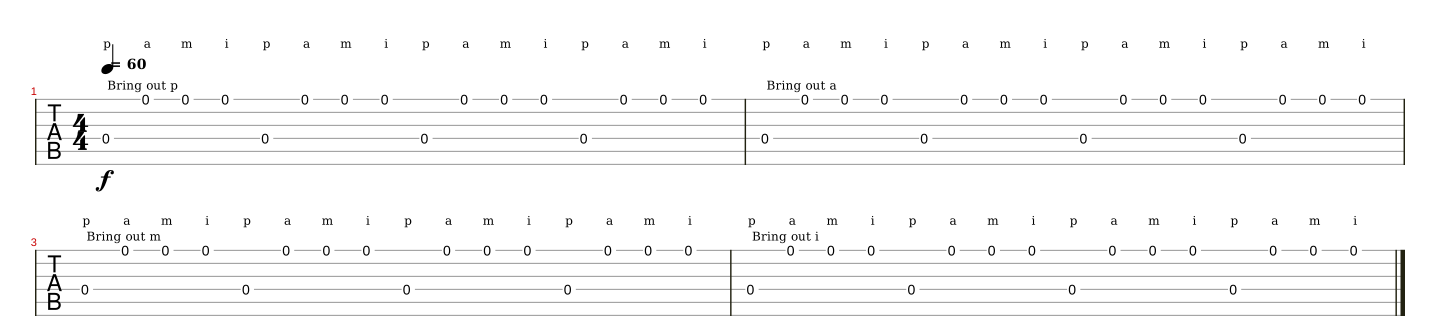
4. Move the accent
Play one long note and three short ones, then move the long note. Also try p-i-m-a and rotating accents.
These variations address unevenness; return to a steady rhythm afterwards.
Your checkpoint: You can change the accent deliberately without tensing up.

Read the complete static tab · Download the alphaTex file
The player and its sounds load when you choose to use them.
Other versions to read

5. Prepare the piece separately
Practise the chords of Recuerdos as blocks before adding tremolo. Record the same exercise at the same tempo every two weeks.
The target 120 × 4 comes from the local guide, not the Niedt page consulted. Niedt recommends 72–78 quarter notes per minute for his interpretation of the piece; these are two separate goals. Limit the block to five minutes at first.
Your checkpoint: The left hand no longer disrupts the right hand.

Read the complete static tab · Download the alphaTex file

The player and its sounds load when you choose to use them.
Common difficulties and corrections
The rhythm is uneven.
Play the four strings slowly again and make the four attacks even.
Return to step 1The thumb overpowers the repeated notes.
Lighten p until it matches the volume of the other attacks.
Return to step 1The fingers stay tense.
Slow down on one string until you can release each finger after its note.
Return to step 2The chord disrupts the tremolo.
Practise the chords alone and return to tremolo on open strings.
Return to step 5Speed hides the problems.
Return to a tempo where each attack stays distinct and relaxed.
Return to step 2Watch and listen
Choose the recording that matches your current goal. Videos load only when you select them and require an internet connection.
Lesson · This is Classical Guitar
Before your first tremolo session.
English commentary. Link and metadata checked for our selection.
Performance · Jorge Caballero
To understand the movement in a musical context.
English commentary. Link and metadata checked for our selection.
Performance · Jorge Caballero
To review alignment and the exercises.
English commentary. Link and metadata checked for our selection.
Performance · Classical Songs
As a listening reference, without copying the speed.
English commentary. Link and metadata checked for our selection.
Sources and transcription choices
- Tennant / Tonebase — Five tremolo tips
- Werner — Tremolo exercises
- Niedt — Preparing Recuerdos
- Gretchen Menn / Jiji — Tremolo accents and rhythms
The notes follow the credited sources. Fingerings, phrase divisions and practice tempos are editorial learning choices. How our transcriptions work.