Recuerdos de la Alhambra depends on an even tremolo, but the repeated notes are only one part of its music. The thumb has a moving line of its own, and the left hand must prepare chord shapes without breaking the sustained melody. Learn those jobs separately before combining them.
Start with a slow p-a-m-i pattern on a simple shape. Listen for equal spacing and a balanced volume across a, m and i. Then play the thumb line from a short passage by itself. When the parts come together, the thumb should keep its direction without disturbing the upper repetitions.
Practise position changes without tremolo first. Place the required notes, check which basses must remain held and release anything that no longer needs pressure. Add one p-a-m-i group to each shape before extending the passage. This makes it easier to hear whether a disruption comes from the right-hand pattern or the left-hand transition.
The full score contains repeats, alternative endings and a return to the coda. Trace that route before attempting a complete performance. Our practice checkpoints help you choose an appropriate starting point; they do not predict how many weeks the piece will take. Keep the melodic line, rather than the speed of repetition, at the centre of each session.
The thumb traces a line beneath repeated a-m-i notes. Prepare the chord shapes and tremolo separately first. The engraving writes two p-a-m-i groups per beat. Repeats and the return to the coda are preserved. The app uses 60 bpm as a practice reference.
Skills to prepare
- P-a-m-i tremolo
- Balance between voices
- Sustained bass notes
- Position shifts
- Barres
- Slurred ornaments
Before learning the piece
- App checkpoint: keep four p-a-m-i attacks even per click for three twenty-second attempts. Practise this skill (French).
- App checkpoint: sound bars 29–30’s shapes without tremolo three times in a row. Practise this skill (French).
- App checkpoint: play the thumb line alone in bars 1–2, then the melody alone, before combining them. Practise this skill (French).
These checkpoints belong to our learning path. They do not set a deadline for your progress.
Tablature and fingerings
The six lines represent the strings, with high E at the top. Numbers show frets; 0 means an open string. The letters p, i, m and a indicate right-hand fingers.

Read the complete static tab · Download the alphaTex file
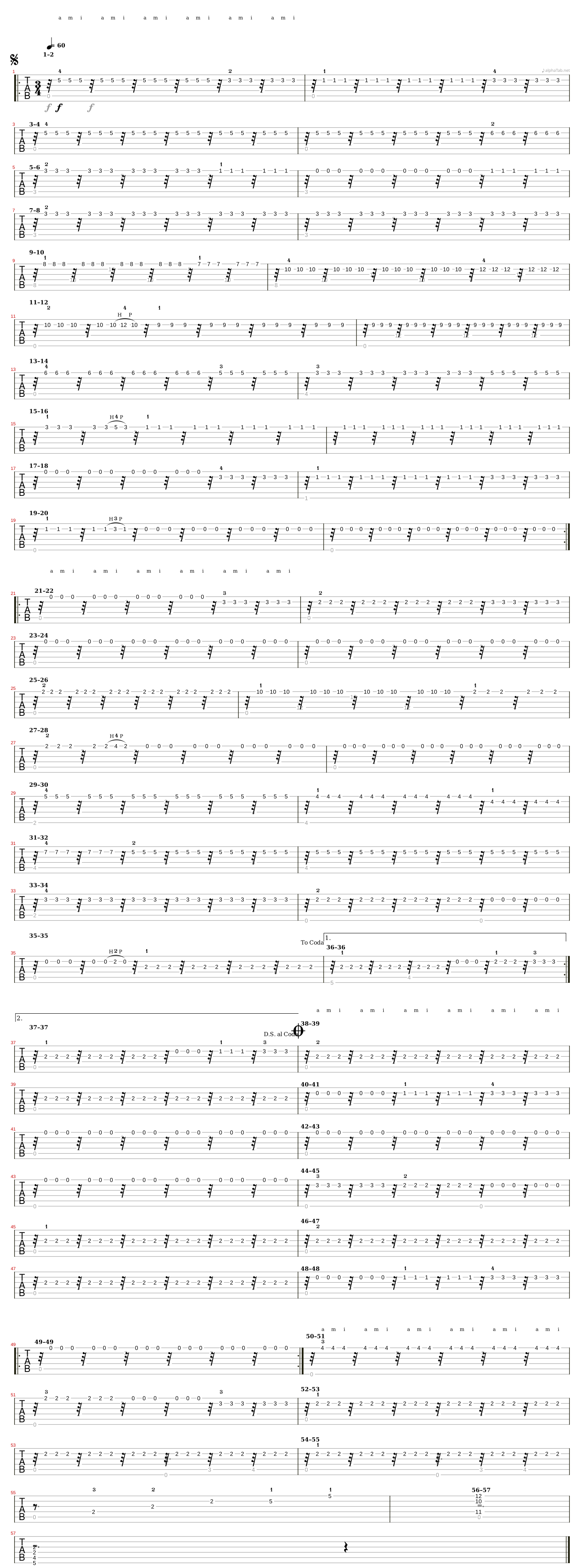
The player and its sounds load when you choose to use them.
Your phrase-by-phrase plan
Work on a short passage. Aim for five clean attempts in a row, then connect two phrases. Bar numbers follow our transcription, including a separately numbered pickup where applicable.
Phrase 1 · bars 1–2
Each group is p-a-m-i: two groups per beat, six per bar. Play the chords without tremolo first. String 2’s melody moves 5–3 in bar 1, then 1–3 in bar 2.
Phrase 2 · bars 3–4
Hold string 2 at fret 5 in bar 3; move 5–6 in bar 4. Prepare the thumb line’s shift before restoring the tremolo.
Phrase 3 · bars 5–6
The melody moves 3–1 on string 1 in bar 5, then 0–1 in bar 6. Hold the bass on string 5 at fret 3.
Phrase 4 · bars 7–8
Keep the melody at fret 3 on string 1 in bars 7–8. Play the thumb line alone, then add a-m-i repetitions at an even volume.
Phrase 5 · bars 9–10
The melody moves 8–7 on string 1 in bar 9: prepare both positions separately. It moves 10–12 on string 2 in bar 10. Open string 4 replaces the first bass on beat three.
Phrase 6 · bars 11–12
Isolate bar 11’s 10–12–10 ornament on string 2. Its three small ornamental notes share the duration of two ordinary tremolo notes. Hold the melody at 9 in bar 12 and prepare string 4 at 12 for the thumb.
Phrase 7 · bars 13–14
The melody moves 6–5 on string 1 in bar 13, then 3–5 in bar 14. Prepare left-hand shapes alone, then add one p-a-m-i group per shape.
Phrase 8 · bars 15–16
Practise bar 15’s 3–5–3 ornament on string 1 and its arrival at 1. Keep the melody at 1 in bar 16. Open string 4 supports both bars.
Phrase 9 · bars 17–18
Bar 17’s melody moves from open string 1 to string 2 at fret 3. Prepare the small barre at 1 in bar 18 and sustain string 6 at fret 1 below it.
Phrase 10 · bars 19–20
Isolate 1–3–1 on string 2 in bar 19, then move to the open second string. Keep it as the melody in bar 20 and repeat from 1. On the final return towards the coda, continue directly to 21.
Phrase 11 · bars 21–22
The music moves into the major section. Open string 1 answers string 2 at fret 3 in bar 21. The melody moves 2–3 on string 2 in bar 22. Prepare chords without tremolo.
Phrase 12 · bars 23–24
Keep the melody on open string 1 in bars 23–24. Listen to the thumb line, including string 2 at fret 2. Add a-m-i without changing its rhythm.
Phrase 13 · bars 25–26
Hold string 1 at fret 2 in bar 25. In bar 26, prepare the high position around 10 and 12 and the return to string 1 at 2. Work without tremolo first.
Phrase 14 · bars 27–28
Isolate 2–4–2 on string 1 in bar 27, then return to the open string. Keep it as bar 28’s melody and let the fifth-string bass ring.
Phrase 15 · bars 29–30
Prepare the barre at 2 beneath the melody at 5 in bar 29. Move to the barre at 4 in bar 30; the melody then changes from string 1 to string 2 at the same fret.
Phrase 16 · bars 31–32
The melody moves 7–5 on string 2 in bar 31 and stays at 5 in 32. Hold string 5 at fret 4 while the thumb moves.
Phrase 17 · bars 33–34
Hold string 2 at fret 3 in bar 33 and hear the thumb’s small movements on string 4. The melody moves 2–0 on string 2 in bar 34. Reattack the low bass on beat three.
Phrase 18 · bar 35
In bar 35, isolate 0–2–0 on string 2. The melody continues on string 3 at fret 2. Prepare the thumb’s final note on string 4 at 6. On the final return, jump from here to 38.
Phrase 19 · bar 36
First ending, bar 36: the melody rises from string 3 to string 2 above string 6 at fret 5. Return to 21, then replace this ending with bar 37.
Phrase 20 · bar 37
Second ending, bar 37: the melody rises to frets 1 and 3 on string 2. Return to 1 without taking the repeats again. After 35, jump to the coda at 38.
Phrase 21 · bars 38–39
Hold string 3 at fret 2. The thumb repeats fret 2 on string 4 in bar 38, then fret 3 in bar 39. Practise each voice separately before combining them.
Phrase 22 · bars 40–41
The melody rises 0–1–3 on string 2 in bar 40, reaching open string 1 in 41. Prepare string changes without disturbing the p-a-m-i flow.
Phrase 23 · bars 42–43
Keep the melody on open string 1. The thumb outlines the major chord in bar 42, then repeats string 3 at fret 1 in bar 43. Balance its volume carefully.
Phrase 24 · bars 44–45
The melody descends 3–2–0 on string 2 in bar 44. Reattack string 6 on beat three. Hold string 3 at fret 2 in bar 45 while the thumb plays 2–3–4–3 on string 4.
Phrase 25 · bars 46–47
Keep the melody at fret 2 on string 3. The thumb repeats fret 2 on string 4 in bar 46, then fret 3 in 47. Keep all three a-m-i attacks equal in volume.
Phrase 26 · bar 48
Bar 48’s melody rises 0–1–3 on string 2. Prepare the three shapes separately while sustaining the fifth-string bass underneath.
Phrase 27 · bar 49
Keep bar 49’s melody on open string 1. Play this bar twice, following the engraving’s bis instruction, with exactly the same flow.
Phrase 28 · bars 50–51
Hold string 1 at fret 4 in bar 50; the thumb includes string 2 at 5. Bar 51’s melody descends from string 1 at 2 to the open string, then string 2 at 3.
Phrase 29 · bars 52–53
Keep string 2 at fret 2. Prepare the barre at 2 in bar 52. Bar 53’s first bass lasts a beat and a half before open string 6 takes over; the thumb finishes with 3 and 4 on string 5.
Phrase 30 · bars 54–55
Repeat bar 53’s final thumb movement in bar 54. Tremolo stops in bar 55: play six even arpeggio notes, holding the first bass through the ascent.
Phrase 31 · bars 56–57
Hold bar 56’s upper chord for three beats above open string 5. Hold bar 57’s final low chord for two beats, then observe one beat of silence.
Watch and listen
Choose the recording that matches your current goal. Videos load only when you select them and require an internet connection.
Lesson · This is Classical Guitar
Follow the Recuerdos lesson and its tremolo preparation. Learn the chord shapes separately before adding the repetitions. Fingerings and bar numbers may differ from this transcription.
English commentary. Link and metadata checked for our selection.
Lesson · This is Classical Guitar
Return to this exercise when the four attacks become uneven. Practise slowly on one string, then across strings, before returning to the piece.
English commentary. Link and metadata checked for our selection.
Sources and transcription choices
- Tárrega — Recuerdos de la Alhambra, Ildefonso Alier, plate 1102; complete BNE copy, printed pp. 1–4
- Bradford Werner — Recuerdos performance and lesson
- Bradford Werner — slow, even and balanced tremolo
- Rhayn Jooste — left-hand shapes without tremolo, followed by separate tremolo practice
The notes follow the credited sources. Fingerings, phrase divisions and practice tempos are editorial learning choices. How our transcriptions work.