María brings together wide slides, mobile chord shapes, harmonics and muted passages. Treat those colours as parts of a musical line rather than a list of effects to master at once. A pair of bars is often enough material for a focused session.
Start with the main melody notes. Where a grace note or a slide leads into them, find the arrival first and listen to how it fits the beat. Then add the approach without letting it rush the next chord. This is especially useful when a slide crosses a large distance on the neck.
For moving chords, sound each required string separately before playing the whole shape. Identify the notes that must continue while another voice changes. Practise the shift into the position as carefully as the position itself; a shape that works when placed slowly may still be difficult to reach in time.
The harmonics and pizzicato passages need their own short experiments. Find a reliable harmonic contact, or an even muted attack, before restoring the surrounding phrase. Near the ending, keep the long upper notes and the final silence intact. The player uses a steady tempo, so use the reference performance to think about musical pacing beyond the mechanical count.
An advanced gavotte with wide slides, moving chords and harmonics. Work on a pair of bars at a time. The app uses 60 bpm as a practice reference.
Skills to prepare
- Slides
- Slurs and held notes
- Barres
- Natural harmonics
- Pizzicato
Before learning the piece
- App checkpoint: play bar 2’s pull-off five times without a second right-hand attack. Practise this skill (French).
- App checkpoint: sound the three required strings under the barre at 5 for three consecutive attempts. Practise this skill (French).
- App checkpoint: play four even notes per click for 15 seconds without tightening the hand. Practise this skill (French).
These checkpoints belong to our learning path. They do not set a deadline for your progress.
Tablature and fingerings
The six lines represent the strings, with high E at the top. Numbers show frets; 0 means an open string. The letters p, i, m and a indicate right-hand fingers.

Read the complete static tab · Download the alphaTex file
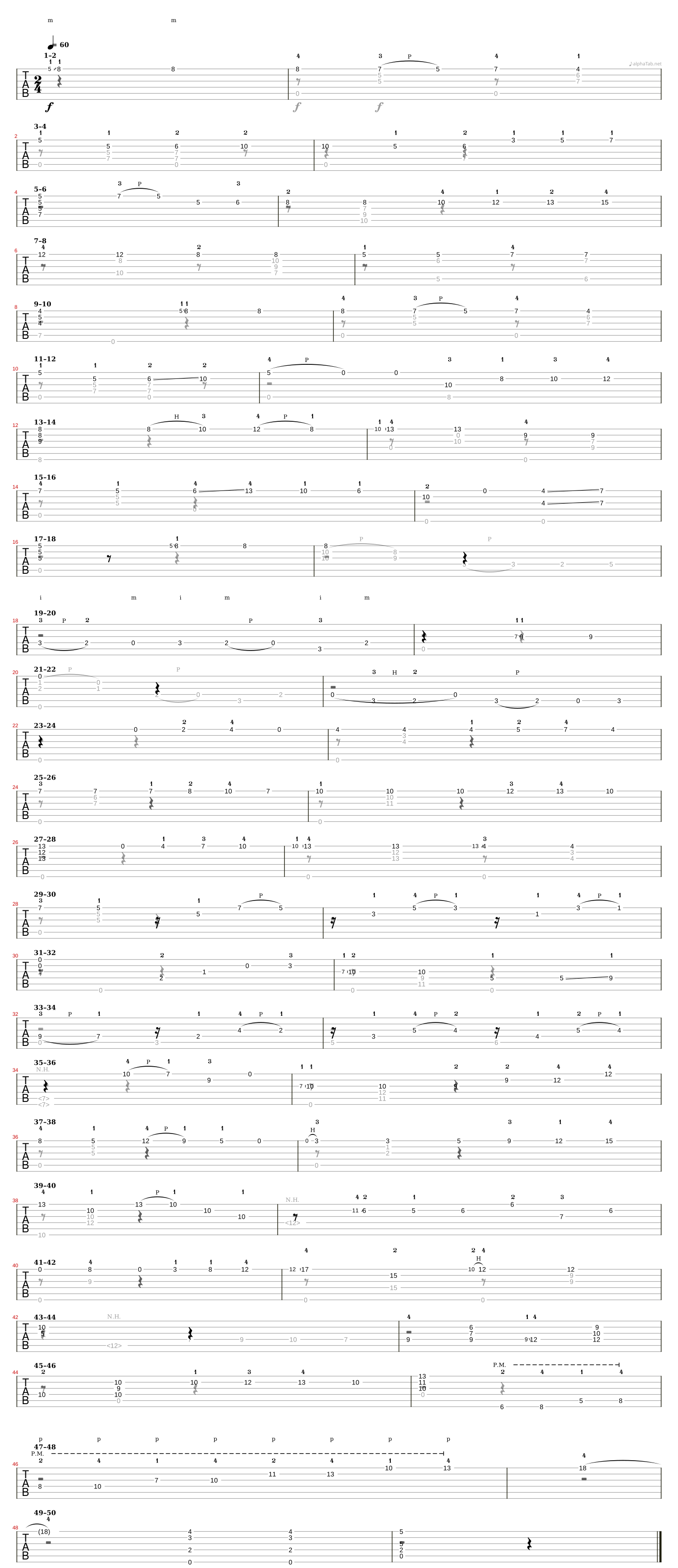
The player and its sounds load when you choose to use them.
Your phrase-by-phrase plan
Work on a short passage. Aim for five clean attempts in a row, then connect two phrases. Bar numbers follow our transcription, including a separately numbered pickup where applicable.
Phrase 1 · bars 1–2
Bar 1 is a one-beat pickup. Slide 5–8 on string 1. In bar 2, pull off 7–5 without replucking.
Phrase 2 · bars 3–4
Keep the inner notes beneath the melody in bar 3. Finish bar 4 with four even short notes, isolating the string 2 to string 1 crossing.
Phrase 3 · bars 5–6
Sound bar 5’s chord before the four moving notes. Bar 6’s ascent stays on string 2: aim for frets 10, 12, 13 and 15.
Phrase 4 · bars 7–8
Balance bar 7’s accompaniment close to the melody without covering it. Prepare bar 8’s two chords: the lower positions rise one fret.
Phrase 5 · bars 9–10
Bar 9’s short ascent brings back the opening motif. In bar 10, return to the barre at 5 and the two slurred notes on string 1.
Phrase 6 · bars 11–12
Slide 6–10 on string 2 in bar 11. Use open string 1 in bar 12 to prepare position 8. Place the bass before the ascent.
Phrase 7 · bars 13–14
Practise the two slurred pairs on string 1 in bar 13. In bar 14, prepare fret 13 and the return to string 2. The first chord includes open string 2.
Phrase 8 · bars 15–16
In bar 15, slide 6–13 on string 1. In bar 16, move both notes on strings 1 and 3 together from fret 4 to 7.
Phrase 9 · bars 17–18
Leave a rest after bar 17’s first chord. In bar 18, hold the upper note through the two descending inner voices; the lower notes follow.
Phrase 10 · bars 19–20
Locate the two slurred starts in bar 19’s descent. In bar 20, the bass comes before the 7–9 slide on string 3.
Phrase 11 · bars 21–22
Hold open string 1 over the two slurred chords in bar 21. Descend through strings 4 and 5 in bar 22; a slurred note needs no second right-hand attack.
Phrase 12 · bars 23–24
Wait for beat two before starting bar 23’s ascent. In bar 24, distinguish the thumb from the melody; accompaniment follows the first upper note.
Phrase 13 · bars 25–26
Check strings 1, 2 and 3 separately in bar 25’s chord. In bar 26, ascend to fret 13 on string 1, then return to 10.
Phrase 14 · bars 27–28
Bar 27’s chord precedes an upper arpeggio. Practise each slide in bar 28 alone before adding the following chord. Prepare the large return from 13 to 4.
Phrase 15 · bars 29–30
In bars 29–30, an inner note precedes each slurred melody pair. Play the groups slowly, holding the lower notes beneath the upper line.
Phrase 16 · bars 31–32
In bar 31, the bass follows the chord. In bar 32, slide 7–10 on string 3. The final shift follows string 4 from 5 to 9.
Phrase 17 · bars 33–34
Pull off 9–7 on string 4 in bar 33. Prepare bar 34’s two neighbouring positions before the slurred pairs on string 3.
Phrase 18 · bars 35–36
In bar 35, touch strings 6 and 5 lightly above fret 7, lifting after the attack. Prepare bar 36’s string 3 slide before the upper ascent.
Phrase 19 · bars 37–38
Separate bar 37’s slurred start from the following shifts. In bar 38, the open grace note precedes fret 3; the ascent finishes at 15.
Phrase 20 · bars 39–40
Prepare the barre at 10 in bar 39. In bar 40, sustain string 4’s fret-12 harmonic beneath the upper figure. Secure the main notes before adding the grace note.
Phrase 21 · bars 41–42
Use open string 1 in bar 41 to prepare fret 8. Bar 42’s first slide reaches 17. Practise the return to lower positions separately.
Phrase 22 · bars 43–44
Play string 5’s fret-12 harmonic after the chord in bar 43. Bar 44’s melody stays on string 4. Check each chord’s three notes before the slide.
Phrase 23 · bars 45–46
Bar 45’s ascent stays on string 2. Sound the chord in bar 46, then begin the muted lower notes. The pizzicato marking continues into bar 47.
Phrase 24 · bars 47–48
Ascend through bar 47’s eight muted notes without rushing. Let string 1 at fret 18 ring in bar 48. The player keeps a fixed tempo.
Phrase 25 · bars 49–50
Bar 49’s first note continues from bar 48: do not repluck it. The next two chords prepare the ending. Observe the rest after bar 50’s final chord.
Watch and listen
Choose the recording that matches your current goal. Videos load only when you select them and require an internet connection.
Lesson · This is Classical Guitar
Listen to the gavotte, then follow the lesson, noticing slides and shifts. Its fingerings may differ from those in the app.
English commentary. Link and metadata checked for our selection.
Sources and transcription choices
- Tárrega — María, Vidal Llimona y Boceta 1032, BNE reproduction, music pp. 2–3
- Tárrega — María, historical Orfeo 1032 edition; Gaylord copy, public domain
- Bradford Werner — María performance and lesson on shifts and slides
- Classical Guitar Corner — notation symbols, natural harmonics and pizzicato
The notes follow the credited sources. Fingerings, phrase divisions and practice tempos are editorial learning choices. How our transcriptions work.