Las dos hermanitas brings two waltzes into a larger musical route. Learn the character of each waltz before trying to connect all sixty-eight written bars. The second eventually leads back to the first, so the repeat plan needs to become as familiar as the opening melody.
Start with a short phrase from the first waltz and play its upper line alone. Add the bass and inner chords more quietly, listening for notes that must continue across an accompaniment change. The slurred ornaments should remain clear without turning into sudden accents or shortening the next sustained note.
In the second waltz, keep the held melody audible above the answering inner voices. Practise those replies separately if their fingering draws attention away from the tune. A barre supports this balance; it should not make the whole hand work harder throughout the phrase.
Our tablature follows the credited Alier edition rather than combining it with the differently titled manuscript. Follow its alternative endings and final return consistently. Before a complete run, trace the route at a comfortable tempo and anticipate the next section. Once the direction feels secure, connect longer passages while keeping the same relaxed movement of the waltz.
Two contrasting waltzes, the second leading back to the first. This transcription follows the 68 bars of Alier 6040 and does not combine that version with the Las dos hermanas manuscript. Learn each waltz separately. The app’s fingerings and 72 bpm tempo are practice choices.
Skills to prepare
- Sustained melody
- Slurred ornaments
- Slides
- Barres
- Natural harmonic
- Repeats and alternative endings
Before learning the piece
- App checkpoint: sound the small chords in positions 2, 5 and 7 three times, then release the pressure. Practise this skill (French).
- App checkpoint: play 2–4–2 and 10–12–10 on string 1 three times, with one attack per group. Practise this skill (French).
- App checkpoint: sustain an upper note through two quieter chords on neighbouring strings without cutting it off. Practise this skill (French).
These checkpoints belong to our learning path. They do not set a deadline for your progress.
Tablature and fingerings
The six lines represent the strings, with high E at the top. Numbers show frets; 0 means an open string. The letters p, i, m and a indicate right-hand fingers.
Read the complete static tab · Download the alphaTex file

The player and its sounds load when you choose to use them.
Your phrase-by-phrase plan
Work on a short passage. Aim for five clean attempts in a row, then connect two phrases. Bar numbers follow our transcription, including a separately numbered pickup where applicable.
Phrase 1 · bars 1–2
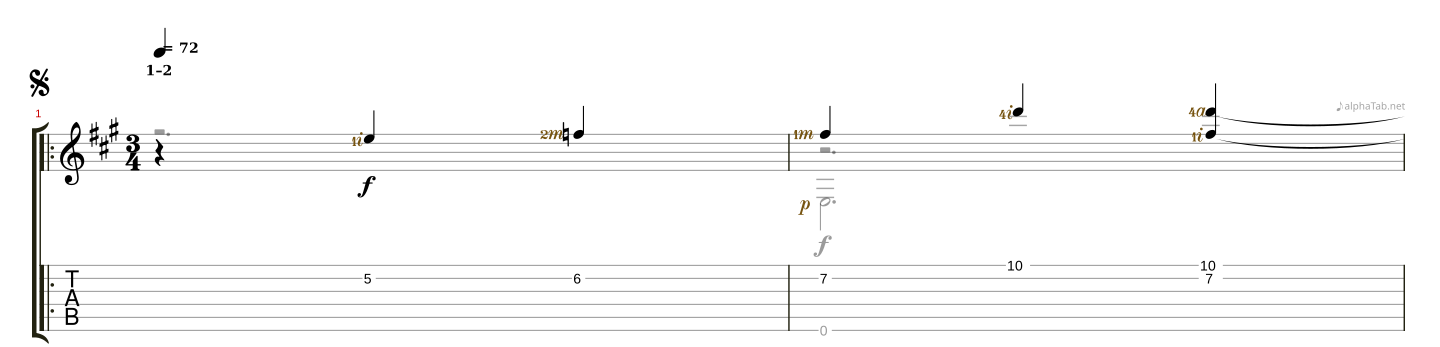
Rest on bar 1’s first beat, then play 5–6 on string 2. Reach position 7 in bar 2 and hold the final chord’s two notes into bar 3.
Phrase 2 · bars 3–4
Do not repluck the two notes tied from bar 2 into 3. The short 10–9 descends on string 1. Practise bar 4’s 7–9–7 slur before returning to position 5.
Phrase 3 · bars 5–6
Hold string 2 at fret 2 through string 1’s 4–5–4 ornament in bar 5. Keep the bass at fret 2 in bar 6 and repeat the two identical replies.
Phrase 4 · bars 7–8
Let open string 6 support bar 7’s two chords. In bar 8, the 2–4–2 slur precedes the two small chords at fret 2.
Phrase 5 · bars 9–10
Bars 9–10 revisit the opening of bars 1–2, with an open bass in 9. Sustain bar 10’s final chord into 11.
Phrase 6 · bars 11–12
Bars 11–12 revisit bars 3–4’s ornaments. Bar 11’s parenthesised notes continue from 10. Prepare the return to position 5 in bar 12.
Phrase 7 · bars 13–14
Keep the small barre at 2 in bar 13; only the upper note rises a fret. Prepare the barre at 4 in bar 14 before adding frets 5 and 6.
Phrase 8 · bars 15–16
Hold the bass at fret 4 while string 2’s melody moves 4–5 in bar 15. Observe bar 16’s short rest. First time, return to 1; second time, jump from 12 to 17.
Phrase 9 · bars 17–18
Hold the bass at fret 1 through bar 17’s two chords. Isolate bar 18’s ascent: its final three notes share the last beat.
Phrase 10 · bars 19–20
Touch string 1 above fret 12 for bar 19’s harmonic, then return to the low chord. Keep the silence between bar 20’s attacks before continuing to 21.
Phrase 11 · bars 21–22
In bar 21, hammer on 4–7 on string 1, then 5–7 on string 2. Prepare both 11–9 descents in bar 22, with open string 2 alongside their arrivals.
Phrase 12 · bars 23–24
Hold the bass at fret 4 through bar 23’s descent. In bar 24, prepare the bass at 2, then the two upper chords without moving that bass.
Phrase 13 · bars 25–26
Practise bar 25’s 5–4 and 2–0 pull-offs on string 1. In bar 26, hold the bass and prepare the small barre at 2.
Phrase 14 · bars 27–28
Bar 27’s descent ends on the bass: release its earlier sustain just before the new attack. Distinguish bar 28’s two chords, whose top note falls 5–4.
Phrase 15 · bars 29–30
Bars 29–30 revisit 21–22, now with a bass at the start of 29. Keep bar 30’s two short 11–9 figures even and let open string 2 answer.
Phrase 16 · bars 31–32
Bar 31 revisits bar 23’s descent. Slide the grace note 4–11 on string 1 in bar 32, then prepare chords around frets 9–11.
Phrase 17 · bars 33–34
Pull off 4–2 on string 1 in bar 33 before returning to strings 2 and 3. Use open strings 1 and 2 in bar 34 to hold the bass at fret 2.
Phrase 18 · bars 35–36
Bar 35’s chord arrives only on beat three. Observe bar 36’s rest. Repeat 21–36 once, then start the second waltz at 37. On the final return, stop at 36.
Phrase 19 · bars 37–38
Wait two beats before bar 37’s short 2–5 slide. Hold the melody on string 1 through the replies on strings 3 and 2 in bar 38.
Phrase 20 · bars 39–40
Hold the melody at fret 5 in bars 39–40. The bass rises 6–7 on string 5. Prepare the two accompaniment changes separately.
Phrase 21 · bars 41–42
Alternate strings 3 and 1 while moving the whole shape in bar 41: 6–9, 4–7, 2–5. Hold bar 42’s upper note through the replies on strings 3 and 2.
Phrase 22 · bars 43–44
The bass moves to open string 5 in bar 43. Prepare the bass at fret 5 in bar 44, leaving string 4 free for the accompaniment at fret 4.
Phrase 23 · bars 45–46
Return to the octave shifts 7–10, 6–9, 4–7 in bar 45. Prepare the barre at 5 in bar 46 and sustain the melody through both replies.
Phrase 24 · bars 47–48
Return to the bass at 6 and held melody at 5 in bar 47. In bar 48, the bass rises to 7 and the inner chord changes. Listen to each voice separately.
Phrase 25 · bars 49–50
Practise bar 49’s three slurred pairs on string 1: 9–10, 11–12, 14–12. Hold bar 50’s upper note at 2 above the chords at 4.
Phrase 26 · bars 51–52
Keep finger 4 on string 1 at fret 4 in bar 51 while the other fingers play the accompaniment. Rest in bar 52, then repeat 37–52 once.
Phrase 27 · bars 53–54
Slide the grace note 2–10 on string 2 in bar 53, then reach 11. Prepare position 7 in bar 54 as string 1’s melody rises 7–9–10.
Phrase 28 · bars 55–56
Practise bar 55’s 10–14 slur and descent slowly. The grace note at 5 prepares bar 56. Repluck the melody in bar 56 and sustain it through both replies.
Phrase 29 · bars 57–58
Rest on bar 57’s first beat before 12–14–12, then descend to 10. Hold bar 58’s melody at 3 above the small barre at 2.
Phrase 30 · bars 59–60
Bar 59’s slur moves down a position: 10–12–10, then 9. Hold bar 60’s upper note at 2 through the replies on strings 3 and 2.
Phrase 31 · bars 61–62
Slide 3–10 on string 2 in bar 61, then reach 11. Hold bar 62’s two inner notes through string 1’s 7–9–10 ascent.
Phrase 32 · bars 63–64
Keep open strings 3 and 2 beneath bar 63’s 12–14–12 ornament. Prepare position 9 in bar 64 and hold the upper note at 10 through the accompaniment.
Phrase 33 · bars 65–66
Prepare the barre at 7 in bar 65, ending with string 1’s 8–7 pull-off. Slide 7–10 on string 2 in bar 66 before the two identical replies.
Phrase 34 · bars 67–68
Hold bar 67’s two inner notes through the melody’s 7–5 movement. Rest in bar 68. Repeat 53–68 once, then play 1–12 and 17–36 without further repeats.
Watch and listen
Choose the recording that matches your current goal. Videos load only when you select them and require an internet connection.
Performance · Yuval Te’eni
Listen to the contrast between the two waltzes. Repeats, ornaments and fingerings may differ from the Alier edition used here.
English commentary. Link and metadata checked for our selection.
Sources and transcription choices
- Tárrega — Las dos hermanitas, two waltzes; Ildefonso Alier, plate 6040, historical edition
- IMSLP — Las dos hermanitas facsimile, catalogue 292945, public domain
- David J. Buch — Las nuevas fuentes de las obras de Tárrega: differences between manuscript and posthumous edition
The notes follow the credited sources. Fingerings, phrase divisions and practice tempos are editorial learning choices. How our transcriptions work.