Isabel asks the melody to remain present while inner voices answer beneath it. The waltz rhythm needs to keep moving even when the left hand is preparing a barre, a slur or a high position. Begin with the tune alone, then use that sound as your reference when adding the accompaniment.
The opening pickup leads directly into the dance. Practise its slide together with the following downbeat so it feels like a beginning rather than an isolated decoration. Through the next phrases, listen to the sustained upper note during each pair of quieter replies. If it stops early, remove the accompaniment and recover the duration before rebuilding the chord.
Wide shifts work better when you know what can be released. Locate the destination string and fret, let unnecessary pressure go and make the journey slowly. Return to the barre or slur exercises when the movement takes attention away from the melody.
Read both endings before playing the complete piece. This adaptation writes each cadence separately to preserve its sustained notes. Follow the repeat instructions and listen to the continuations, including notes carried across a barline. Keep the final silence as deliberate as the last chord, and let the waltz’s direction remain clear throughout.
Tárrega’s waltz arrangement of a theme by Johann Strauss II. Keep the melody above the inner replies. Our tablature adapts Tony Wilkinson’s 2010 engraving under CC BY 3.0. Both cadences are written into their respective endings to preserve the correct sustains. Fingerings and the 84 bpm practice tempo are editorial choices.
Skills to prepare
- Sustained melody
- Barres
- Slurs
- Slides
- Upper-position shifts
- Alternative endings
Before learning the piece
- App checkpoint: hold a first-string melody over two replies on strings 3 and 2 in position 5, three times. Practise this skill (French).
- App checkpoint: play 7–9 and 12–10 on string 1 three times, plucking once per pair. Practise this skill (French).
- App checkpoint: find frets 17, 14 and 10 on string 1 slowly, releasing pressure during the shift. Practise this skill (French).
These checkpoints belong to our learning path. They do not set a deadline for your progress.
Tablature and fingerings
The six lines represent the strings, with high E at the top. Numbers show frets; 0 means an open string. The letters p, i, m and a indicate right-hand fingers.

Read the complete static tab · Download the alphaTex file
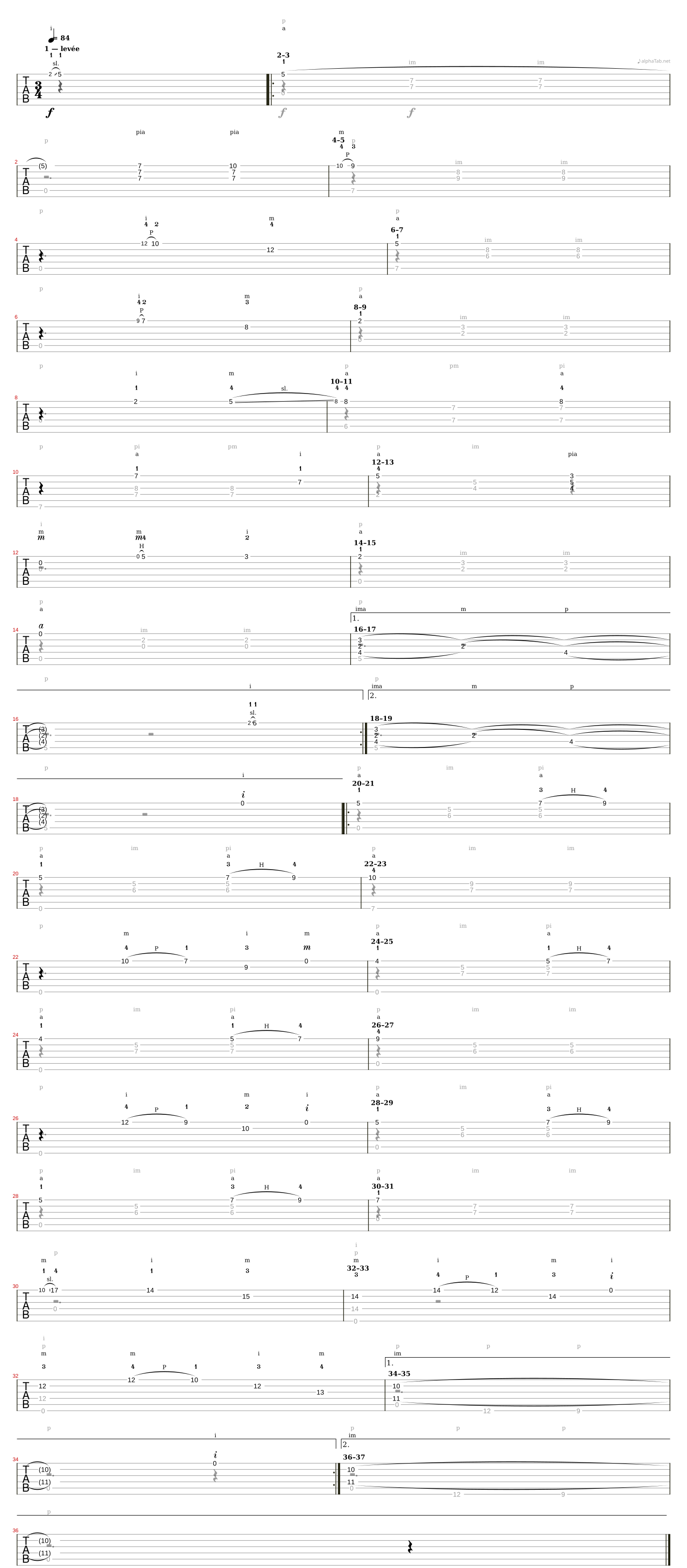
The player and its sounds load when you choose to use them.
Your phrase-by-phrase plan
Work on a short passage. Aim for five clean attempts in a row, then connect two phrases. Bar numbers follow our transcription, including a separately numbered pickup where applicable.
Phrase 1 · bar 1
Bar 1’s pickup lasts one beat. Slide 2–5 on string 1, then begin bar 2 on the following downbeat.
Phrase 2 · bars 2–3
Hold the melody at fret 5 through bar 2’s inner replies. Do not repluck its continuation in bar 3. Prepare the barre at 7 and upper note at 10.
Phrase 3 · bars 4–5
Pull off 10–9 on string 1 in bar 4, holding the arrival through the replies. Bar 5’s short 12–10 pull-off precedes fret 12 on string 2.
Phrase 4 · bars 6–7
Hold the melody at fret 5 above bar 6’s two chords. Pull off 9–7 on string 1 in bar 7, then reach string 2 at fret 8.
Phrase 5 · bars 8–9
Keep string 1 at fret 2 above the open bass in bar 8. Rest on bar 9’s first beat; its final fret 5 slides to the next bar’s grace note at 8.
Phrase 6 · bars 10–11
Let bar 10’s slide reach its grace note before replucking the main note. Keep the bass at fret 6. Bar 11’s melody enters on beat two with a long–short rhythm.
Phrase 7 · bars 12–13
Hold string 4 at fret 2 in bar 12 as string 1’s melody moves 5–3. In bar 13, hammer on from the open first-string grace note to fret 5.
Phrase 8 · bars 14–15
Hold the melody at fret 2 in bar 14. It moves to open string 1 in bar 15. Keep the inner replies softer than these sustained notes.
Phrase 9 · bars 16–17
Hold string 2’s melody through the two inner reattacks in bar 16. In bar 17, sustain the three parenthesised notes, replay the 2–5 pickup and return to 2.
Phrase 10 · bars 18–19
Second time, jump from 15 to 18. Bar 18 revisits bar 16’s cadence. Hold bar 19’s tied notes for two beats, then use open string 1 to begin the second section.
Phrase 11 · bars 20–21
Hold the melody at fret 5 through bars 20–21’s replies. Hammer on 7–9 on the last beat. Only the bass changes: open string 5 in 20, open string 6 in 21.
Phrase 12 · bars 22–23
Prepare the barre at 7 and hold the upper note at 10 in bar 22. Rest on bar 23’s first beat before 10–7, string 2 at 9 and open string 1.
Phrase 13 · bars 24–25
In bars 24–25, hold the upper note at 4, then prepare the small barre at 5 for the 5–7 hammer-on. Both bars use the same movement.
Phrase 14 · bars 26–27
Hold the upper note at 9 through bar 26’s replies. Bar 27’s 12–9 pull-off precedes string 2 at 10 and open string 1.
Phrase 15 · bars 28–29
Bars 28–29 repeat bar 20’s movement: held melody at 5, two replies, then 7–9. The bass remains on open string 5.
Phrase 16 · bars 30–31
Keep bar 30’s melody and replies around fret 7. Slide the grace note 10–17 on string 1 in bar 31, then descend to 14 and string 2 at 15.
Phrase 17 · bars 32–33
Prepare position 12–14 and string 1’s 14–12 pull-off in bar 32. Move down for 12–10 in bar 33, sustaining the inner note beneath the upper line.
Phrase 18 · bars 34–35
Hold bar 34’s upper pair over the bass: open string 5, then string 6 at 12 and 9. Sustain bar 35’s chord for two beats, play open string 1 and return to 20.
Phrase 19 · bars 36–37
Second time, jump from 33 to 36. Revisit bar 34’s moving bass in bar 36. Hold bar 37’s tied notes for two beats, then observe the final rest.
Watch and listen
Choose the recording that matches your current goal. Videos load only when you select them and require an internet connection.
Performance · Yuval Te’eni
Listen to the waltz melody and its replies. The performance tempo and fingerings may differ from the app’s choices.
English commentary. Link and metadata checked for our selection.
Sources and transcription choices
- Tony Wilkinson (2010) — Francisco Tárrega’s Isabel; source of this adaptation, CC BY 3.0
- CC BY 3.0 licence — attribution and adaptation; tablature, fingerings, voices and numbering modified for GUITARE
- IMSLP — Isabel, a waltz on a theme by Johann Strauss II; source and licence identification
The notes follow the credited sources. Fingerings, phrase divisions and practice tempos are editorial learning choices. How our transcriptions work.