The Mazurka in G combines large shifts with small ornamental gestures. The contrast is easier to control when you separate the journey across the neck from the finger movement inside one position. Work on each task slowly before trying to preserve the dance pulse through both.
Begin with the opening inner line and bass changes. Listen for the chromatic movement instead of treating each chord as an unrelated shape. When a barre changes position, identify which notes need to continue and which can be released. That distinction makes room for the next movement without sacrificing the musical line.
The sustained harmonic is another useful listening checkpoint. Find the contact above the indicated fret, then hear how the sound carries into the next bar. Adding the following notes should not lead you to repluck a harmonic that is meant to continue.
The forty-eight written bars follow an edition that already writes out the second section’s repeated material. Follow the phrase guide before adding any extra repeats. For the widest slide, release the bass notes before travelling, locate the destination and practise the return separately. Finish with a short connected phrase in which the shift serves the melody rather than interrupting it.
A mazurka with wide shifts, ornaments and a sustained harmonic. Its 48 bars follow the written sequence of the Orfeo Tracio edition, where the second section’s repetition is already written out. Practise shifts separately. The app’s fingerings and 60 bpm tempo are practice choices.
Skills to prepare
- Barres
- Slides
- Slurred ornaments
- Inner voices
- Natural harmonic
Before learning the piece
- App checkpoint: sound the required strings in positions 3, 5, 7 and 8, releasing the hand between three attempts. Practise this skill (French).
- App checkpoint: play 3–5–3 on string 1 three times with one right-hand attack. Practise this skill (French).
- App checkpoint: move from fret 4 to 16 on string 2 three times, very slowly, releasing the bass notes before the shift. Practise this skill (French).
These checkpoints belong to our learning path. They do not set a deadline for your progress.
Tablature and fingerings
The six lines represent the strings, with high E at the top. Numbers show frets; 0 means an open string. The letters p, i, m and a indicate right-hand fingers.

Read the complete static tab · Download the alphaTex file
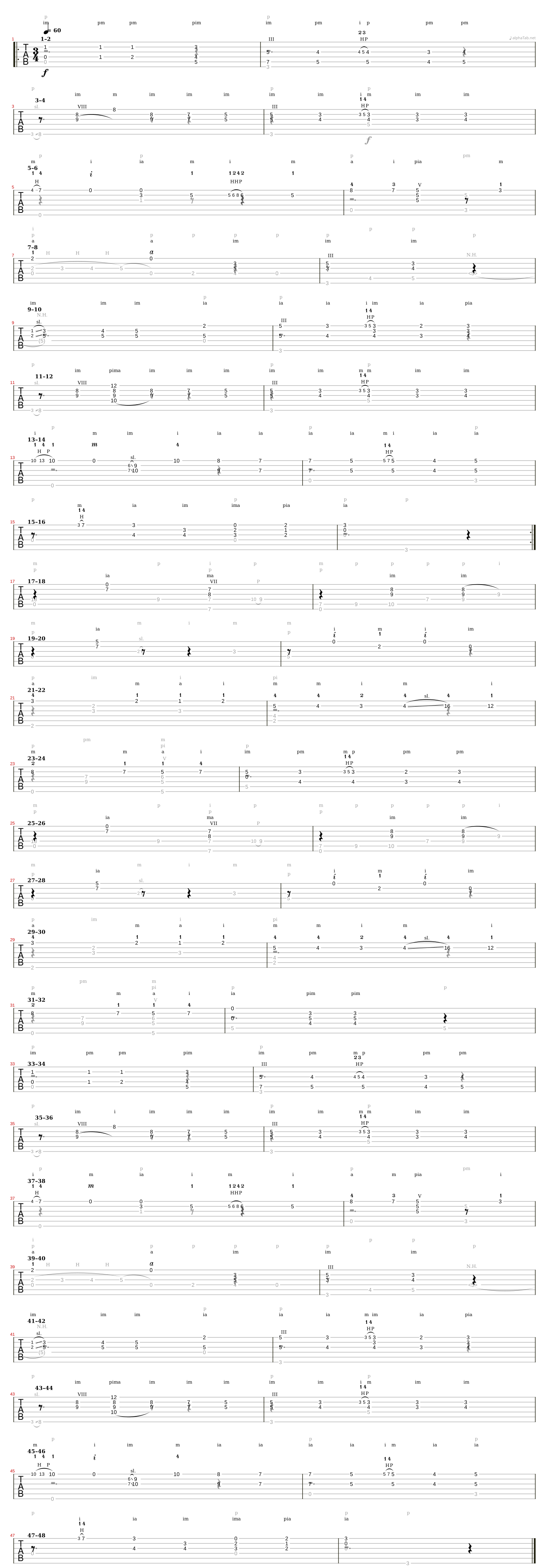
The player and its sounds load when you choose to use them.
Your phrase-by-phrase plan
Work on a short passage. Aim for five clean attempts in a row, then connect two phrases. Bar numbers follow our transcription, including a separately numbered pickup where applicable.
Phrase 1 · bars 1–2
Listen to string 4’s chromatic 0–1–2 movement in bar 1. Prepare the barre at 3 and the 4–5–4 slur on string 3 in bar 2.
Phrase 2 · bars 3–4
Slide the bass grace note 3–8 on string 6 in bar 3, then set the barre at 8. Return to 3 in bar 4, holding string 4 beneath the melody.
Phrase 3 · bars 5–6
Isolate both ornaments in bar 5. The second stays on string 2: 5–6–8–6. In bar 6, prepare the barre at 5 and the return to 3.
Phrase 4 · bars 7–8
Pluck only the start of string 3’s 2–3–4–5 ascent in bar 7, then sustain the C. Touch string 4 above fret 5 for bar 8’s harmonic.
Phrase 5 · bars 9–10
Hold bar 8’s harmonic through bar 9’s first two beats. Slide the two grace notes together. Practise 3–5–3 on string 1 in bar 10.
Phrase 6 · bars 11–12
Aim for the 10–9–8–12 chord across strings 4–1 in bar 11, keeping the barre at 8 through the peak. Return to bar 4’s positions in bar 12.
Phrase 7 · bars 13–14
Bar 13’s first ornament stays on string 1: 10–13–10. Slide the next two grace notes three frets together. In bar 14, slur 5–7–5 before the chord returns.
Phrase 8 · bars 15–16
Distinguish bar 15’s final two chords. In bar 16, hold the melody for two beats, then rest. Repeat from 1 once, then continue to 17.
Phrase 9 · bars 17–18
Bar 17’s melody begins in the middle register, on string 4 at fret 10. Prepare the barre at 7. Hear the rising lower line beneath bar 18’s chords.
Phrase 10 · bars 19–20
Hold open string 4 while the melody shifts in bar 19. In bar 20, keep the bass on string 4, fret 5; finger 4 reaches string 3, fret 7 for the final chord.
Phrase 11 · bars 21–22
Keep finger 2 on the bass at fret 2 in bar 21, leaving the index free for the melody. In bar 22, release both bass notes before sliding 4–16 on string 2.
Phrase 12 · bars 23–24
Prepare the barre at 5 on bar 23’s last beat. In bar 24, slur 3–5–3 on string 2 above the held bass. Continue to 25 without adding a repeat.
Phrase 13 · bars 25–26
Bars 25–26 repeat the movements from 17–18: the repeat is already written out. Keep the same flow in bar 26’s rising bass.
Phrase 14 · bars 27–28
Bars 27–28 revisit 19–20. Prepare bar 27’s shift after the upper chord, and hold bar 28’s bass through the melody’s replies.
Phrase 15 · bars 29–30
Bars 29–30 revisit 21–22. Release the basses before bar 30’s wide slide, then return 16–12 on string 2.
Phrase 16 · bars 31–32
Prepare the change to the barre at 5 in bar 31. Bar 32 has a long–short rhythm followed by a sustained attack. Observe the rest before the theme returns in 33.
Phrase 17 · bars 33–34
Bars 33–34 revisit 1–2. Bring out the small bass changes and prepare the barre at 3 before bar 34’s ornament.
Phrase 18 · bars 35–36
Slide the bass to fret 8 before the melody in bar 35. Return to 3 in bar 36, letting string 4 support the upper notes.
Phrase 19 · bars 37–38
Bar 37 revisits bar 5’s two ornaments. In bar 38, prepare the barre at 5 and return to 3, keeping the short upper reply distinct.
Phrase 20 · bars 39–40
Slur string 3’s 2–3–4–5 ascent in bar 39. Touch string 4 above fret 5 in bar 40 and sustain the harmonic into the next bar.
Phrase 21 · bars 41–42
Do not repluck the harmonic in bar 41. In bar 42, return to 3–5–3 on string 1 and keep the chord attacks together.
Phrase 22 · bars 43–44
Return to the 10–9–8–12 chord in bar 43 and listen to the peak. Move back towards the barre at 3 in bar 44 without rushing.
Phrase 23 · bars 45–46
Practise bar 45’s 10–13–10 ornament separately from its two-note slide. In bar 46, return to 5–7–5 before the final two chords.
Phrase 24 · bars 47–48
Prepare bar 47’s two cadential chords. In bar 48, let bass and melody finish their full lengths, then observe the rest. The piece ends here.
Watch and listen
Choose the recording that matches your current goal. Videos load only when you select them and require an internet connection.
Lesson · NBN GUITAR
Watch the shifts and follow the form against the app’s bar numbers. Fingerings and the presentation of repeats may differ.
English commentary. Link and metadata checked for our selection.
Sources and transcription choices
- Tárrega — Mazurka in G, Orfeo Tracio, plate 1123; three pages of the historical edition
- Tárrega — Mazurka, autograph dated Barcelona, 14 March 1897; repeat structure
- IMSLP — identification of Orfeo Tracio 1123, public domain
The notes follow the credited sources. Fingerings, phrase divisions and practice tempos are editorial learning choices. How our transcriptions work.