Week 3 · 12 min
The chords in nos. 21–24
By the end, you can link groups of three across chord changes without losing the pulse.
Before this lesson
Lesson steps
1 Two chords
Move from C to G seventh keeping all four groups of three.
3 min · 44 bpm · 3 notes per click


Check for · 2 bars at 52 BPM — You hear twelve attacks in each bar.
More detail
Listen particularly closely to the attack after the barline.
2 The group in no. 21
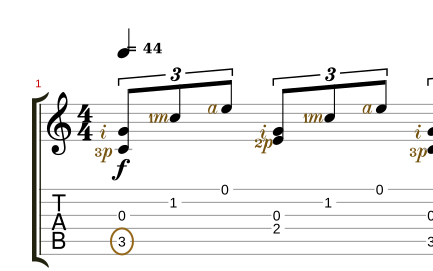
Play two p+m+a attacks followed by a single i.
3 min · 40 bpm · 3 notes per click


Check for · 2 bars at 48 BPM — The two chords are followed by a single note on string 3.
More detail
The thumb changes strings within the bar. The index stays on the same string.
3 Giuliani 21–24
Practise one pattern from 21–24 on C and then on G7.
3 min · 40 bpm · 3 notes per click

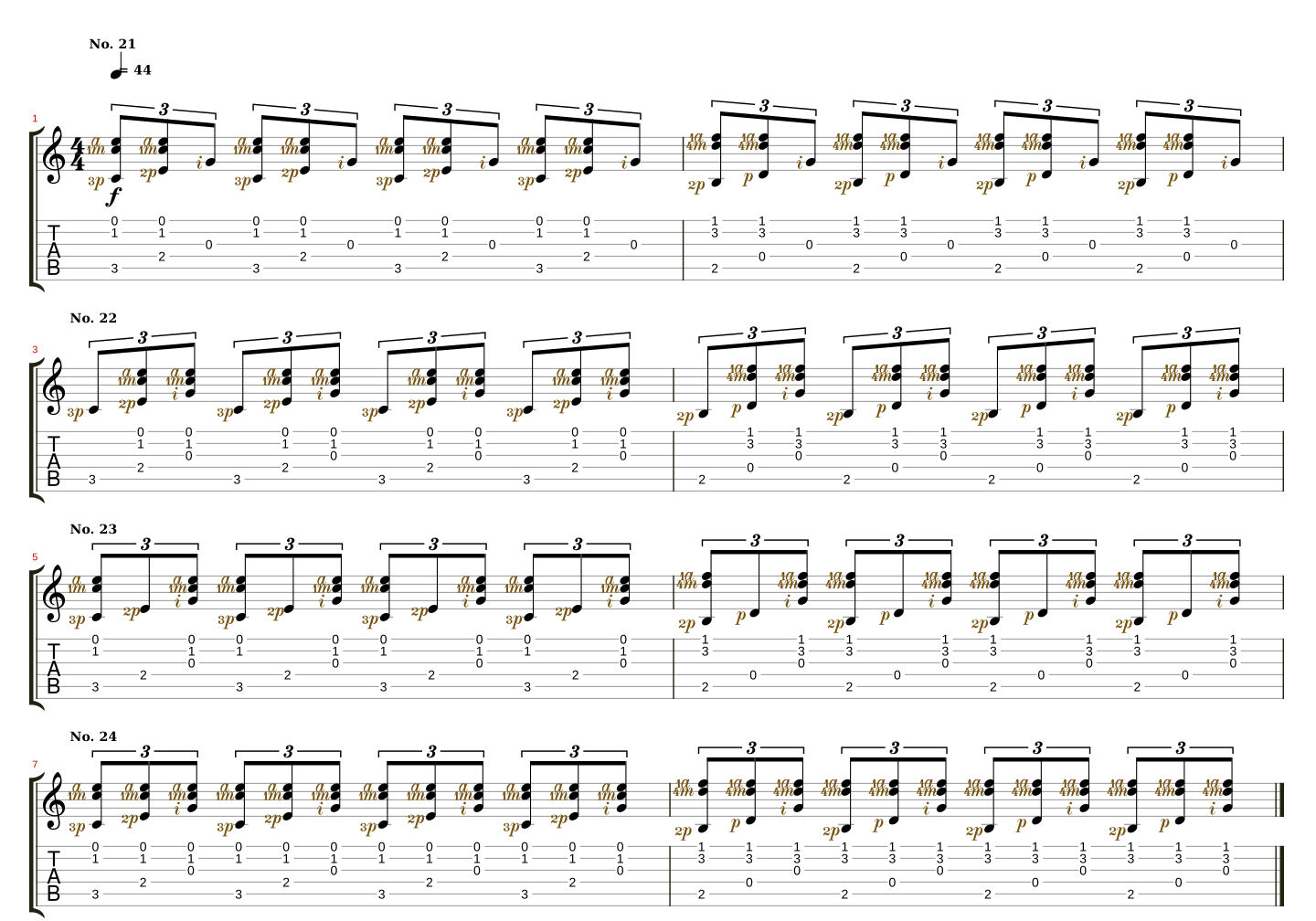
Check for · 2 bars at 48 BPM — Each beat contains 3 attacks on both chords.
More detail
In no. 21, the first beat reads p+m+a · p+m+a · i. A plus sign joins simultaneous fingers. Move to the next number after two clean bars.
4 Giuliani 21–24
Practise one pattern from 21–24 on C and then on G7.
3 min · 44 bpm · 3 notes per click
Revisit the tablature · Step 3
Check for · 4 bars at 52 BPM — Each beat contains 3 attacks on both chords.
More detail
In no. 21, the first beat reads p+m+a · p+m+a · i. A plus sign joins simultaneous fingers. Move to the next number after two clean bars.
You can move on when…
You pass when, over 4 bars at 52 BPM, each beat contains 3 attacks on both chords.
If a movement feels difficult
The bass overpowers the fingers.
Soften the thumb; play the notes together again without forcing the fingers.
Planting cuts the notes short.
Plant the next finger more gently and a little later; listen to the end of each note.