Week 5 · 12 min
Four attacks and the return to no. 40
By the end, you can switch from sextuplets to the sixteenth notes in patterns 36–40.
Before this lesson
Lesson steps
1 Giuliani 25–29
Practise one pattern from 25–29 on C and then on G7.
3 min · 40 bpm · 1 note per click

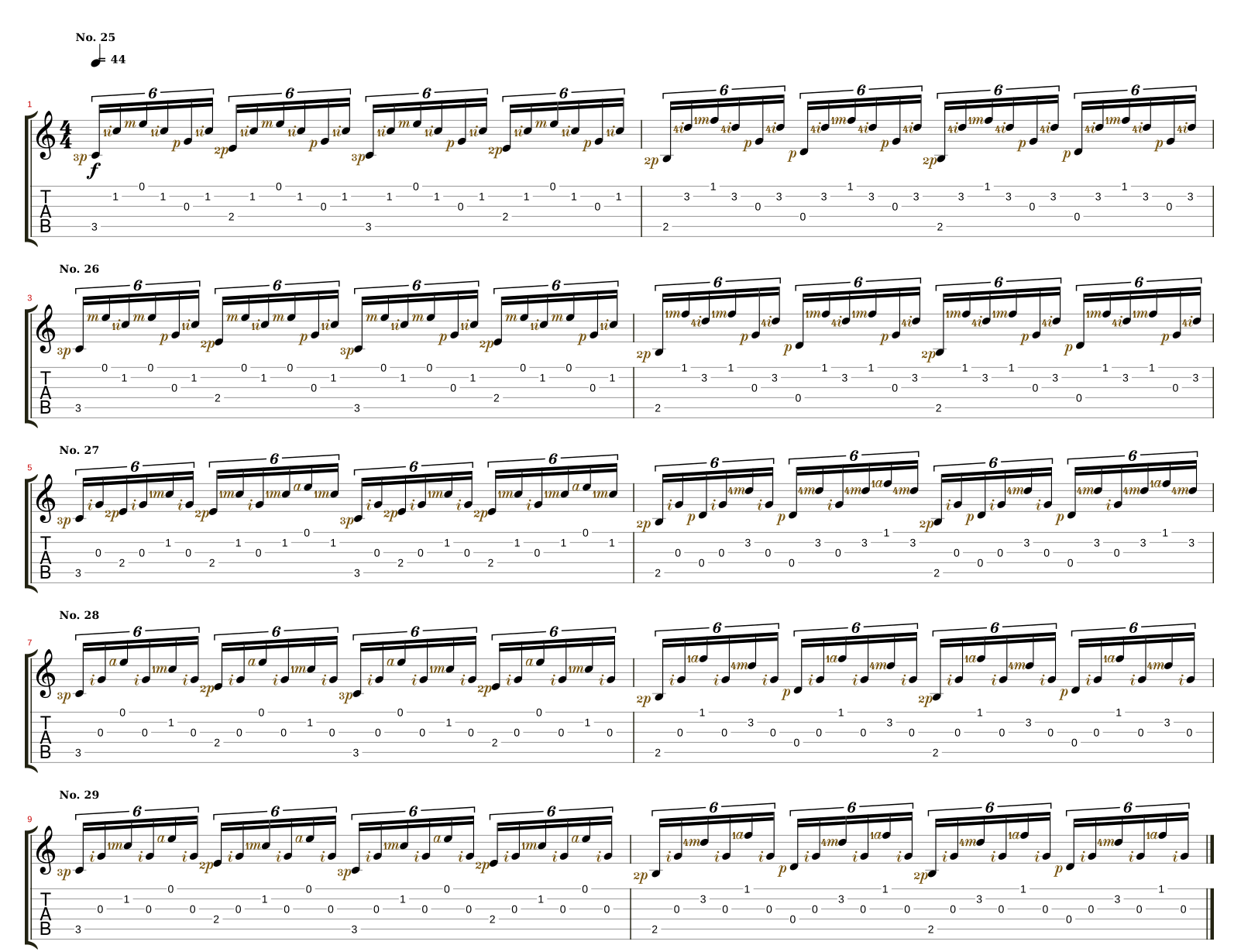
Check for · 2 bars at 44 BPM — Each beat contains 6 attacks on both chords.
More detail
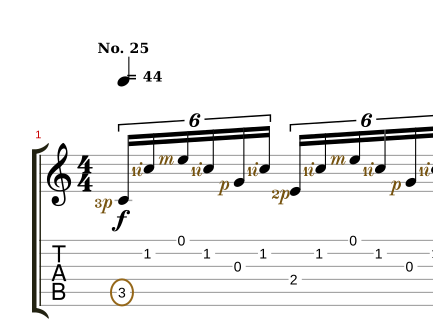
In no. 25, the first beat reads p · i · m · i · p · i. A plus sign joins simultaneous fingers. Move to the next number after two clean bars.
2 Giuliani 36–39
Practise one pattern from 36–39 on C and then on G7.
3 min · 40 bpm · 4 notes per click

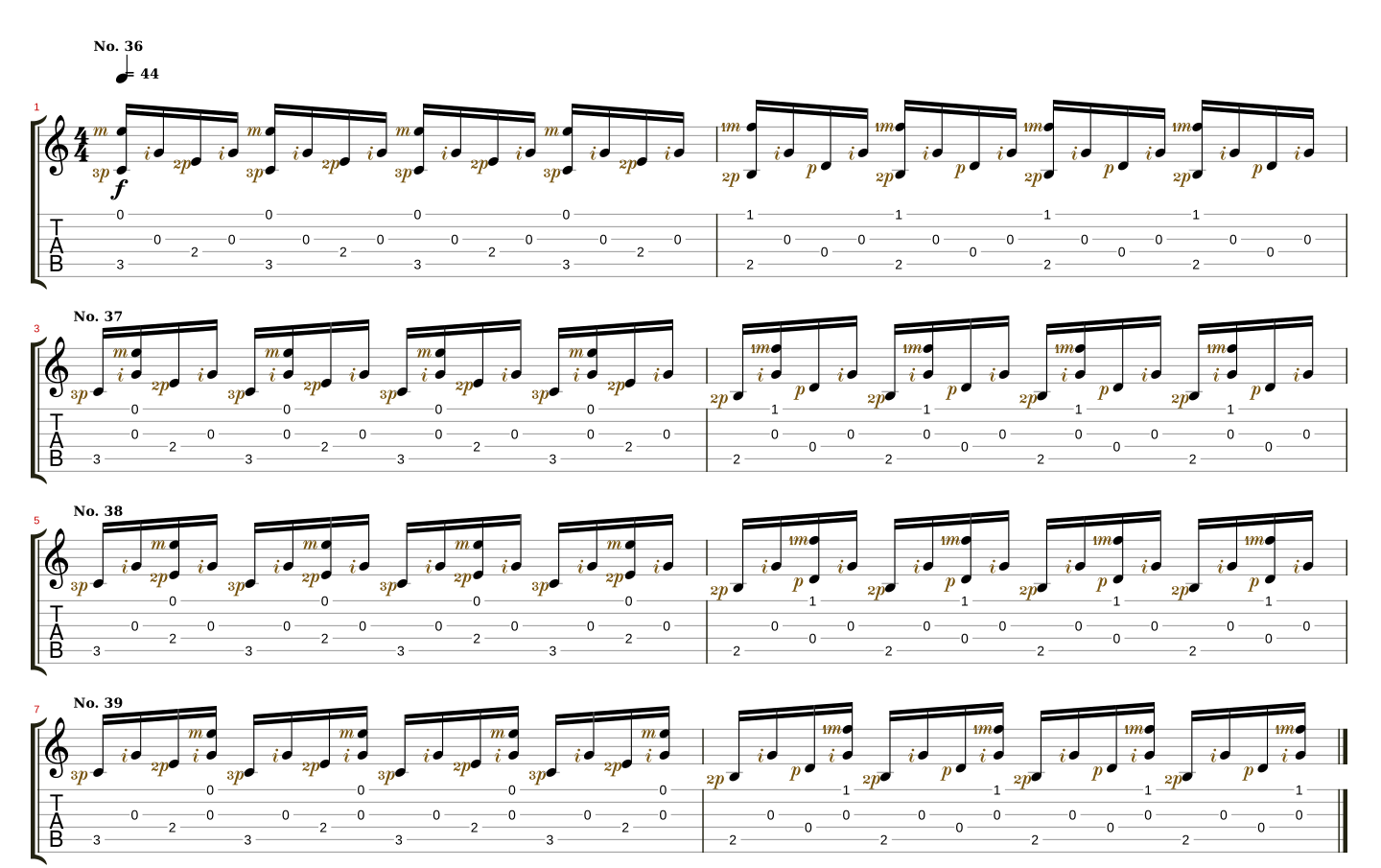
Check for · 2 bars at 48 BPM — Each beat contains 4 attacks on both chords.
More detail
In no. 36, the first beat reads p+m · i · p · i. A plus sign joins simultaneous fingers. Move to the next number after two clean bars.
3 Four subdivisions in no. 40
Play p+m, i+m, p and i on each beat.
3 min · 40 bpm · 4 notes per click


Check for · 2 bars at 48 BPM — The middle finger participates in both of the first two attacks.
More detail
The facsimile gives the middle finger on both successive treble notes. Make two separate attacks.
4 Four subdivisions in no. 40
Play p+m, i+m, p and i on each beat.
3 min · 44 bpm · 4 notes per click
Revisit the tablature · Step 3
Check for · 4 bars at 52 BPM — The middle finger participates in both of the first two attacks.
More detail
The facsimile gives the middle finger on both successive treble notes. Make two separate attacks.
You can move on when…
You pass when, over 4 bars at 52 BPM, the middle finger participates in both of the first two attacks.
If a movement feels difficult
The bass overpowers the fingers.
Soften the thumb; play the notes together again without forcing the fingers.
Planting cuts the notes short.
Plant the next finger more gently and a little later; listen to the end of each note.