Week 3 · 12 min
Extend the barre to six strings
By the end, you can check the bass and treble sides of the F chord separately.
Before this lesson
Lesson steps
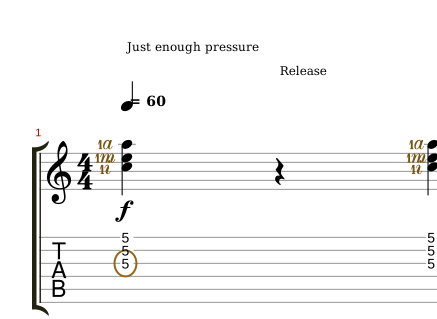
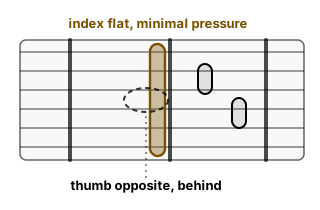
1 Just enough pressure
Find the lightest pressure that still sounds all three strings.
3 min · 44 bpm · 1 note per click


Check for · 2 bars at 48 BPM — The sound stays clear with less effort.
More detail
Listen after each rest. A finger close to the fret wire often needs less pressure.
2 The bass side of F
Play strings 6, 5 and 4 while holding the full F shape.
3 min · 40 bpm · 1 note per click


Check for · 2 bars at 48 BPM — Low F and both notes at fret 3 sound clear.
More detail
Play the first bar twice. Restart at 40 BPM for this six-string F. The index holds fret 1 and two other fingers hold fret 3.
3 The treble side of F
Play strings 3, 2 and 1 in the second bar.
3 min · 40 bpm · 1 note per click
Revisit the tablature · Step 2
Check for · 2 bars at 48 BPM — Fret 2 on string 3 and both first-fret notes sound distinct.
More detail
Curve the left middle finger enough to clear string 2.
4 Check string by string
Sound all six strings of F from bass to treble.
3 min · 44 bpm · 1 note per click
Revisit the tablature · Step 2
Check for · 4 bars at 48 BPM — you hear all six notes of the F chord on each of two passes.
More detail
F reads 1–3–3–2–1–1, from string 6 to string 1.
You can move on when…
You pass when all six strings of the F chord ring individually on two passes, covering 4 bars at 48 BPM.
If a movement feels difficult
One string under the barre buzzes.
Check each string separately and move your index finger a little closer to the fret.
You keep holding the barre during pauses.
Release all pressure between attempts.