Week 1 · 12 min
Play an artificial harmonic
By the end, you can find the octave touch point of a fretted note.
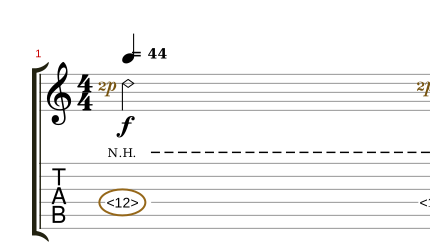
Before this lesson
Lesson steps
1 Two more strings
Play bar 3 keeping the left hand at fret XII.
3 min · 40 bpm · 1 note per click

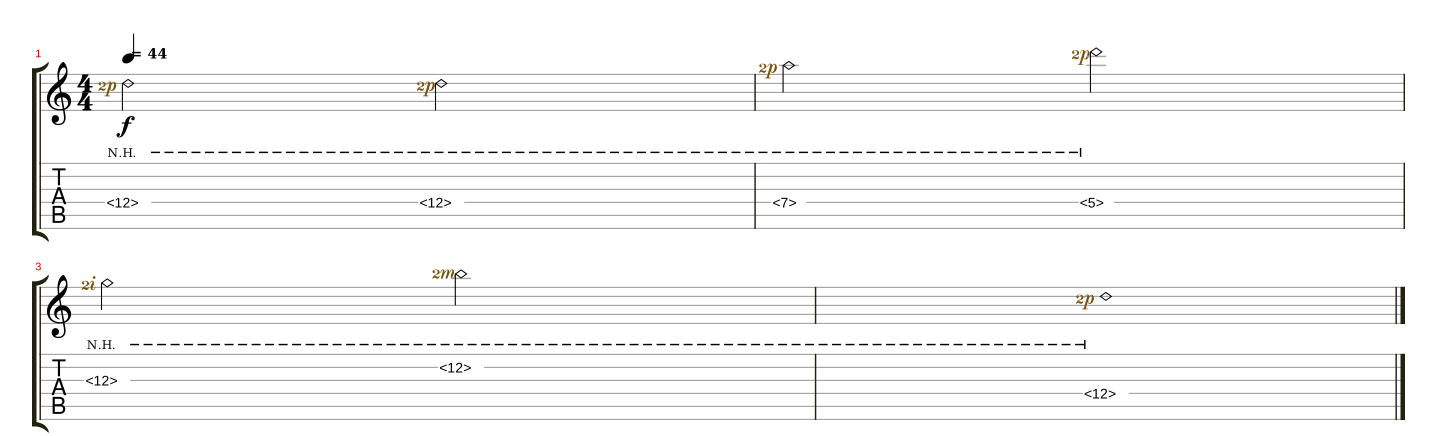
Check for · 2 bars at 48 BPM — Strings 3 and 2 yield two distinct clear notes.
More detail
First aim at string 3 with i, then at string 2 with m.
2 Twelve frets higher
Fret 2, touch fret 14 with right i and pluck with a.
3 min · 40 bpm · 1 note per click


Check for · 2 bars at 44 BPM — The second sound is an octave above the first.
More detail
The tab gives the left-hand fret. XIV marks the right index’s light touch directly above the fret wire.
3 Move the touch point
Repeat at fret 3 with the right index touching above fret 15.
3 min · 40 bpm · 1 note per click
Revisit the tablature · Step 2
Check for · 2 bars at 44 BPM — Both fretted notes produce a clear octave harmonic.
More detail
Keep the left finger down. Lift the right index as the note starts and let the octave ring.
4 Move the touch point
Play both bars twice, moving the right-hand contact from XIV to XV.
3 min · 40 bpm · 1 note per click
Revisit the tablature · Step 2
Check for · 4 bars at 48 BPM — Both fretted notes produce a clear octave harmonic.
More detail
Keep the left finger down. Lift the right index as the note starts and let the octave ring.
You can move on when…
You pass when, over 4 bars at 48 BPM, both fretted notes produce a clear octave harmonic.
If a movement feels difficult
The string makes a dull thud.
Touch lightly directly over the fret wire and lift the finger just after plucking.
The harmonic cuts off at the next attack.
Move your finger clear of the ringing string before preparing the next one.
What to practise next
Sources
- Bradford Werner — Harmonics on the Classical Guitar
- Douglas Niedt — Natural and artificial harmonics