Week 2 · 12 min
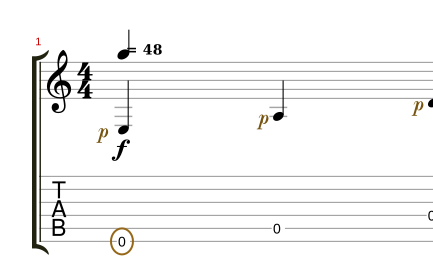
Control pizzicato
By the end, you can shorten a bass note while keeping its pitch audible.
Before this lesson
Lesson steps
1 The ordinary bass
Play the first bar with the thumb, letting the strings ring.
3 min · 44 bpm · 1 note per click


Check for · 2 bars at 48 BPM — You hear the bass notes E, A, D and A.
More detail
The first bar gives a reference for comparing how long each bass rings.
2 Pizzicato
Rest the outer right palm near the bridge throughout the second bar.
3 min · 40 bpm · 1 note per click
Revisit the tablature · Step 1
Check for · 2 bars at 48 BPM — The same four pitches remain recognisable and die away sooner.
More detail
Shift the contact point very slightly to adjust damping while the thumb plucks.
3 Four muted bass notes
Compare the four ordinary bass notes with the same four muted bass notes.
3 min · 44 bpm · 1 note per click
Revisit the tablature · Step 1
Check for · 2 bars at 48 BPM — The second pass has shorter resonance and retains all four pitches.
More detail
Listen to the guitar in your hands. The position of your palm near the bridge makes the difference.
4 Four muted bass notes
Compare the four ordinary bass notes with the same four muted bass notes.
3 min · 44 bpm · 1 note per click
Revisit the tablature · Step 1
Check for · 4 bars at 52 BPM — The second pass has shorter resonance and retains all four pitches.
More detail
Listen to the guitar in your hands. The position of your palm near the bridge makes the difference.
You can move on when…
You pass when, over 4 bars at 52 BPM, the second pass has shorter resonance and retains all four pitches.
If a movement feels difficult
The muted bass loses its pitch.
Move the palm contact nearer the bridge.
All three fingers strum at once.
Isolate one finger movement on each slow click.