Week 2 · 12 min
The tambora pulse
By the end, you can place two tambora strokes in a four-beat bar.
Before this lesson
Lesson steps
1 The ordinary bass
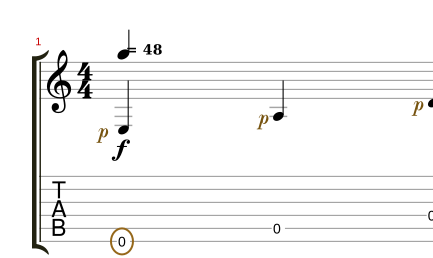
Play the first bar with the thumb, letting the strings ring.
3 min · 44 bpm · 1 note per click


Check for · 2 bars at 52 BPM — You hear the bass notes E, A, D and A.
More detail
The first bar gives a reference for comparing how long each bass rings.
2 Four muted bass notes
Compare the four ordinary bass notes with the same four muted bass notes.
3 min · 44 bpm · 1 note per click
Revisit the tablature · Step 1
Check for · 2 bars at 52 BPM — The second pass has shorter resonance and retains all four pitches.
More detail
Listen to the guitar in your hands. The position of your palm near the bridge makes the difference.
3 Tambora
Tap the strings gently near the bridge with the side of the right thumb.
3 min · 40 bpm · 1 note per click

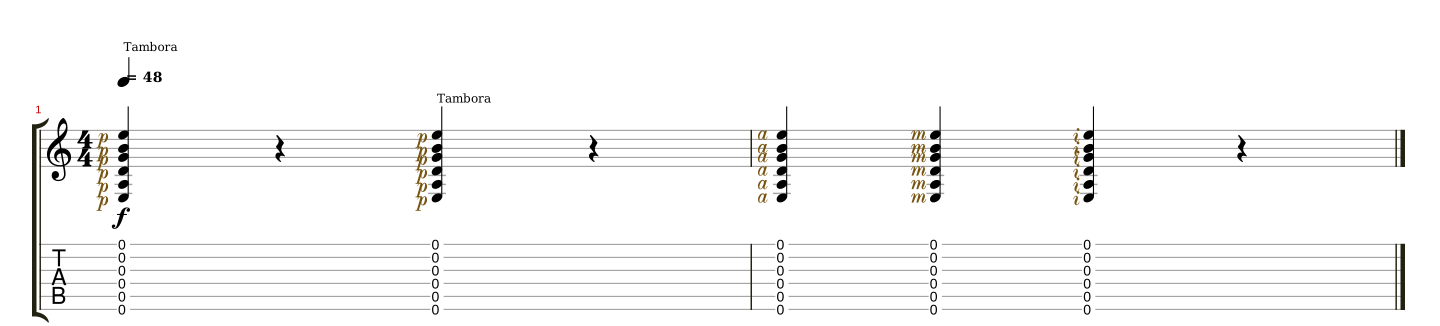
Check for · 2 bars at 48 BPM — A drum-like sound follows each gesture on beats 1 and 3.
More detail
Aim for the strings. A small forearm rotation supplies the gesture and the strings rebound after contact.
4 Two strokes with space between
Play the first bar with one beat of silence after each tambora stroke.
3 min · 44 bpm · 1 note per click
Revisit the tablature · Step 3
Check for · 4 bars at 52 BPM — The two light strokes fall on beats 1 and 3.
More detail
The side of the thumb touches the strings near the bridge. Listen for the drum sound from the strings themselves.
You can move on when…
You pass when, over 4 bars at 52 BPM, the two light strokes fall on beats 1 and 3.
If a movement feels difficult
The muted bass loses its pitch.
Move the palm contact nearer the bridge.
All three fingers strum at once.
Isolate one finger movement on each slow click.