Week 3 · 12 min
Listen to the rhythm in Danza Mora
By the end, you can distinguish a chosen effect from the articulation written in the dance.
Before this lesson
Lesson steps
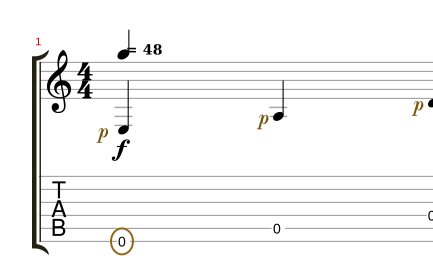
1 Four muted bass notes
Compare the four ordinary bass notes with the same four muted bass notes.
3 min · 44 bpm · 1 note per click


Check for · 2 bars at 52 BPM — The second pass has shorter resonance and retains all four pitches.
More detail
Listen to the guitar in your hands. The position of your palm near the bridge makes the difference.
2 Three distinct brushes
Open one finger per beat in the second bar, then observe the rest.
3 min · 44 bpm · 1 note per click

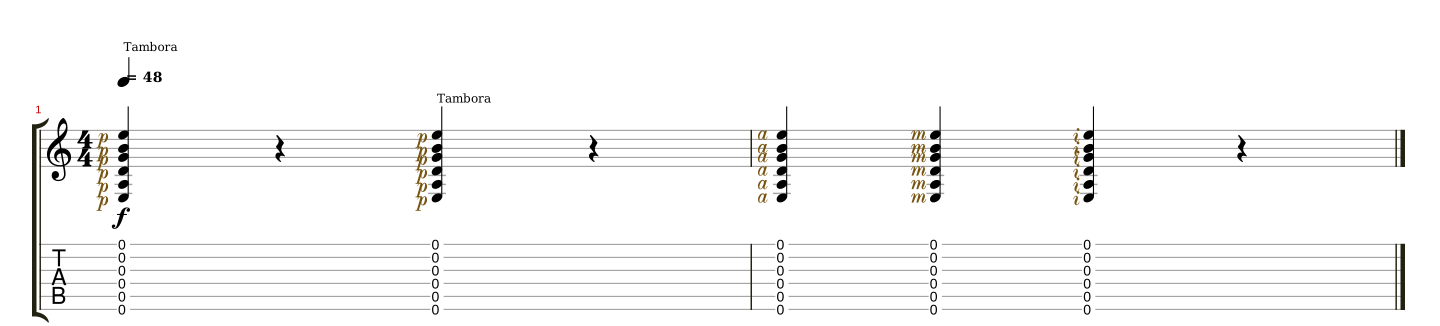
Check for · 2 bars at 52 BPM — You hear a, m and then i before the silent fourth beat.
More detail
Start with a small movement. Each finger brushes the strings independently of the next.
3 Return to the written attacks
Play the chords after the rest in bar 12, then bring out the bass rhythm in bar 13.
3 min · 40 bpm · 2 notes per click

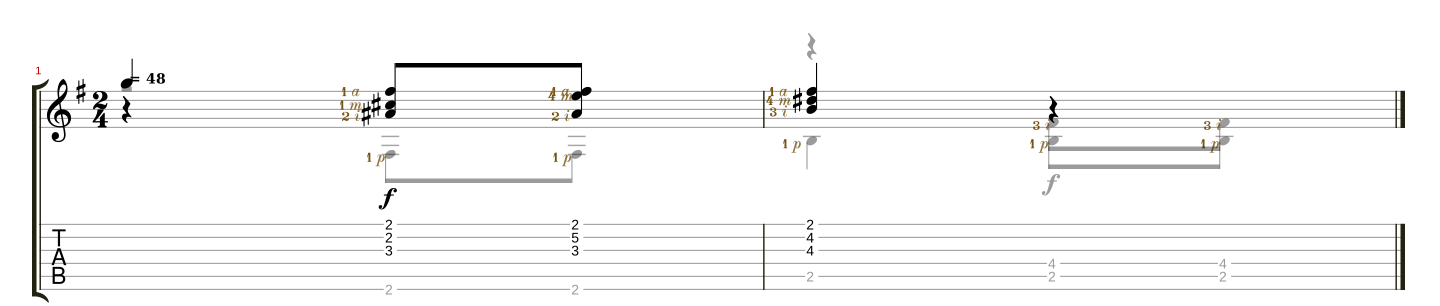
Check for · 2 bars at 48 BPM — You hear a quarter note and two eighths in the bass of bar 13.
More detail
Use the ordinary written attacks in this excerpt. The preceding effects were comparison exercises.
4 Return to the written attacks
Play the chords after the rest in bar 12, then bring out the bass rhythm in bar 13.
3 min · 44 bpm · 2 notes per click
Revisit the tablature · Step 3
Check for · 4 bars at 52 BPM — You hear a quarter note and two eighths in the bass of bar 13.
More detail
Use the ordinary written attacks in this excerpt. The preceding effects were comparison exercises.
You can move on when…
You pass when, over 4 bars at 52 BPM, you hear a quarter note and two eighths in the bass of bar 13.
If a movement feels difficult
The muted bass loses its pitch.
Move the palm contact nearer the bridge.
All three fingers strum at once.
Isolate one finger movement on each slow click.