Danza Mora places fast moving lines above a recurring bass rhythm. The main challenge is to let those lines move freely without disturbing the bass underneath. Begin by playing the bass pattern alone, then add a short upper passage at a speed where both parts remain easy to hear.
The opening scales travel from the high register through the middle strings and into the bass. Keep four notes per beat and pay particular attention to string crossings. A crossing should not sound longer or louder simply because the hand needs more time to prepare it.
The three-note slurs require a different movement from separately plucked scale notes. Use one right-hand attack for the start of each marked group, then let the left hand produce the remaining notes. Practise the group alone before connecting it to the sustained note or bass response that follows.
Later passages change register, texture and mode while returning to familiar rhythmic ideas. Learn the entrances after rests as carefully as the fast notes themselves. Before a complete performance, trace the repeat and the return to the final section. End a session with one short passage whose bass stays steady, whose melody remains distinct and whose silences keep their full value.
An even bass rhythm supports scales and ornaments, alternating lower passages, upper runs and three-note slurs. The repeat and return to the ending are preserved. The app uses 60 bpm as a practice reference.
Skills to prepare
- Even bass line
- Scales across strings
- Slurred triplets
- Barres
- Position shifts
- Sustained notes and chords
Before learning the piece
- App checkpoint: play bars 2–4 slowly at four even notes per beat, three times in a row. Practise this skill (French).
- App checkpoint: play 9–11–9 on string 2 and 8–10–8 on string 1 without adding a right-hand attack. Practise this skill (French).
- App checkpoint: sound the opening chord in position 7, releasing the hand between attempts. Practise this skill (French).
These checkpoints belong to our learning path. They do not set a deadline for your progress.
Tablature and fingerings
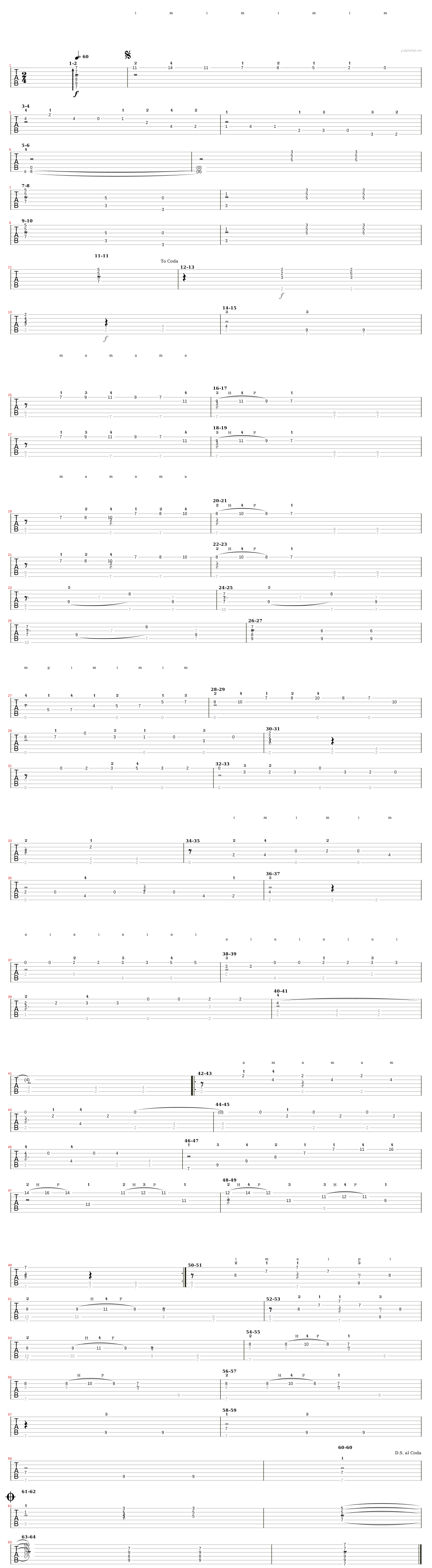
The six lines represent the strings, with high E at the top. Numbers show frets; 0 means an open string. The letters p, i, m and a indicate right-hand fingers.
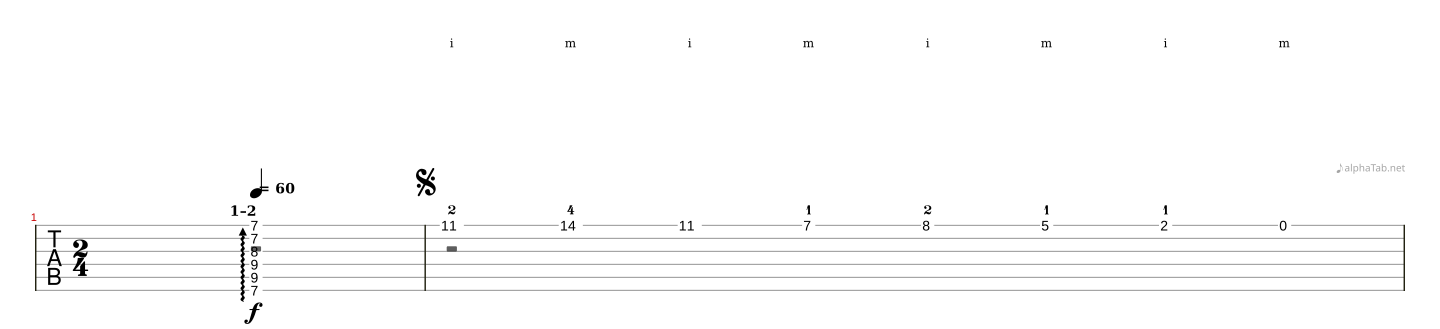
Read the complete static tab · Download the alphaTex file
The player and its sounds load when you choose to use them.
Your phrase-by-phrase plan
Work on a short passage. Aim for five clean attempts in a row, then connect two phrases. Bar numbers follow our transcription, including a separately numbered pickup where applicable.
Phrase 1 · bars 1–2
Bars 1–2. Spread bar 1’s chord from bass to treble. Play eight even notes in bar 2, four per beat. The scale descends on string 1 from the high position to the open string.
Phrase 2 · bars 3–4
The same descent moves through the middle register in bar 3 and into the bass in bar 4. Keep four notes per beat and prepare each string crossing without rushing.
Phrase 3 · bars 5–6
Bars 5–6. Play open string 5 with string 6 at fret 8 in bar 5, holding the interval through bar 6’s first beat. The following two chords are eighth notes around frets 3 and 5.
Phrase 4 · bars 7–8
Bar 7’s upper chord precedes two lower intervals. Bar 8 begins with a one-beat interval answered by two chords. Read the positions first, then keep two equal beats per bar.
Phrase 5 · bars 9–10
Bars 9–10 revisit 7–8’s dialogue. Sound the opening chord, then two lighter replies. Prepare bar 10’s next chord without releasing the sustained notes too early.
Phrase 6 · bar 11
Hold bar 11’s chord for two beats. First time, continue to 12. After returning from 60, jump directly to the ending at 61.
Phrase 7 · bars 12–13
Wait one beat before bar 12’s two chords. Bar 13 establishes the bass rhythm: one quarter note, then two eighth notes. Practise that alone before adding the chord’s upper notes.
Phrase 8 · bars 14–15
Prepare position 7 in bar 14. Keep bar 15’s bass steady beneath six upper notes that begin after half a beat. The melody moves from string 1 to string 2.
Phrase 9 · bars 16–17
Slur 9–11–9 on string 2 in bar 16. The three notes share half a beat, followed by fret 7 held for a beat and a half. Return to six rising and falling notes in bar 17.
Phrase 10 · bars 18–19
Repeat bar 16’s short slurred triplet in bar 18. Bar 19’s line rises from string 2 at 7 to string 1 at 10. Keep the thumb’s rhythm unchanged.
Phrase 11 · bars 20–21
Slur 8–10–8 on string 1 in bar 20, then hold fret 7. Repeat bar 19’s ascent in bar 21. Fast upper notes must not displace the three bass attacks.
Phrase 12 · bars 22–23
Repeat the 8–10–8 triplet on string 1 in bar 22. Let bar 23’s inner notes enter one at a time, then add string 2 at 8 as the melody. Sustain common notes.
Phrase 13 · bars 24–25
Prepare the small barre at 7 and string 6 at 10 in bars 24–25. Release the accented chord before the inner notes enter. Bar 25’s final two basses move to string 5 at 7.
Phrase 14 · bars 26–27
Place bar 26’s chord around frets 6–9, then its two lower replies. Play bar 27’s eight ascending notes, four per beat, while open string 6 maintains the rhythm.
Phrase 15 · bars 28–29
Bar 28’s scale reaches fret 10 on string 1, then descends. Continue towards the low frets in bar 29, keeping the thumb on open string 6.
Phrase 16 · bars 30–31
Prepare the barre at 2 in bar 30. Hold open string 4 under bar 31’s first-string ascent. Its six upper notes begin after half a beat.
Phrase 17 · bars 32–33
Alternate open string 1 with string 2 at frets 3 and 2 in bar 32. Bar 33’s melody moves from string 3 at 3 to string 2 at 2. Keep the bass even.
Phrase 18 · bars 34–35
Bar 34’s six notes move through strings 4 and 3; bar 35 continues down strings 4 and 5. Release the first bass after one beat to keep the lower line clear.
Phrase 19 · bars 36–37
Play string 4 at fret 4 in bar 36, then observe the melody’s rest. Repeat each upper note twice in bar 37 while the thumb changes bass every half-beat.
Phrase 20 · bars 38–39
Keep bar 38’s upper repetitions even through the thumb’s descent. Prepare bar 39’s four basses separately. The final chord adds string 3 at 3 beneath string 1 at 2.
Phrase 21 · bars 40–41
The passage moves into the major mode in bars 40–41. Hold string 2 at fret 4 across both bars without reattacking at 41. The thumb keeps one quarter and two eighth notes per bar.
Phrase 22 · bars 42–43
Bar 42’s six upper notes begin after half a beat. Bar 43’s melody reaches open string 1; hold its last tied note into bar 44.
Phrase 23 · bars 44–45
Let bar 44’s tied note ring before resuming six sixteenth notes. Bar 45 returns towards string 2 at 4. Keep the bass steady through the string changes.
Phrase 24 · bars 46–47
Bar 46’s arpeggio rises to fret 16 on string 1: prepare the final shift alone. In bar 47, isolate each three-note slur before connecting it to the following lower note.
Phrase 25 · bars 48–49
Practise bar 48’s two slurred groups separately; the bass enters only on beat two. Bar 49’s melody stops after one beat. Repeat from 42 once, then continue to 50.
Phrase 26 · bars 50–51
Follow i-m-a-i-p-i for bar 50’s six-note motif. Slur 9–11–9 on string 3 in bar 51. Hear the two attacks on string 5 at 10, followed by those at 9.
Phrase 27 · bars 52–53
Bars 52–53 repeat 50–51’s motifs. Keep the melody above the bass. Pluck the slurred triplet’s first note; the left hand produces the next two.
Phrase 28 · bars 54–55
The motif thickens into two voices in bars 54–55. Hold string 3’s notes through the 8–10–8 triplet on string 2. The final chord descends to string 3 at 8 and string 2 at 7.
Phrase 29 · bars 56–57
Play the two-voice motif again in bar 56. The melody rests in bar 57, leaving the held bass and two replies on string 5 at 9. Preserve that space.
Phrase 30 · bars 58–59
In bars 58–59, the melody plays string 4 at fret 7 for one beat, then leaves room for string 5’s two eighth notes. Hold string 6 at 7 and prepare the section ending without rushing.
Phrase 31 · bar 60
Hold bar 60’s two notes for two beats. Return to the sign at bar 2, then jump from 11 to the ending at 61. Shape the fermata freely in your own playing.
Phrase 32 · bars 61–62
Bar 61’s melody and bass play their naturals before two answering chords. Prepare the barre at 5 and sustain bar 62’s chord. These ending bars follow the engraving.
Phrase 33 · bars 63–64
Keep bar 63’s tied chord on beat one, then play the next chord’s two eighth notes. Place bar 64’s final chord with the barre at 7 and let it ring for two beats.
Watch and listen
Choose the recording that matches your current goal. Videos load only when you select them and require an internet connection.
Performance · Thu Le
Listen to Thu Le’s performance for contrasts and returns. This is a performance, not a lesson; fingerings and repeat choices may differ from this transcription.
English commentary. Link and metadata checked for our selection.
Lesson · This is Classical Guitar
Prepare three-note slur groups before Danza Mora’s triplets. This lesson teaches the technique rather than the piece itself.
English commentary. Link and metadata checked for our selection.
Sources and transcription choices
- Tárrega — Danza Mora, Ildefonso Alier, plate I. 5229 A, printed pp. 2–3; Royal Danish Library copy
- Bradford Werner — slurs, three-note groups and shifts; distinguishing ties from left-hand slurs
The notes follow the credited sources. Fingerings, phrase divisions and practice tempos are editorial learning choices. How our transcriptions work.