Week 1 · 12 min
Alternate without repeating a finger
By the end, you can keep i-m going across a string change.
Lesson steps
1 On one string
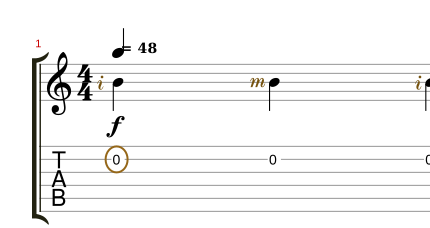
Alternate index and middle on open string 2.
3 min · 44 bpm · 1 note per click


Check for · 2 bars at 52 BPM — Two consecutive notes are not played by the same finger.
More detail
The right-hand marking i–m means one stroke with the index, then one with the middle finger.
2 The first crossing
Move from string 2 to string 1 after three strokes.
3 min · 44 bpm · 1 note per click


Check for · 2 bars at 52 BPM — After i-m-i, m plays the first note on string 1.
More detail
Three is odd, so the new string starts with the other finger.
3 The return crossing
Return to string 2 following the letters in bar two.
3 min · 44 bpm · 1 note per click
Revisit the tablature · Step 2
Check for · 2 bars at 52 BPM — The first note back on string 2 is played by i.
More detail
The left hand stays free. Listen only to the right hand’s evenness.
4 On the scale
Play the first two bars of C major twice, alternating i and m on every note.
3 min · 44 bpm · 1 note per click
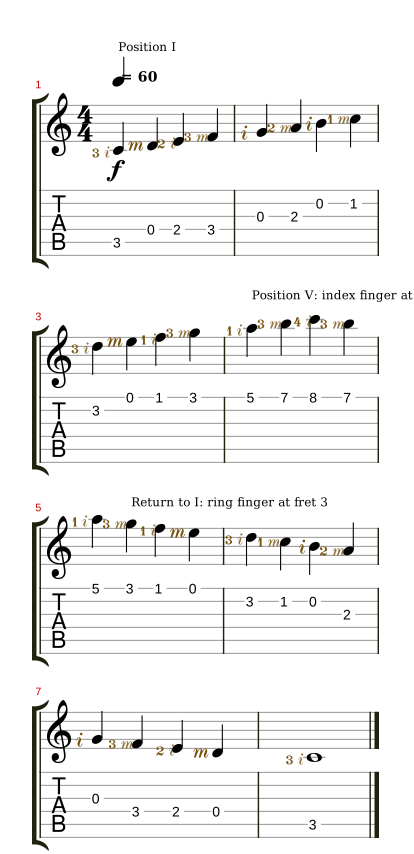
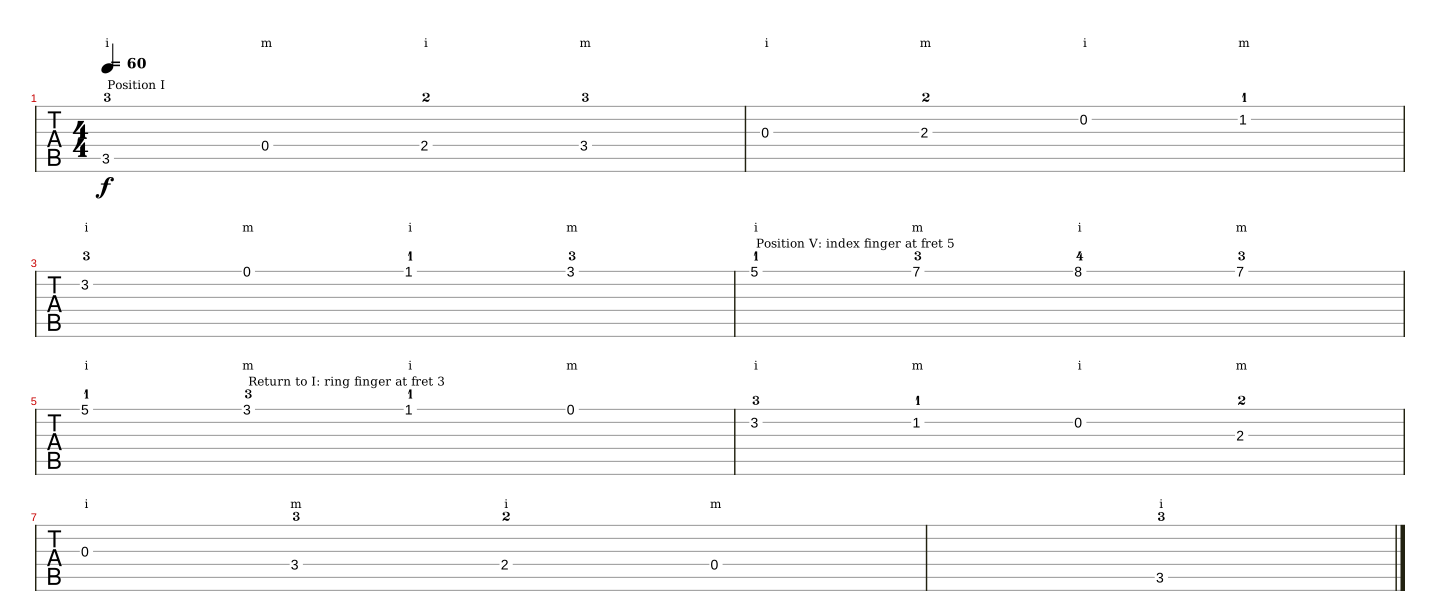
Check for · 4 bars at 52 BPM — all eight notes in each pass use strict alternation.
More detail
Start with i and say the letters quietly to catch repeated fingers.
You can move on when…
You pass when you play the eight notes twice with alternating i and m over 4 bars at 52 BPM.
If a movement feels difficult
You repeat the same finger.
Return to slow i-m alternation and check every stroke before speeding up.
The tone changes with every string.
Go back note by note and even out the tone before continuing.