Week 1 · 12 min
Four fingers on four strings
By the end, you can repeat p-a-m-i without shifting the beat.
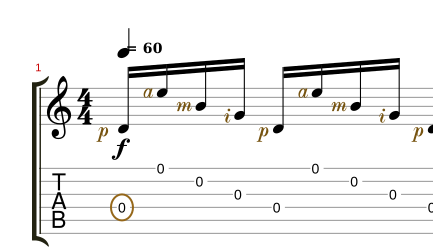
Lesson steps
1 Assign each finger a string
Play strings 4, 1, 2 and 3 with p, a, m and i.
3 min · 52 bpm · 4 notes per click


Check for · 2 bars at 52 BPM — all four strings sound in order.
More detail
p is the thumb, a the ring finger, m the middle finger and i the index. String 1 is the highest.
2 Put the thumb on the beat
Play the bass on each beat, then a, m and i on the three subdivisions that follow.
3 min · 52 bpm · 4 notes per click
Revisit the tablature · Step 1
Check for · 4 bars at 52 BPM — every bass opens a group of four.
More detail
Use the main click to place p. Count four attacks from one bass to the next, including the opening bass.
3 Finish the group with i
Listen to the transition from the index finger to the next thumb stroke.
3 min · 52 bpm · 4 notes per click
Revisit the tablature · Step 1
Check for · 4 bars at 60 BPM — the i-p gap matches the m-i gap.
More detail
The fourth attack leads into the next bass. Give i its full time before the beat.
4 Repeat without a break
Play the tab four times in succession.
3 min · 52 bpm · 4 notes per click
Revisit the tablature · Step 1
Check for · 8 bars at 60 BPM — four separate attacks are audible on every beat.
More detail
Count each pass on its opening bass. Listen where the last bar loops back to the first.
You can move on when…
You pass when you play 8 bars at 60 BPM with the thumb on every beat and four distinct attacks.
If a movement feels difficult
There is a gap between i and p.
Slow down and space all four sounds evenly across the group boundary.
The fingers travel away from the string.
Slow down. Bring the next finger close as the previous stroke ends.