Week 1 · 12 min
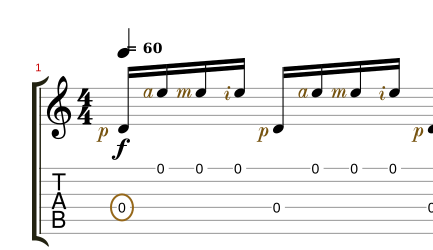
Three fingers on one string
By the end, you can play three even upper notes after the bass.
Before this lesson
Lesson steps
1 Bring the three upper strokes together
Play a, m and i on string 1 after the thumb on string 4.
3 min · 52 bpm · 4 notes per click


Check for · 2 bars at 52 BPM — three upper notes follow every bass.
More detail
The pitch stays the same so you can compare the three fingers by ear.
2 Prepare the next stroke
Place the next finger on the string just before playing.
3 min · 52 bpm · 4 notes per click
Revisit the tablature · Step 1
Check for · 2 bars at 52 BPM — each finger finds the string directly.
More detail
Planting deliberately shortens the sound. Try one slow group, then delay contact until just before the stroke.
3 Let the upper notes ring
Let each upper note ring until the next finger plays.
3 min · 52 bpm · 4 notes per click
Revisit the tablature · Step 1
Check for · 4 bars at 60 BPM — none of the three upper notes is cut short.
More detail
Keep the short travel you found in the previous step. Touch the string at the last moment.
4 Compare a, m and i
Loop the pattern and listen to a, then m, then i.
3 min · 52 bpm · 4 notes per click
Revisit the tablature · Step 1
Check for · 20 seconds at 60 BPM — the three upper notes have similar volume.
More detail
Focus on one finger per pass. You can then try the same passage with the microphone.
You can move on when…
You pass when you hear three even upper notes after every bass for 20 seconds at 60 BPM.
If a movement feels difficult
The ring finger is barely audible.
Bring out a for one group. Then match the volume of a, m and i.
The fingers travel away from the string.
Slow down. Bring the next finger close as the previous stroke ends.
Your hand tightens.
Stop, let your hand relax and restart slowly with a smaller stroke.