Week 2 · 12 min
From one treble string to the next
By the end, you can switch the three upper strokes to another string without delaying the thumb.
Before this lesson
Lesson steps
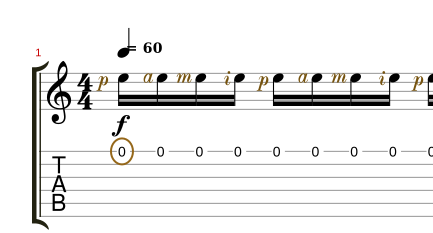
1 One contact point
Play the thumb on string 1 as well.
3 min · 60 bpm · 4 notes per click


Check for · 2 bars at 60 BPM — all four fingers sound the same pitch.
More detail
The bass returns later. Here a finger change alone reveals any unevenness.
2 Restore the separate bass
Return p to string 4 and keep a-m-i on the first string.
3 min · 60 bpm · 4 notes per click


Check for · 4 bars at 66 BPM — bringing the bass back creates no gap.
More detail
Listen to the first a after each bass. Its position in the group stays the same.
3 Aim for open B
Move the three fingers to string 2 on beat three of the first bar.
3 min · 60 bpm · 4 notes per click


Check for · 2 bars at 66 BPM — the first a on string 2 sounds B cleanly.
More detail
The thumb stays on string 4. The second bar takes the fingers from B back to high E.
4 Cross in both directions
Play the trip between E and B twice.
3 min · 66 bpm · 4 notes per click
Revisit the tablature · Step 3
Check for · 4 bars at 72 BPM — you make four changes without doubling a stroke.
More detail
Listen to each direction separately. Revisit the less fluent crossing on your next attempt.
You can move on when…
You pass when you make four string changes in 4 bars at 72 BPM without missing an upper note.
If a movement feels difficult
The first a lands on the wrong string.
Find the next treble string during the bass note. Replay the crossing slowly.
There is a gap between i and p.
Slow down and space all four sounds evenly across the group boundary.