Week 2 · 12 min
Place and remove an accent
By the end, you can move an accent to each finger and then restore an even tremolo.
Before this lesson
Lesson steps
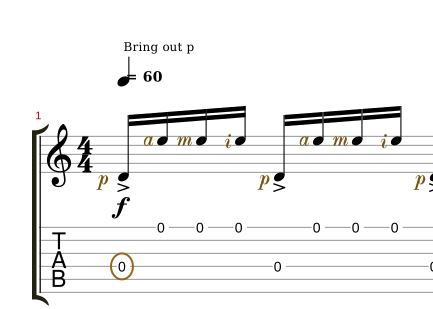
1 From thumb to ring finger
Bring out p in the first bar and a in the second.
3 min · 60 bpm · 4 notes per click

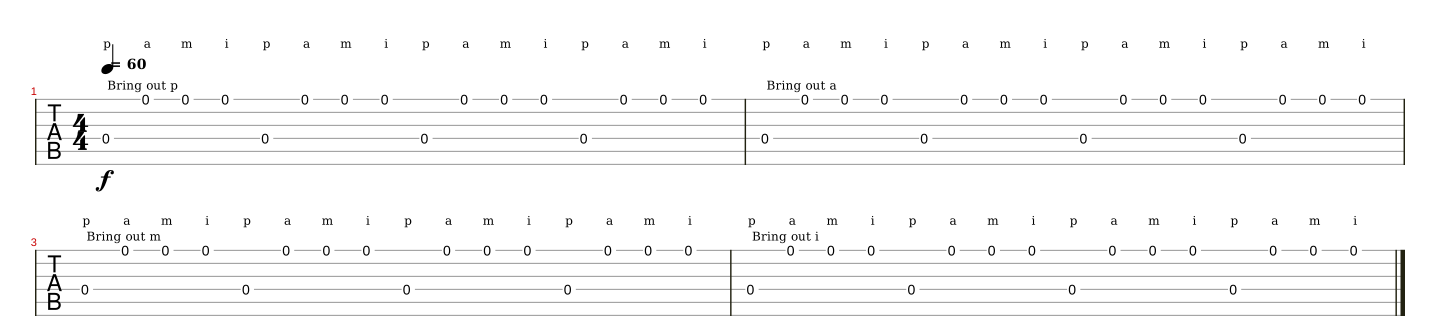
Check for · 2 bars at 66 BPM — only the marked finger stands out in each bar.
More detail
The accent changes volume. Every note keeps the same length.
2 From middle to index finger
Start at the third bar and move the accent from m to i.
3 min · 60 bpm · 4 notes per click
Revisit the tablature · Step 1
Check for · 2 bars at 66 BPM — the accent changes finger at the bar line.
More detail
Compare the last group of bar 3 with the first group of bar 4.
3 Rotate the accent
Play all four bars following the accent marks.
3 min · 66 bpm · 4 notes per click
Revisit the tablature · Step 1
Check for · 4 bars at 72 BPM — you hear p, a, m and then i in the foreground.
More detail
Assess this variation by ear. Use the microphone’s evenness check on the regular pattern in the next step.
4 Remove all four accents
Return to the unaccented pattern and loop the tab.
3 min · 66 bpm · 4 notes per click


Check for · 20 seconds at 72 BPM — no single upper note consistently sticks out.
More detail
A finger may stay louder out of habit. Compare two passes, then match all three upper strokes again.
You can move on when…
You pass when you place four successive accents and then play evenly for 20 seconds at 72 BPM.
If a movement feels difficult
The ring finger is barely audible.
Bring out a for one group. Then match the volume of a, m and i.
The thumb covers the melody.
Repeat one bar with a lighter bass. Keep listening for all three upper notes.