Level 3 · Classical technique · 20 min
Chromatic drill and spider
By the end you can move one finger, then a diagonal pair, while the others stay in place.
Before this lesson
Lesson steps
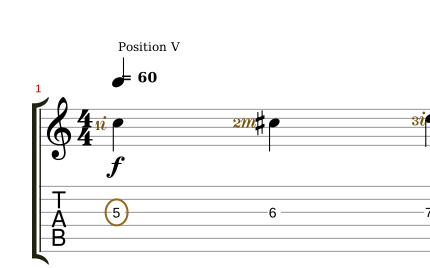
1 Place 1-2-3-4
Place fingers 1, 2, 3 and 4 on string 3 in turn.
4 min · Quarter note = 48, 1 note per click


Check for · All four notes ring without buzzing.
More detail
Use frets 5 to 8. Keep the index at 5 as the middle finger lands.
2 Move one finger at a time
Transfer the fingers one at a time to string 4.
4 min · Quarter note = 48, 1 note per click

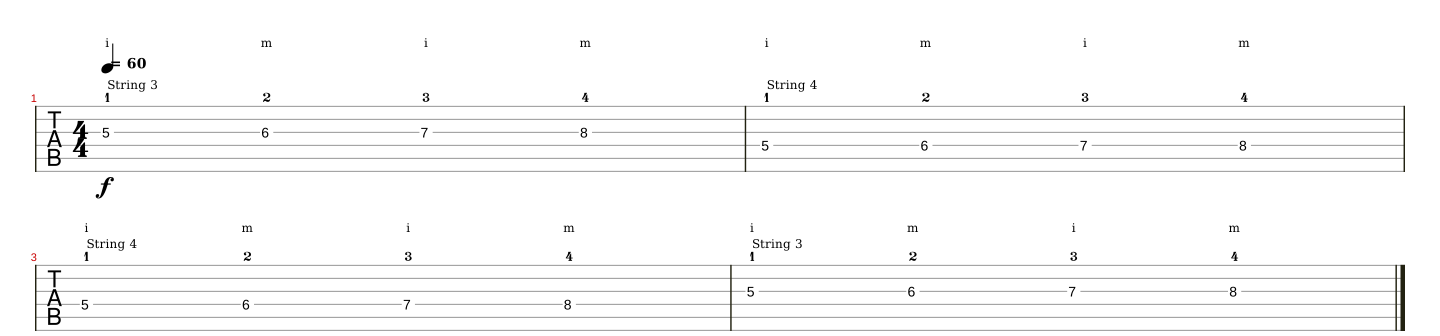
Check for · The waiting fingers stay in place.
More detail
When the index changes string, three fingers still wait on string 3.
3 Adjust the placement
Check that each fingertip leaves the adjacent string clear.
4 min · Quarter note = 48, 1 note per click
Revisit the tablature · Step 1
Check for · Each string remains free to ring.
More detail
Fingers 1 and 4 may lean slightly outwards; 2 and 3 stay more perpendicular.
4 Switch to the piston movement
Lift each finger just after its note, keeping it close to the string.
4 min · Quarter note = 48, 1 note per click


Check for · No finger moves more than one centimetre away.
More detail
Compare this movement with step one, where the fingers stayed down.
5 Add the spider exercise
Move the diagonal pairs across strings 5 and 2.
4 min · Quarter note = 40, 1 note per click

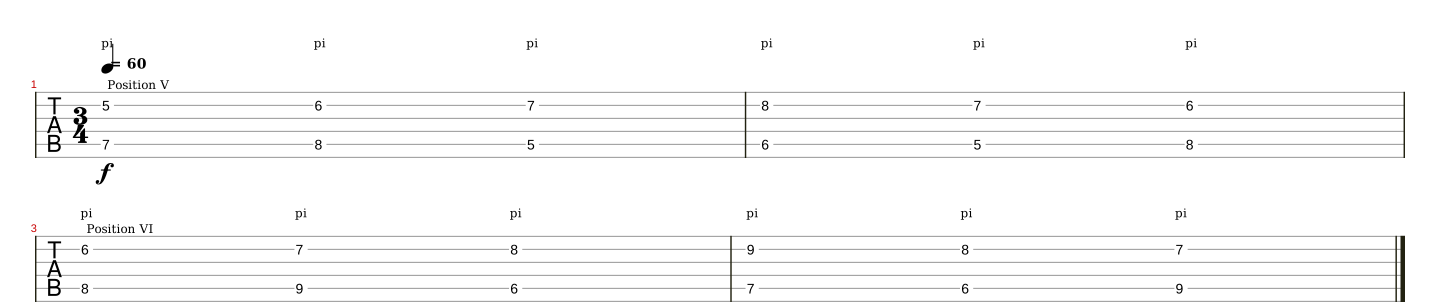
Check for · The fingers that stay down do not move.
More detail
Play right thumb and index together. Pause after each pair to check both sounds.
You can move on when…
You pass when both notes sound clearly in all six spider shapes.
If a movement feels difficult
Your fingers lift too far.
Repeat the piston movement slowly, keeping your fingers hovering close to the string.
Your wrist bends sharply during the spider exercise.
Stop the variation and return to curved fingers and a relaxed wrist.