Level 3 · Classical technique · 20 min
Two colours of A minor
By the end you can distinguish harmonic and melodic A minor going up and down.
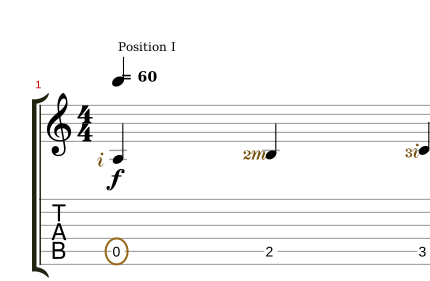
Before this lesson
Lesson steps
1 The leading note
Find G sharp just before the top A.
4 min · Quarter note = 44, 1 note per click
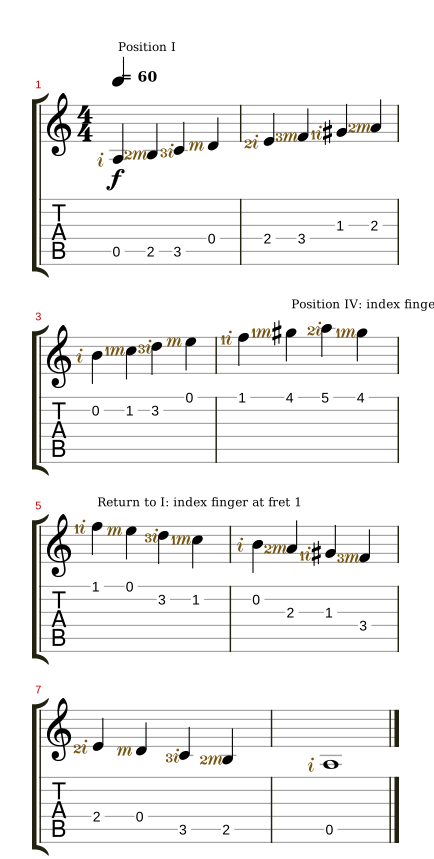
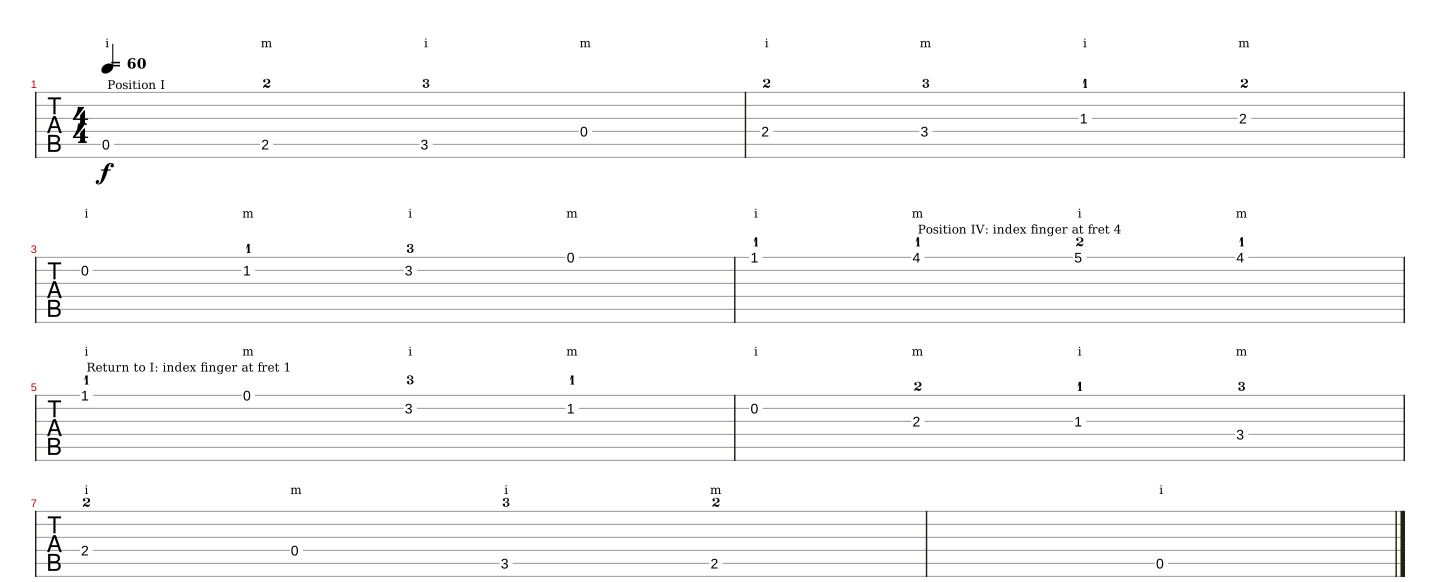
Check for · On string 1 you play fret 4 before fret 5.
More detail
In this octave of harmonic A minor, F is natural and G is sharp.
2 The harmonic descent
Descend retaining G sharp.
4 min · Quarter note = 44, 1 note per click
Revisit the tablature · Step 1
Check for · You return through the same frets in reverse order.
More detail
The three-fret interval between F and G sharp is audible in both directions on string 1.
3 The melodic ascent
Play frets 0, 2, 4 and 5 on string 1.
4 min · Quarter note = 44, 1 note per click


Check for · You hear E, F sharp, G sharp and A.
More detail
One click per note leaves time to prepare the shift to A.
4 The classical melodic descent
Play the second bar following frets 5, 3, 1 and 0.
4 min · Quarter note = 44, 1 note per click
Revisit the tablature · Step 3
Check for · You hear A, G natural, F natural and E.
More detail
In this classical form the sixth and seventh degrees return to their natural form on the descent.
5 The listening test
Alternate the printed melodic descent with the harmonic descent you learned.
4 min · Quarter note = 48, 1 note per click
Revisit the tablature · Step 3
Check for · You can sing both descents after putting down the guitar.
More detail
At the top, compare 5–3–1–0 with 5–4–1–0 on the first string.
You can move on when…
You pass when you play both forms and name the frets that change.
If a movement feels difficult
You repeat the same finger.
Return to slow i-m alternation and check every stroke before speeding up.
The position shift leaves a gap.
Isolate the shift and alternate long-short, then short-long rhythms.