Week 3 · 12 min
Aim for the new position
By the end, you can move from fret 3 to fret 5 and back on the beat.
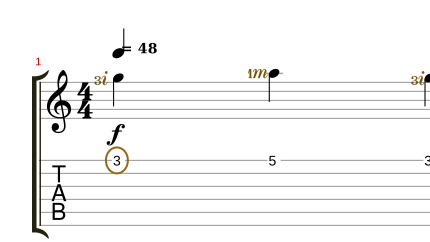
Before this lesson
Lesson steps
1 The starting point
Play G on string 1 with the ring finger at fret 3.
3 min · 44 bpm · 1 note per click


Check for · 2 bars at 52 BPM — The note rings without buzzing and your index can move freely.
More detail
A position is named for the fret under the index finger. A shift moves the hand to another position.
2 The target
Place the index at fret 5 after G.
3 min · 44 bpm · 1 note per click
Revisit the tablature · Step 1
Check for · 2 bars at 52 BPM — A at fret 5 starts with the click.
More detail
The forearm carries the hand. Look towards the target fret before leaving G.
3 The return
Return to G at fret 3 with the ring finger.
3 min · 44 bpm · 1 note per click
Revisit the tablature · Step 1
Check for · 2 bars at 52 BPM — You find the fret without an audible slide.
More detail
Let the thumb travel with the hand. Slow down if you have to correct the landing.
4 Two rhythms
Play the shift in the long-short rhythm of the first bar.
3 min · 48 bpm · 1 note per click

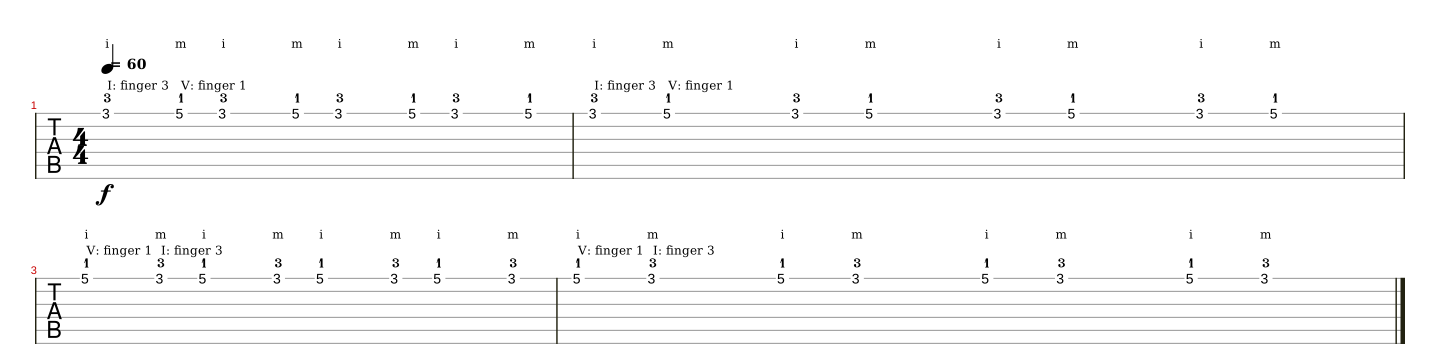
Check for · 4 bars at 56 BPM — The index arrives on time even when its note is short.
More detail
The second bar reverses the note lengths. Start with whichever direction leaves an audible gap.
You can move on when…
You pass when, over 4 bars at 56 BPM, the index arrives on time even when its note is short.
If a movement feels difficult
The position shift leaves a gap.
Isolate the shift and alternate long-short, then short-long rhythms.
A note buzzes.
Stop on that note and move your finger closer to the fret.