Week 4 · 12 min
Change note density on one pulse
By the end, you can switch between quarter notes, eighths, triplets and sixteenths.
Before this lesson
Lesson steps
1 On one string
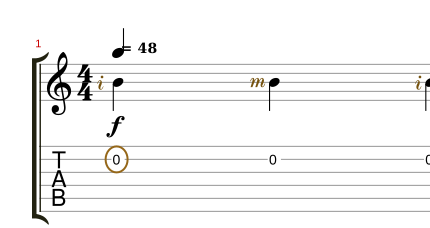
Alternate index and middle on open string 2.
3 min · 48 bpm · 1 note per click


Check for · 2 bars at 56 BPM — Two consecutive notes are not played by the same finger.
More detail
The right-hand marking i–m means one stroke with the index, then one with the middle finger.
2 Subdivisions
Play one, two, three and then four sounds per click.
3 min · 40 bpm · 1 note per click

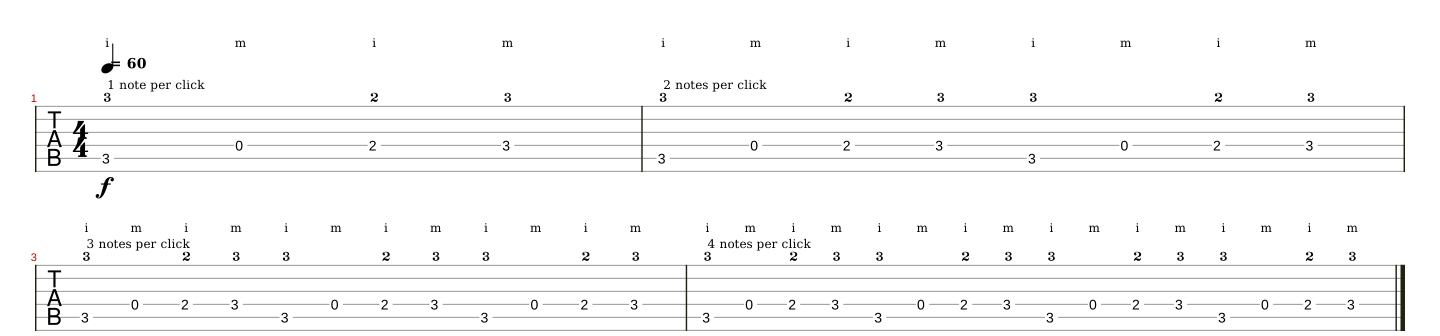
Check for · 4 bars at 48 BPM — you play 4, 8, 12 and then 16 attacks while keeping the pulse steady.
More detail
Restart at 40 BPM for the four subdivisions. Keep the same main click for all four bars and change the number of notes per beat.
3 Two rhythms
Play the shift in the long-short rhythm of the first bar.
3 min · 44 bpm · 1 note per click

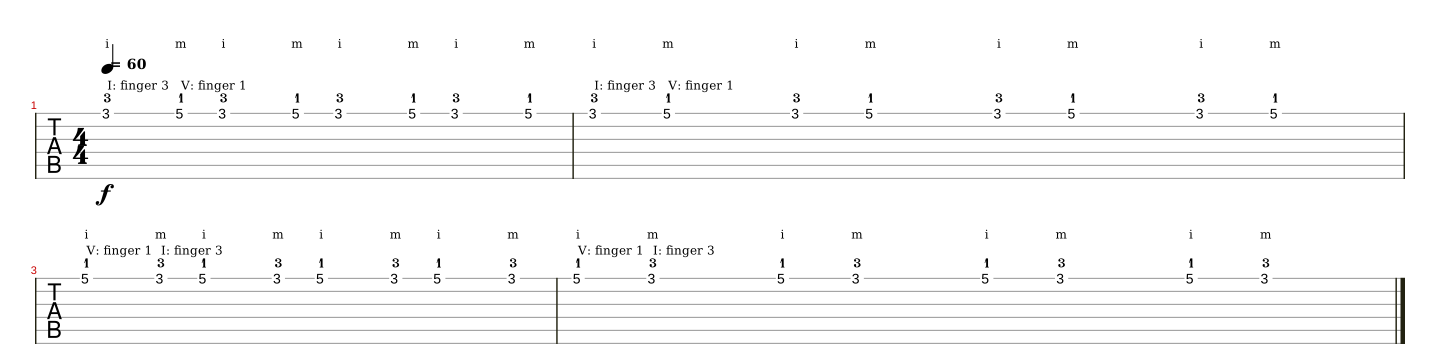
Check for · 2 bars at 52 BPM — The index arrives on time even when its note is short.
More detail
The second bar reverses the note lengths. Start with whichever direction leaves an audible gap.
4 Subdivisions
Play one, two, three and then four sounds per click.
3 min · 44 bpm · 1 note per click
Revisit the tablature · Step 2
Check for · 4 bars at 52 BPM — you play 4, 8, 12 and then 16 attacks while keeping the pulse steady.
More detail
Go back to two sounds per click if the triplet becomes uneven.
You can move on when…
You pass when you keep the pulse at 52 BPM for 4 bars with one, two, three and then four notes per beat.
If a movement feels difficult
The position shift leaves a gap.
Isolate the shift and alternate long-short, then short-long rhythms.
The groups are uneven.
Return to one note per click at 60, then build the subdivisions back up.