Week 5 · 12 min
G major in three octaves
By the end, you can reach high G and return to low G at the same tempo.
Before this lesson
Lesson steps
1 The target
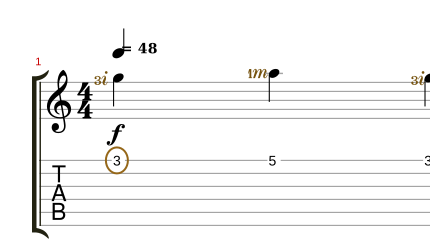
Place the index at fret 5 after G.
3 min · 48 bpm · 1 note per click


Check for · 2 bars at 56 BPM — A at fret 5 starts with the click.
More detail
The forearm carries the hand. Look towards the target fret before leaving G.
2 Three octaves in G
Ascend from the first G to high G following the tab fingering.
3 min · 44 bpm · 1 note per click

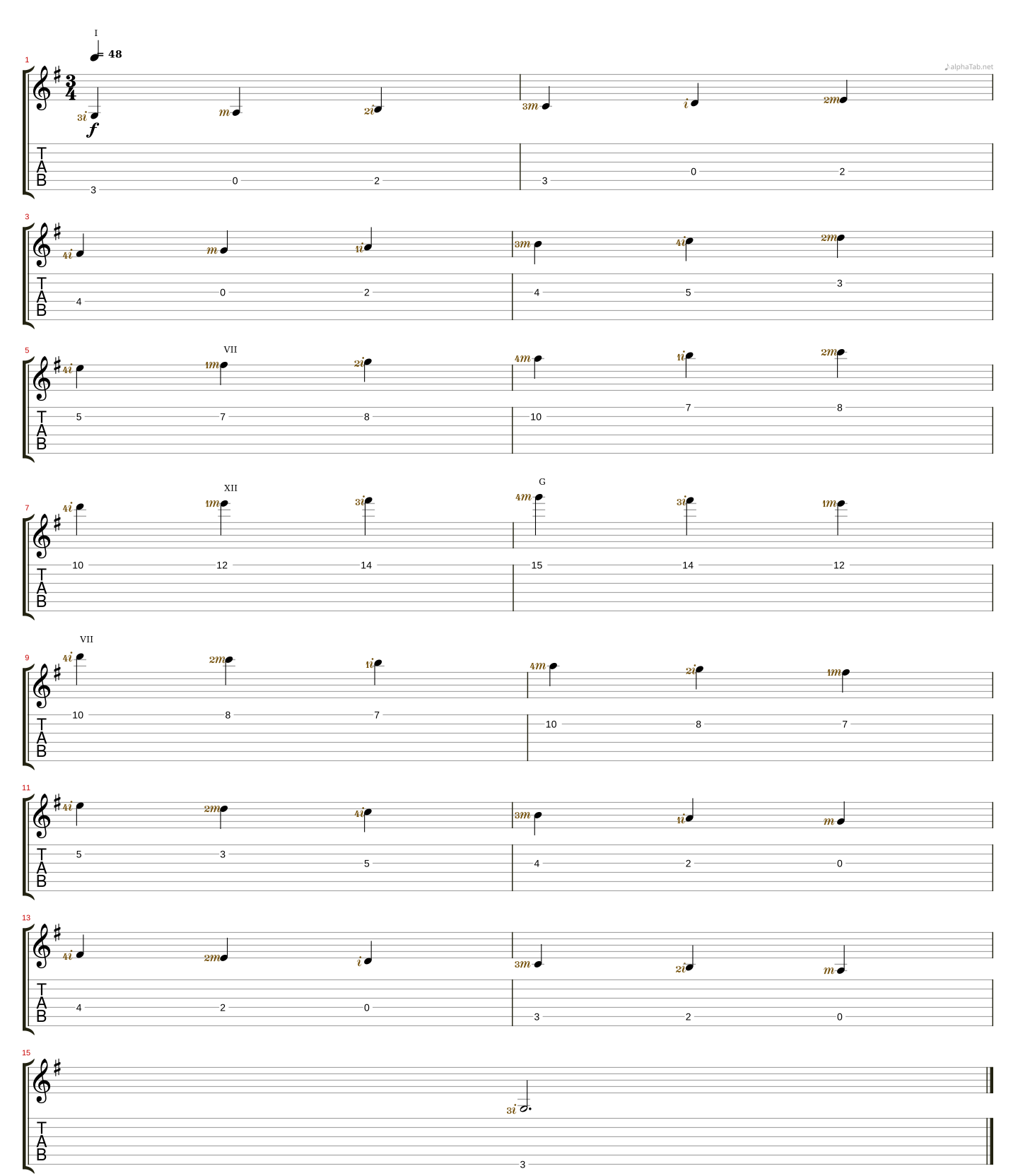
Check for · 8 bars at 52 BPM — High G arrives without a repeated note or a doubled right-hand finger.
More detail
On string 1 aim for fret 12 with the index. High G falls on beat one of bar 8. Hold it when practising the ascent alone.
3 Three octaves in G
Ascend from the first G to high G following the tab fingering.
3 min · 48 bpm · 1 note per click
Revisit the tablature · Step 2
Check for · 8 bars at 56 BPM — High G arrives without a repeated note or a doubled right-hand finger.
More detail
On string 1 aim for fret 12 with the index. High G falls on beat one of bar 8. Hold it when practising the ascent alone.
4 Low G and back
Ascend and descend all three octaves, keeping the alternation at the top.
3 min · 48 bpm · 1 note per click
Revisit the tablature · Step 2
Check for · 15 bars at 56 BPM — The line returns to low G and the pulse stays steady at the turnaround.
More detail
Count three beats per bar. High G opens bar eight. The final low G lasts all three beats of bar fifteen.
You can move on when…
You pass when, over 15 bars at 56 BPM, the line returns to low G and the pulse stays steady at the turnaround.
If a movement feels difficult
The position shift leaves a gap.
Isolate the shift and alternate long-short, then short-long rhythms.
The groups are uneven.
Return to one note per click at 60, then build the subdivisions back up.