Week 1 · 12 min
Listen to nail contact
By the end, you can hear when a nail edge catches a string.
Lesson steps
1 Check each finger’s contact
Play i, m and a slowly on the same string and listen to the beginning of each note.
3 min · 40 bpm · 1 note per click


Check for · 2 bars at 44 BPM — You can identify which finger catches or releases cleanly.
More detail
If you play with nails, check the edge that contacts the string. Without nails, compare the release from the fingertip.
2 The free stroke
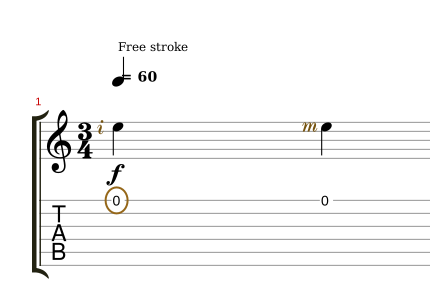
Play free strokes on string 1 in the first bar, leaving the adjacent string untouched.
3 min · 40 bpm · 1 note per click
Revisit the tablature · Step 1
Check for · 2 bars at 44 BPM — Three free strokes produce three distinct starts.
More detail
The right finger leaves the string without resting on the next. Compare i, m and a at the same spot.
3 Play again after polishing
Lightly smooth the edge that catches and play string 1 again.
3 min · 40 bpm · 1 note per click

Revisit the tablature · Step 1
Check for · 2 bars at 48 BPM — the same finger releases the string without a scratch.
More detail
Try the same finger before and after polishing. If you play without nails, compare two fingertip contact angles.
4 Check each finger’s contact
Play i, m and a slowly on the same string and listen to the beginning of each note.
3 min · 44 bpm · 1 note per click
Revisit the tablature · Step 1
Check for · 4 bars at 48 BPM — You can identify which finger catches or releases cleanly.
More detail
If you play with nails, check the edge that contacts the string. Without nails, compare the release from the fingertip.
You can move on when…
You pass when, over 4 bars at 48 BPM, you can identify which finger catches or releases cleanly.
If a movement feels difficult
Your nail catches the string.
Check the nail edge and gradually adjust the angle that catches the string.
Each finger has a different tone colour.
Compare i, m and a on the same string, at the same place.