Week 1 · 12 min
Compare free and rest strokes
By the end, you can change stroke type on the same string.
Before this lesson
Lesson steps
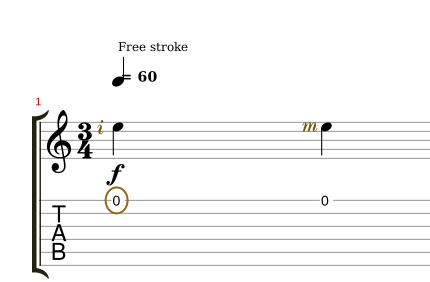
1 The free stroke
Play free strokes on string 1 in the first bar, leaving the adjacent string untouched.
3 min · 44 bpm · 1 note per click


Check for · 2 bars at 48 BPM — Three free strokes produce three distinct starts.
More detail
The right finger leaves the string without resting on the next. Compare i, m and a at the same spot.
2 Two fingers
Alternate i and m with rest strokes on open string 2.
3 min · 44 bpm · 1 note per click


Check for · 2 bars at 48 BPM — Both fingers come to rest on string 3 in turn.
More detail
The finger that just played leaves room for the next one.
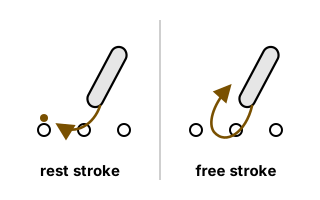
3 Compare the strokes
Compare free and rest strokes on the same open string.
3 min · 44 bpm · 1 note per click
Revisit the tablature · Step 1
Check for · 2 bars at 52 BPM — You can show the difference by freezing just after each stroke.
More detail
Using the same string and finger lets you compare just the movement.
4 Compare i, m and a
Compare i, m and a on string 1, first with free strokes and then with rest strokes.
3 min · 48 bpm · 1 note per click
Revisit the tablature · Step 1
Check for · 4 bars at 52 BPM — on both passes, i, m and a clear string 2 in the free stroke and land on it in the rest stroke.
More detail
Use the same contact point for every finger. In the rest stroke, let each finger come to rest on string 2.
You can move on when…
You pass when you alternate one bar of free strokes with one bar of rest strokes twice at 52 BPM, with three clear attacks per bar.
If a movement feels difficult
You repeat the same finger.
Return to slow i-m alternation and check every stroke before speeding up.
Each finger has a different tone colour.
Compare i, m and a on the same string, at the same place.