Week 2 · 12 min
Two colours on one note
By the end, you can move from sound hole to bridge while keeping the pitch unchanged.
Before this lesson
Lesson steps
1 The free stroke
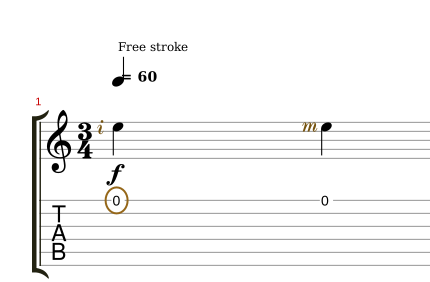
Play free strokes on string 1 in the first bar, leaving the adjacent string untouched.
3 min · 44 bpm · 1 note per click


Check for · 2 bars at 52 BPM — Three free strokes produce three distinct starts.
More detail
The right finger leaves the string without resting on the next. Compare i, m and a at the same spot.
2 Near the sound hole
Play the first bar near the sound hole with i and m.
3 min · 44 bpm · 1 note per click


Check for · 2 bars at 52 BPM — All four notes have a similar colour across both fingers.
More detail
Keep the string and tempo unchanged when comparing this sound with the sound near the bridge.
3 Explore tone colours
Play the same note near the sound hole and then near the bridge, keeping the same attack angle.
3 min · 44 bpm · 1 note per click
Revisit the tablature · Step 2
Check for · 2 bars at 52 BPM — You can deliberately produce a round tone, then a brighter one.
More detail
Near the fingerboard: tasto; near the bridge: ponticello. Distinguish an intentional change from an unintended difference between fingers.
4 Explore tone colours
Repeat the sound hole to bridge sequence twice at the same volume.
3 min · 48 bpm · 1 note per click
Revisit the tablature · Step 2
Check for · 4 bars at 56 BPM — You can deliberately produce a round tone, then a brighter one.
More detail
Near the fingerboard: tasto; near the bridge: ponticello. Distinguish an intentional change from an unintended difference between fingers.
You can move on when…
You pass when, over 4 bars at 56 BPM, you can deliberately produce a round tone, then a brighter one.
If a movement feels difficult
Your nail catches the string.
Check the nail edge and gradually adjust the angle that catches the string.
Each finger has a different tone colour.
Compare i, m and a on the same string, at the same place.