Week 2 · 12 min
Bring out one voice
By the end, you can bring out a bass note and an upper note in turn.
Before this lesson
Lesson steps
1 Compare i, m and a
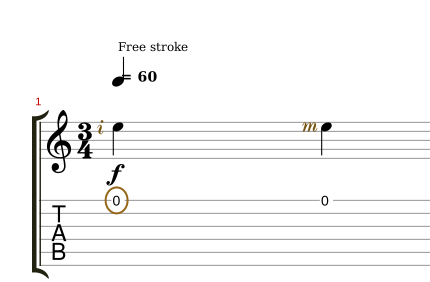
Compare i, m and a on string 1, first with free strokes and then with rest strokes.
3 min · 44 bpm · 1 note per click


Check for · 2 bars at 52 BPM — With your eyes closed, you cannot identify the finger by its tone colour.
More detail
Use the same contact point for every finger. In the rest stroke, let each finger come to rest on string 2.
2 Bring out one voice
Bring out the bass played by the thumb in the p-i-m-a-m-i arpeggio.
3 min · 44 bpm · 1 note per click

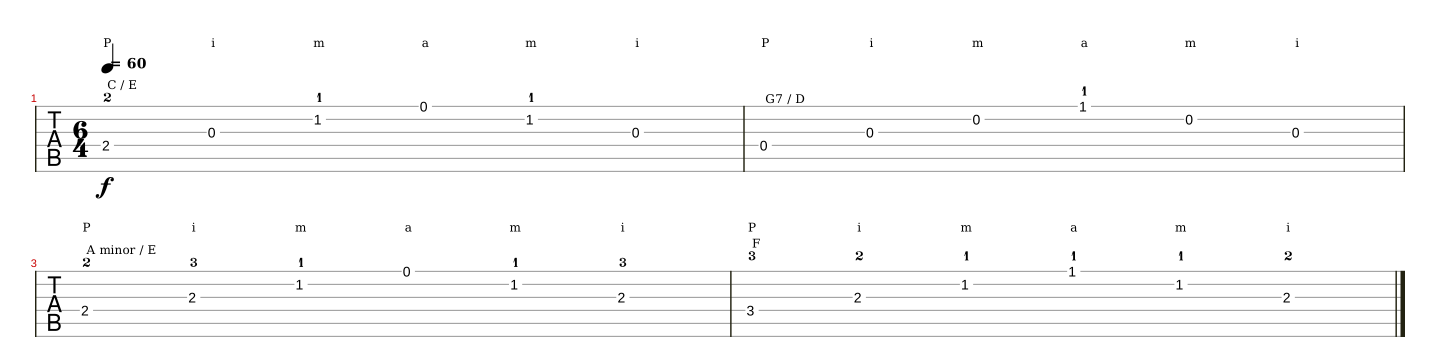
Check for · 2 bars at 52 BPM — the bass stands out above the five remaining notes of each arpeggio.
More detail
Listen first to the bass alone, then to all six notes in sequence. Keep the quieter upper notes distinct.
3 The ring-finger voice
Bring out the upper note played by the ring finger without speeding up the arpeggio.
3 min · 44 bpm · 1 note per click

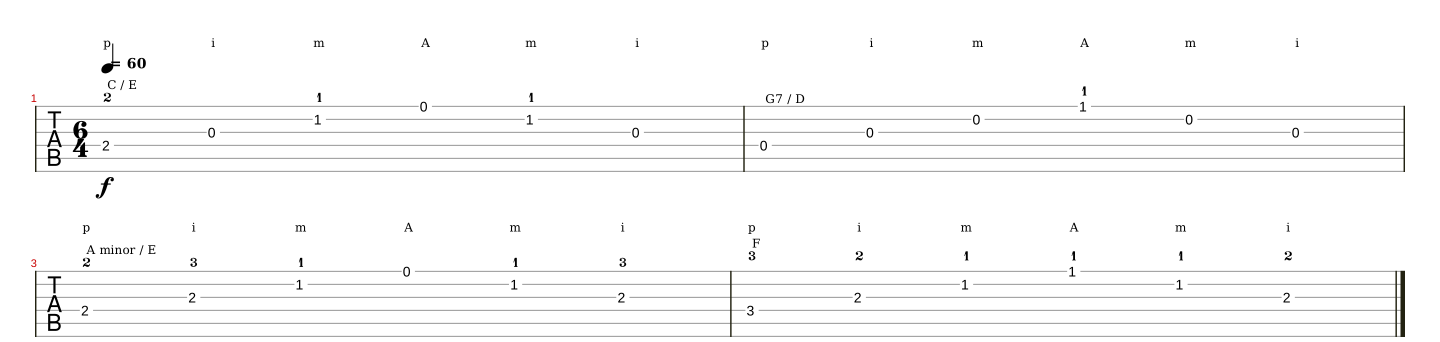
Check for · 2 bars at 52 BPM — The upper note stands out each time a plays.
More detail
Compare the ring-finger note with the notes before and after it. Keep the thumb in the background.
4 The ring-finger voice
Bring out the upper note played by the ring finger without speeding up the arpeggio.
3 min · 48 bpm · 1 note per click
Revisit the tablature · Step 3
Check for · 4 bars at 56 BPM — The upper note stands out each time a plays.
More detail
Compare the ring-finger note with the notes before and after it. Keep the thumb in the background.
You can move on when…
You pass when, over 4 bars at 56 BPM, the upper note stands out each time a plays.
If a movement feels difficult
Your nail catches the string.
Check the nail edge and gradually adjust the angle that catches the string.
Each finger has a different tone colour.
Compare i, m and a on the same string, at the same place.