Adelita asks you to keep a graceful melodic line through pull-offs, short ornaments and changes of position. Its sixteen written bars may look manageable, but the transitions deserve patient work. Aim for a connected melody before trying to make the decorations sound effortless.
Begin with the opening pairs of notes on the first string. Pluck the first note and let the left hand produce the second. Compare the two sounds: the second note should remain clear without becoming a sudden accent. Then add the accompaniment underneath the following sustained note.
Barres become easier to organise when you know exactly which strings must ring. Test those strings separately before placing the full shape, and release unnecessary pressure between attempts. When moving into the upper positions, prepare the destination without cutting off the note that comes before it.
The melody later moves into the middle register. Follow that change with your ear rather than assuming the highest note always carries the tune. Finish a session by playing one section without interruption, keeping the accompaniment lighter. Once both sections are secure, follow the complete route: A twice, B twice and A once, with the final rest given its full place.
A mazurka in two eight-bar sections. Its slurs, ornaments and barres involve more shifts than Lágrima. Play A twice, B twice, then A once. The app’s 56 quarter notes per minute is a practice reference for Lento.
Skills to prepare
- Pull-offs
- Short ornaments
- Slides
- Partial barres
- Sustained melody
- Melody in the middle register
Before learning the piece
- App checkpoint: play 12–11 followed by 10–8 on string 1 five times, plucking only once for each pair. Practise this skill (French).
- App checkpoint: sound the required strings at frets 7 and 9 three times, releasing pressure between attempts. Practise this skill (French).
- App checkpoint: play Lágrima’s opening two bars three times with the melody louder than its accompaniment. Practise this skill (French).
- App checkpoint: shift from fret 7 to 12 five times without losing string 1 or gripping the neck. Practise this skill (French).
These checkpoints belong to our learning path. They do not set a deadline for your progress.
Tablature and fingerings
The six lines represent the strings, with high E at the top. Numbers show frets; 0 means an open string. The letters p, i, m and a indicate right-hand fingers.

Read the complete static tab · Download the alphaTex file
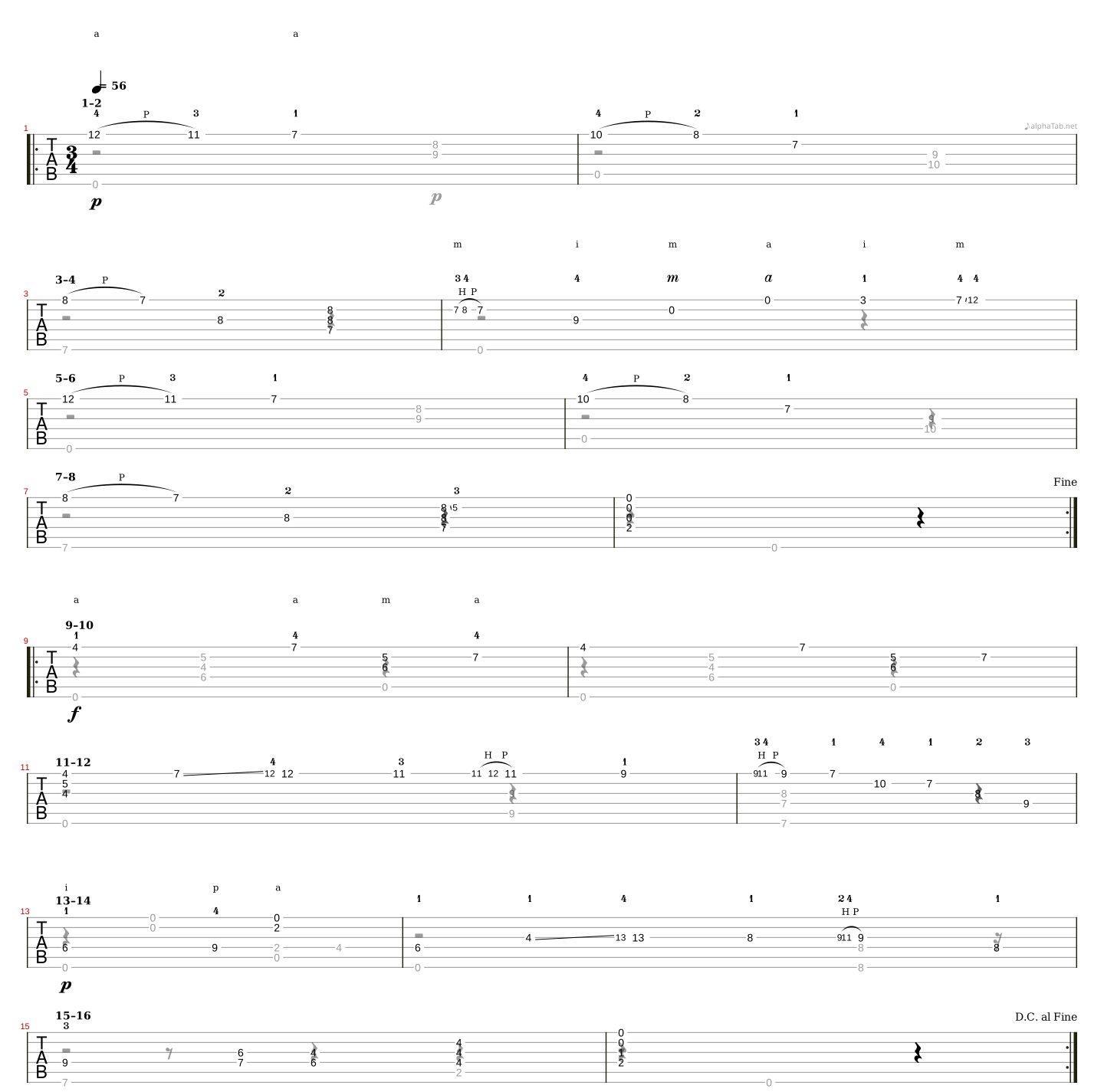
The player and its sounds load when you choose to use them.
Your phrase-by-phrase plan
Work on a short passage. Aim for five clean attempts in a row, then connect two phrases. Bar numbers follow our transcription, including a separately numbered pickup where applicable.
Phrase 1 · bars 1–2
Bars 1–2. Pluck once for 12–11 and once for 10–8. Hold the following note as the accompaniment enters, keeping the melody in front.
Phrase 2 · bars 3–4
Prepare the barre at 7 before bar 3. In bar 4, isolate the 7–8–7 ornament, then the final slide to 12.
Phrase 3 · bars 5–6
Bars 5–6. Repeat the movements from bars 1–2 without accelerating. Keep the melody even as the inner notes enter.
Phrase 4 · bars 7–8
Bars 7–8. The slide in bar 7 leads towards the section ending. Hold bar 8’s chord for two beats, then observe the rest.
Phrase 5 · bars 9–10
In bar 9, hold fret 4 on string 1 through the inner chord. The bass then moves to open string 5. Repeat in bar 10.
Phrase 6 · bars 11–12
Bars 11–12. Isolate the shift from 7 to 12. Prepare a barre at 9 for the end of bar 11, then at 7 for bar 12. Add ornaments after the main notes feel secure.
Phrase 7 · bars 13–14
Bars 13–14. The melody begins on string 4: bring it out. In bar 14, slow down the slide to fret 13 on string 3 and keep the chord at 8 relaxed.
Phrase 8 · bars 15–16
Bars 15–16. Hear the long–short rhythm on bar 15’s first beat. Prepare each chord before playing. After bar 16, return to bars 1–8 once and finish at the rest.
Watch and listen
Choose the recording that matches your current goal. Videos load only when you select them and require an internet connection.
Lesson · This is Classical Guitar
Review slurs between fretted notes before adding the ornaments.
English commentary. Link and metadata checked for our selection.
Lesson · This is Classical Guitar
Before the passages at frets 7 and 9, if one of the strings is muted.
English commentary. Link and metadata checked for our selection.
Sources and transcription choices
The notes follow the credited sources. Fingerings, phrase divisions and practice tempos are editorial learning choices. How our transcriptions work.