Oremus fits a complete musical thought into a short span. Its melody travels over a steady accompaniment, and the movement between positions can easily interrupt the line. Use the compact length to listen closely, rather than treating the piece as something to finish quickly.
Begin by lowering the sixth string to D. Play the bass and accompaniment slowly enough to hear whether the attacks remain even when you change strings. Then bring out the melody without turning every upper note into a separate accent. The sound should move towards a phrase, not just through a succession of shapes.
Prepare the upper positions in pairs of notes. Know where each finger is going before adding the rhythm, and practise the move into the shape as well as the shape itself. When descending towards first position, keep the bass quieter so that the tune remains easy to follow.
The two endings require a clear plan. Read the first ending and the return before attempting a complete performance; then practise the second ending on its own. At the final cadence, allow the lower notes to settle towards the open sixth string. Give the last rest the same attention as the final attack.
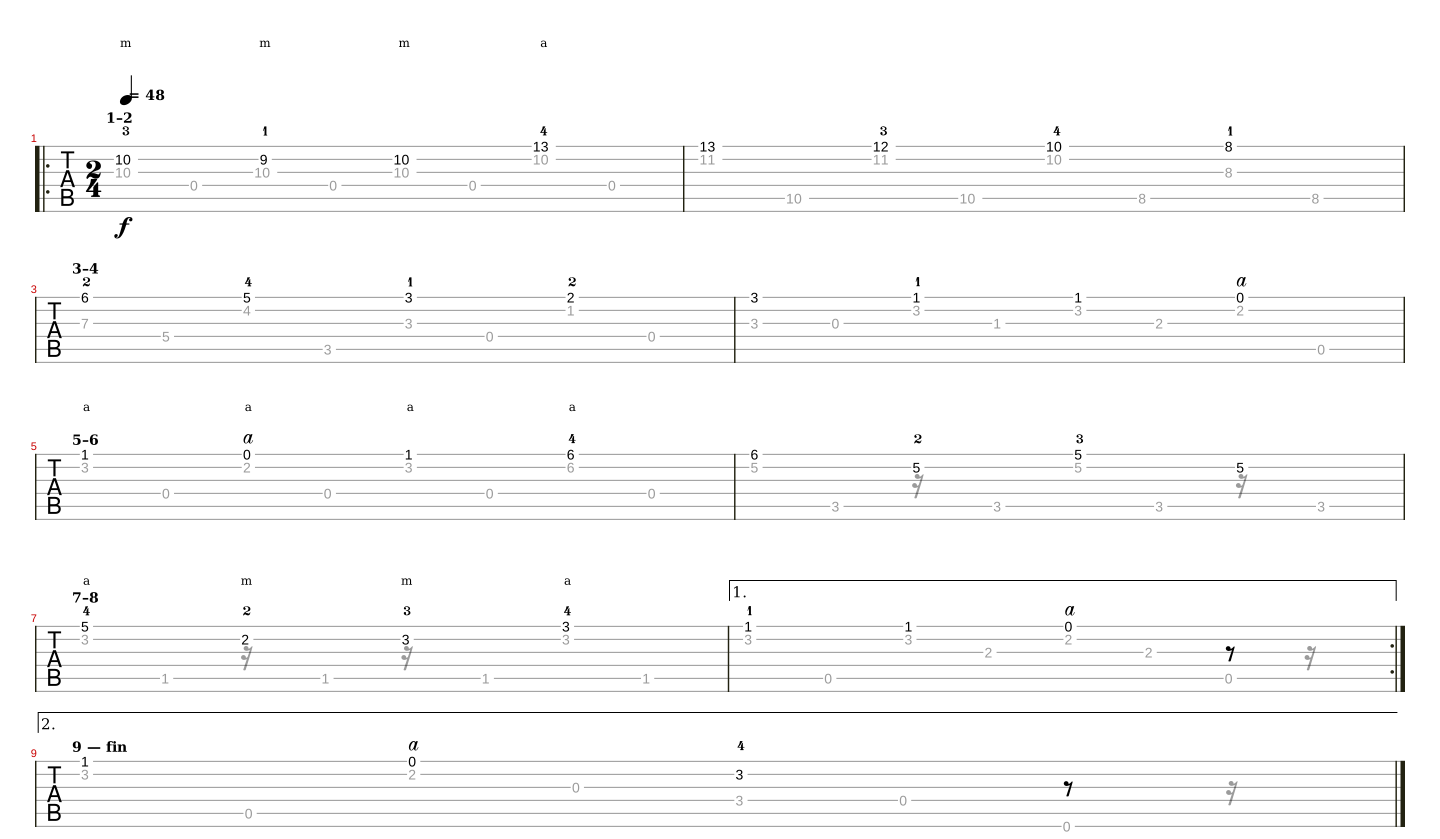
Nine written bars with two alternative endings. The melody moves above an even accompaniment. Shifts into the upper positions need careful preparation. The app uses 48 bpm as a practice reference.
Skills to prepare
- Drop D tuning
- Melody and accompaniment
- Chord preparation
- Position shifts
- Barres
Before learning the piece
- App checkpoint: play four short notes per click for 20 seconds without rushing the string changes. Practise this skill (French).
- App checkpoint: prepare the positions at frets 3, 5, 8 and 10 three times, sounding only the required strings. Practise this skill (French).
- App checkpoint: keep the melody louder than the lower notes over two bars for five consecutive attempts. Practise this skill (French).
These checkpoints belong to our learning path. They do not set a deadline for your progress.
Tablature and fingerings
The six lines represent the strings, with high E at the top. Numbers show frets; 0 means an open string. The letters p, i, m and a indicate right-hand fingers.

Read the complete static tab · Download the alphaTex file
The player and its sounds load when you choose to use them.
Your phrase-by-phrase plan
Work on a short passage. Aim for five clean attempts in a row, then connect two phrases. Bar numbers follow our transcription, including a separately numbered pickup where applicable.
Phrase 1 · bars 1–2
Tune string 6 down to D. In bar 1, keep the open bass even beneath the upper notes. In bar 2, prepare the move from frets 10–13 to 8–10.
Phrase 2 · bars 3–4
Bars 3–4. Descend gradually to first position. Prepare each pair of notes before playing, with the bass softer than the melody.
Phrase 3 · bars 5–6
In bar 5, locate the jump to the two notes at fret 6. In bar 6, the melody returns to string 2, fret 5: pluck once when the tab shows a single note.
Phrase 4 · bars 7–8
Bars 7–8. In bar 7, keep the bass at fret 1 on string 5 even. First time, play bar 8 and return to bar 1. Observe the melody’s rest at the end of bar 8.
Phrase 5 · bar 9
Practise the final bar alone. Second time, skip bar 8 and play bar 9. Let the lower notes descend to open string 6, then observe the final rest.
Watch and listen
Choose the recording that matches your current goal. Videos load only when you select them and require an internet connection.
Performance · SiccasGuitars
Listen to the complete Oremus and compare the melody with the bass. Instrumental performance.
English commentary. Link and metadata checked for our selection.
Lesson · This is Classical Guitar
Before combining the melody and accompaniment.
English commentary. Link and metadata checked for our selection.
Sources and transcription choices
- Tárrega — Endecha y Oremus, Alier 5520, p. 2; Gaylord Music Library, public domain
- Matteo Staffini’s Oremus performance, presented by Bradford Werner
The notes follow the credited sources. Fingerings, phrase divisions and practice tempos are editorial learning choices. How our transcriptions work.