Tárrega’s Prelude No. 2 in A minor asks you to hear several layers at once. The melody, delayed chords and sustained bass notes do not always change together. Your first task is to discover what continues ringing while another part of the hand moves.
Start by playing the melody alone through a short phrase. Notice where its notes cross the barline or remain in place during an accompaniment change. Add the lower notes softly, then listen for any sustain that disappears. A correct new chord can still interrupt the music if you release the previous voice too soon.
Work on each barre with only the strings it needs. Keep open strings clear and release pressure when a shape no longer has to be held. For the slides and ornaments, identify the main destination note before adding the decorative movement. This helps the phrase keep its direction at a slow tempo.
The alternative endings also need rehearsal. Trace the first route through the score, then the second, before combining them in a complete performance. Finish a practice session with one uninterrupted phrase, keeping the melody above the chords. Let the quality of that balance guide the next tempo change.
A prelude with 27 written bars. Melody, off-beat chords and bass overlap, and two alternative endings shape the repeat route. The app uses 60 bpm for practice; the engraving gives no metronome number.
Skills to prepare
- Successive barres
- Sustained bass notes
- Melody over off-beat chords
- Slides
- Short ornaments
- Position shifts
Before learning the piece
- App checkpoint: sound the required strings at frets 2, 5, 6 and 8 three times each. Release between attempts. Practise this skill (French).
- App checkpoint: sustain a melody note for three clicks above three quieter chords without cutting it off. Practise this skill (French).
- App checkpoint: prepare the fingers before each chord and play for 30 seconds without hitting the wrong string. Practise this skill (French).
- App checkpoint: play 13–11 on string 1 five times with one pluck, keeping the hand relaxed. Practise this skill (French).
These checkpoints belong to our learning path. They do not set a deadline for your progress.
Tablature and fingerings
The six lines represent the strings, with high E at the top. Numbers show frets; 0 means an open string. The letters p, i, m and a indicate right-hand fingers.

Read the complete static tab · Download the alphaTex file
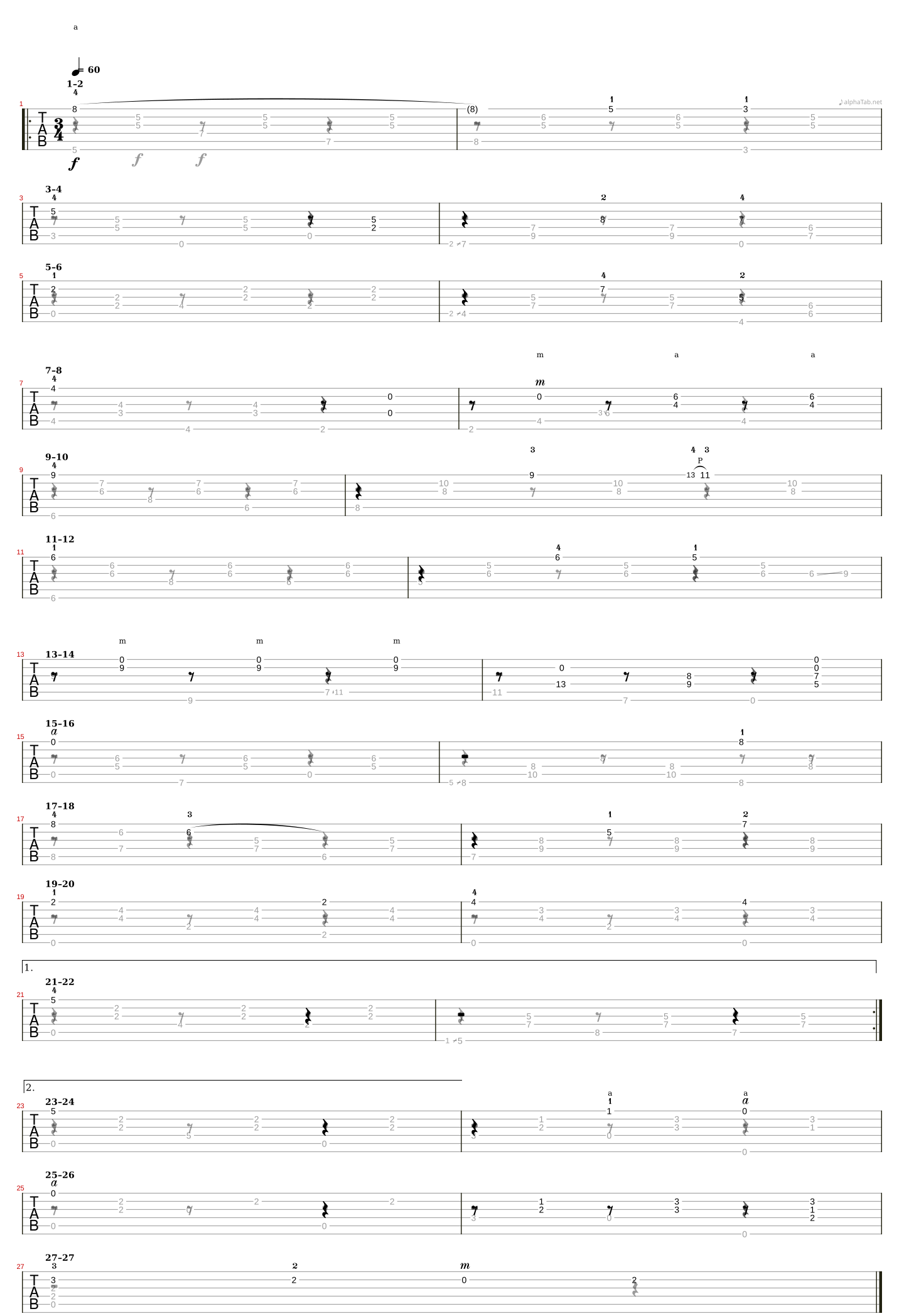
The player and its sounds load when you choose to use them.
Your phrase-by-phrase plan
Work on a short passage. Aim for five clean attempts in a row, then connect two phrases. Bar numbers follow our transcription, including a separately numbered pickup where applicable.
Phrase 1 · bars 1–2
Bars 1–2. Hold the C at fret 8 on string 1 until bar 2’s first beat. Do not pluck it again at the barline. Keep the accompaniment light.
Phrase 2 · bars 3–4
Bars 3–4. Separate bar 3’s three bass notes. In bar 4, prepare the 2–7 slide on string 6 before placing the chord.
Phrase 3 · bars 5–6
Bars 5–6. Set the small barre at 2 without blocking the open strings. In bar 6, prepare the move to fret 7 on string 2. Soften the bass.
Phrase 4 · bars 7–8
Bars 7–8. Let the open strings ring at the end of bar 7. In bar 8, practise the 3–6 slide on string 4 without rushing the chords.
Phrase 5 · bars 9–10
Bars 9–10. Keep the melody louder than the chords under the barre at 6. In bar 10, isolate the 13–11 ornament before combining the voices.
Phrase 6 · bars 11–12
Bars 11–12. Listen to the sustained first string. The quick group at the end of bar 12 is on string 3: isolate it, then place it after the rest.
Phrase 7 · bars 13–14
Bars 13–14. The melody moves to string 2 alongside open string 1. Prepare fret 11 on string 5, followed by fret 13 on string 4.
Phrase 8 · bars 15–16
Let the open high E ring in bar 15. In bar 16, isolate the 5–8 bass slide, then move to the barre at 8.
Phrase 9 · bars 17–18
Bars 17–18. Hold string 2 at fret 6 through bar 17’s last two beats. In bar 18, prepare the chord before bringing out string 1.
Phrase 10 · bars 19–20
Bars 19–20. Compare the bars slowly. The accompaniment changes from fret 4 to 3 on string 2: do not automatically keep the same chord.
Phrase 11 · bars 21–22
Play bars 21–22 only on the first pass, then return to bar 1. Isolate the 1–5 bass slide before joining the passage.
Phrase 12 · bars 23–24
Bars 23–24. On the second pass, skip 21–22 and play 23–24. Release string 1 at the end of bar 24 so its open note can ring.
Phrase 13 · bars 25–26
Keep the open-string melody soft and steady in bar 25. In bar 26, prepare each chord during the rest before it.
Phrase 14 · bar 27
Bar 27. Practise the final bar alone. Hold the low chord while playing 3–2–0–2 on string 2. Let the final note ring before releasing.
Watch and listen
Choose the recording that matches your current goal. Videos load only when you select them and require an internet connection.
Lesson · This is Classical Guitar
Before combining the melody with the chords.
English commentary. Link and metadata checked for our selection.
Lesson · This is Classical Guitar
Before the barre passages, if a string sounds unclear.
English commentary. Link and metadata checked for our selection.
Sources and transcription choices
The notes follow the credited sources. Fingerings, phrase divisions and practice tempos are editorial learning choices. How our transcriptions work.