Marieta changes character when its melody moves from the upper strings into the bass. That change is a useful listening test: can you keep following the tune when it is no longer the highest sound? Work on each register separately before joining the phrases.
Begin with the pickup and the note it leads into. The slide should prepare the arrival, while the sustained upper note keeps its full length. Add the inner voices gently enough that the melodic line still sounds like the version you played alone.
Short slurred groups need clear destinations. Practise a group slowly with the specified single attack, then place it back into the beat. The aim is not to make every ornamental note equally prominent. Listen for a light movement that belongs to the surrounding phrase.
The natural harmonics require a different contact from ordinary fretted notes. Touch lightly above the indicated fret, pluck and release the touching finger. Practise that sound alone before combining it with the bass. In the later triplet passages, count three notes per beat and distinguish them from the notes that stay held. Learn the final return route before increasing the tempo, so the form remains as clear as the fingering.
A mazurka whose melody moves from the upper register into the bass. Slides, quick ornaments and two harmonics need preparation. The pickup is numbered as bar 1. The app’s steady 60 bpm is a practice reference; the engraving asks for a livelier second section.
Skills to prepare
- Melody and accompaniment
- Slurs
- Slides
- Barres
- Natural harmonics
- Triplets
- Position shifts
Before learning the piece
- App checkpoint: play 4–5–6–5 on string 2 with one right-hand attack, five times clearly. Practise this skill (French).
- App checkpoint: prepare small barres at 4, 5 and 7, sounding only the required strings three times each. Practise this skill (French).
- App checkpoint: make the melody louder than the chords in bar 2 and bar 10, five times each. Practise this skill (French).
- App checkpoint: play three notes per click across two strings for 20 seconds without accelerating. Practise this skill (French).
These checkpoints belong to our learning path. They do not set a deadline for your progress.
Tablature and fingerings
The six lines represent the strings, with high E at the top. Numbers show frets; 0 means an open string. The letters p, i, m and a indicate right-hand fingers.

Read the complete static tab · Download the alphaTex file
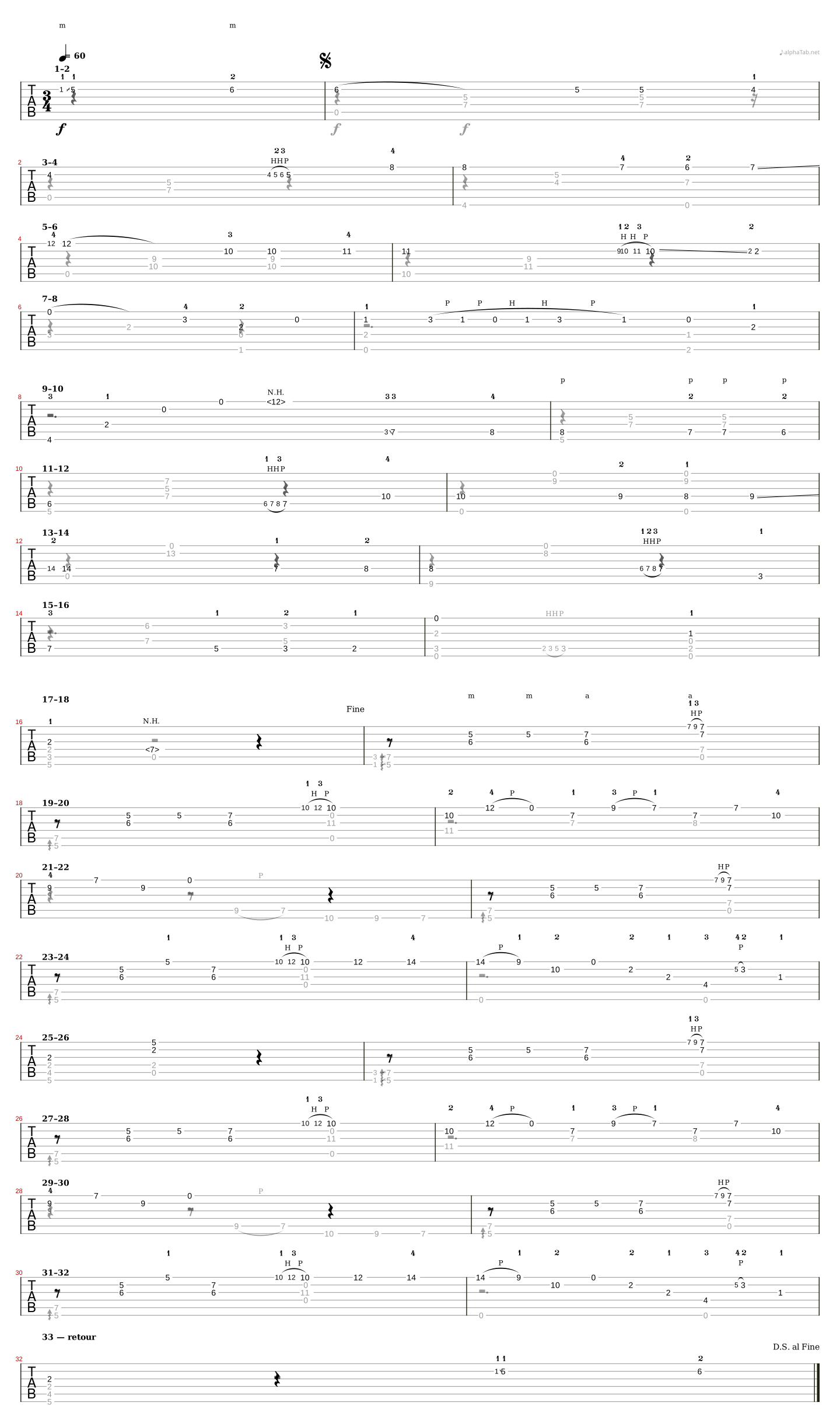
The player and its sounds load when you choose to use them.
Your phrase-by-phrase plan
Work on a short passage. Aim for five clean attempts in a row, then connect two phrases. Bar numbers follow our transcription, including a separately numbered pickup where applicable.
Phrase 1 · bars 1–2
Bar 1 is a one-beat pickup. Slide 1–5 on string 2. In bar 2, let the first high note continue without replucking it.
Phrase 2 · bars 3–4
In bar 3, practise 4–5–6–5 on string 2. In bar 4, prepare the barre at 4, then the shift to fret 12 on string 1.
Phrase 3 · bars 5–6
In bar 5, keep the inner notes softer than the melody. Isolate bar 6’s downward slide from fret 10 to 2 on string 2.
Phrase 4 · bars 7–8
Let open string 1 ring in bar 7. Isolate 3–1–0–1 on string 2 in bar 8, keeping the thumb notes even.
Phrase 5 · bars 9–10
In bar 9, lightly touch string 1 above fret 12 for the harmonic, then lift the finger. In bar 10, bring out the melody on string 5 above softer chords.
Phrase 6 · bars 11–12
Practise 6–7–8–7 on string 5 in bar 11. Hold open string 1 above bar 12’s lower notes. The final short slide leads to fret 14 on string 4.
Phrase 7 · bars 13–14
Prepare string 4 at fret 14 and string 2 at fret 13 in bar 13. In bar 14, isolate 6–7–8–7 on string 4 before adding the other voices.
Phrase 8 · bars 15–16
Listen to the descending fifth string in bar 15. In bar 16, play 2–3–5–3 on that string without covering open string 1.
Phrase 9 · bars 17–18
In bar 17, touch string 4 above fret 7 for the harmonic alongside open string 5, then observe the rest. Stop here after returning from bar 33; on the first pass, continue into the second section at 18.
Phrase 10 · bars 19–20
Prepare 10–12–10 on string 1 in bar 19. Count three notes per beat in bar 20, distinguishing sustained notes from the quick moving notes.
Phrase 11 · bars 21–22
Let the open-string melody finish above the descending bass in bar 21. In bar 22, return to bar 18’s motif with the same balance.
Phrase 12 · bars 23–24
Prepare the ascent to fret 14 on string 1 in bar 23. In bar 24, work in groups of three; keep the small 5–3 figure on string 2 light.
Phrase 13 · bars 25–26
Leave space on bar 25’s last beat. In bar 26, prepare the slide on the two lower strings before the small upper chords.
Phrase 14 · bars 27–28
Keep bar 27’s upper ornament light. In bar 28, return to the three groups of three notes from bar 20.
Phrase 15 · bars 29–30
Keep the descending bass even in bar 29. In bar 30, return to the short motif without rushing its two opening grace notes.
Phrase 16 · bars 31–32
Prepare the ascent to fret 14 again in bar 31. Play bar 32’s descent alone, then add the open bass strings. Keep three notes per beat.
Phrase 17 · bar 33
Bar 33. Final bar: play the chord, observe the rest, then find the pickup. Return to the sign at bar 2 and finish after bar 17.
Watch and listen
Choose the recording that matches your current goal. Videos load only when you select them and require an internet connection.
Performance · Guitar Salon International
Listen to the whole mazurka and compare the upper melody with its later appearance in the bass. Instrumental performance.
English commentary. Link and metadata checked for our selection.
Lesson · This is Classical Guitar
Before the harmonics in bars 9 and 17.
English commentary. Link and metadata checked for our selection.
Sources and transcription choices
- Tárrega — Marieta, Alier 2095, scan pp. 2–3; Gaylord Music Library, public domain
- Tárrega — Marieta, Antich y Tena 393; Boije 829, pp. 8–9, comparison engraving
- Classical Guitar Corner — Tárrega’s harmonic notation, slides and return sign
- Bradford Werner — playing natural harmonics
- Bradford Werner — balance and tone quality
The notes follow the credited sources. Fingerings, phrase divisions and practice tempos are editorial learning choices. How our transcriptions work.