Endecha uses drop D tuning to give the bass a deeper foundation. Lower the sixth string before studying the fingerings, then listen to how the open bass supports the moving melody. The goal is to preserve that resonance without letting it cover the upper line.
Our tablature includes the short opening pickup in its bar numbering. Read the phrase notes alongside the score so that a reference to a bar or an alternative ending leads you to the right place. The route through the music matters as much as the finger pattern within a single measure.
Work on the melody alone when it changes strings. Its sound should remain recognisable as your hand moves between positions. Add the bass only when the line is clear, and check that each barre leaves the required notes free to ring. A small adjustment near the fret can help more than simply squeezing harder.
Several ornaments and pull-offs need a single clean movement. Isolate the pair of notes, then restore the notes on either side. Finish by joining two short phrases at a slow tempo. Listen for the connection across the join and for the silence after the final chord.
A short prelude in drop D tuning. The melody changes strings and moves through several positions. Our 16 numbered bars include the short opening pickup. The app uses 56 bpm as a practice reference.
Skills to prepare
- Drop D tuning
- Position shifts
- Barres
- Pull-offs
- Independent melody and bass
Before learning the piece
- App checkpoint: sound the required strings with barres at frets 3, 5 and 7 three times. Release between attempts. Practise this skill (French).
- App checkpoint: play 12–10 and 13–12 on string 1 five times, plucking once per pair. Practise this skill (French).
- App checkpoint: sustain the open low D under four clearer upper notes for three consecutive attempts. Practise this skill (French).
These checkpoints belong to our learning path. They do not set a deadline for your progress.
Tablature and fingerings
The six lines represent the strings, with high E at the top. Numbers show frets; 0 means an open string. The letters p, i, m and a indicate right-hand fingers.

Read the complete static tab · Download the alphaTex file
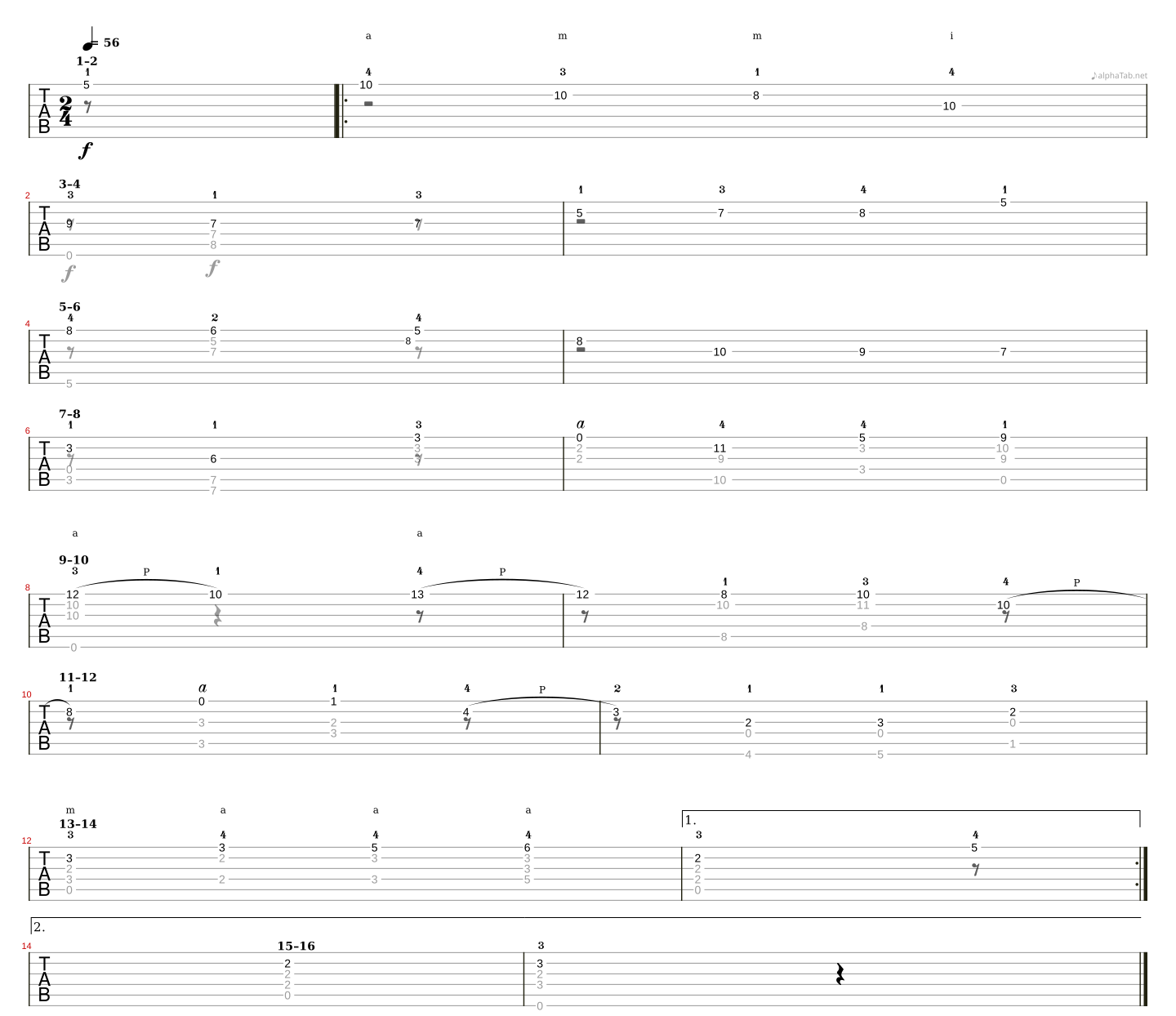
The player and its sounds load when you choose to use them.
Your phrase-by-phrase plan
Work on a short passage. Aim for five clean attempts in a row, then connect two phrases. Bar numbers follow our transcription, including a separately numbered pickup where applicable.
Phrase 1 · bars 1–2
Tune string 6 down to D. Bar 1 contains only the pickup note. In bar 2, follow the melody from string 1 to strings 2 and 3.
Phrase 2 · bars 3–4
Bars 3–4. Let bar 3’s low D ring beneath the melody. Prepare small barres at 7 and then 5. In bar 4, bring the melody out of the chords.
Phrase 3 · bars 5–6
Bars 5–6. In bar 5, release string 2 just before the grace note at fret 8: fret 5 cannot keep ringing on that same string. Isolate the ornament, then add the bass.
Phrase 4 · bars 7–8
In bar 7, prepare each shape separately. In bar 8, locate the shifts towards frets 9 and 3 before joining all four chords.
Phrase 5 · bars 9–10
Bars 9–10. In bar 9, pull off from 12 to 10 on string 1. Begin bar 10 with 13–12. Keep your fingers close to the strings during shifts.
Phrase 6 · bars 11–12
Bars 11–12. Connect fret 4 on string 2 at the end of bar 11 to fret 3 at the start of bar 12 with a pull-off. Follow bar 12’s bass through frets 4 and 5 on string 6.
Phrase 7 · bars 13–14
Bars 13–14. Prepare barres at 2 and then 3. First time through, play bar 14 and return to bar 2: bar 14’s last eighth note replaces the opening pickup.
Phrase 8 · bars 15–16
Bars 15–16. Second time through, skip bar 14 and play 15–16. Hold bar 15’s chord for both beats. In bar 16, observe the rest after the final chord.
Watch and listen
Choose the recording that matches your current goal. Videos load only when you select them and require an internet connection.
Performance · Dave Belcher
Listen to the whole of Endecha. Instrumental performance.
English commentary. Link and metadata checked for our selection.
Lesson · SiccasGuitars
Before the short pull-offs in bars 9–12.
English commentary. Link and metadata checked for our selection.
Lesson · This is Classical Guitar
Before practising the changes between barres.
English commentary. Link and metadata checked for our selection.
Sources and transcription choices
The notes follow the credited sources. Fingerings, phrase divisions and practice tempos are editorial learning choices. How our transcriptions work.