Lágrima is a small piece with a demanding musical task: make one line sing while the other notes stay in the background. The tablature helps you find the frets, but a convincing performance depends just as much on how long you hold each note and how softly you play the accompaniment.
Start with the opening two bars. Play the melody by itself, then add the inner notes without changing its shape. Listen to the end of the sustained note as carefully as its attack. Preparing the next chord too early can shorten a phrase even when every new note is correct.
The upper-position passage needs a different kind of attention. Practise the last note before the shift and the first note after it. Once that connection is secure, put the surrounding notes back. Use the same approach for the small barre and the pull-offs: solve the movement, then check it inside the phrase.
Before playing the whole piece, learn the repeat route. Our transcription has two eight-bar sections: A twice, B twice, then A once. Keep that plan clear at a comfortable tempo, with the melody still leading the sound.
Two eight-bar sections, with the melody above quieter inner notes. The app uses 60 bpm as a practice reference; the engraving says Andante. Play A twice, B twice, then A once.
Skills to prepare
- Melody and accompaniment
- Position shifts
- Small barres
- Pull-offs
- Grace-note slide
Before learning the piece
- App checkpoint: keep a first-string melody louder than a soft accompaniment for three two-bar attempts. Practise this skill (French).
- App checkpoint: play a slow arpeggio for 30 seconds without cutting off sustained notes. Practise this skill (French).
- App checkpoint: play five pull-offs from fret 8 to 7 on string 1 without plucking the second note. Practise this skill (French).
- App checkpoint: sound each string needed for the small barre at fret 2, then release without holding tension. Practise this skill (French).
These checkpoints belong to our learning path. They do not set a deadline for your progress.
Tablature and fingerings
The six lines represent the strings, with high E at the top. Numbers show frets; 0 means an open string. The letters p, i, m and a indicate right-hand fingers.

Read the complete static tab · Download the alphaTex file
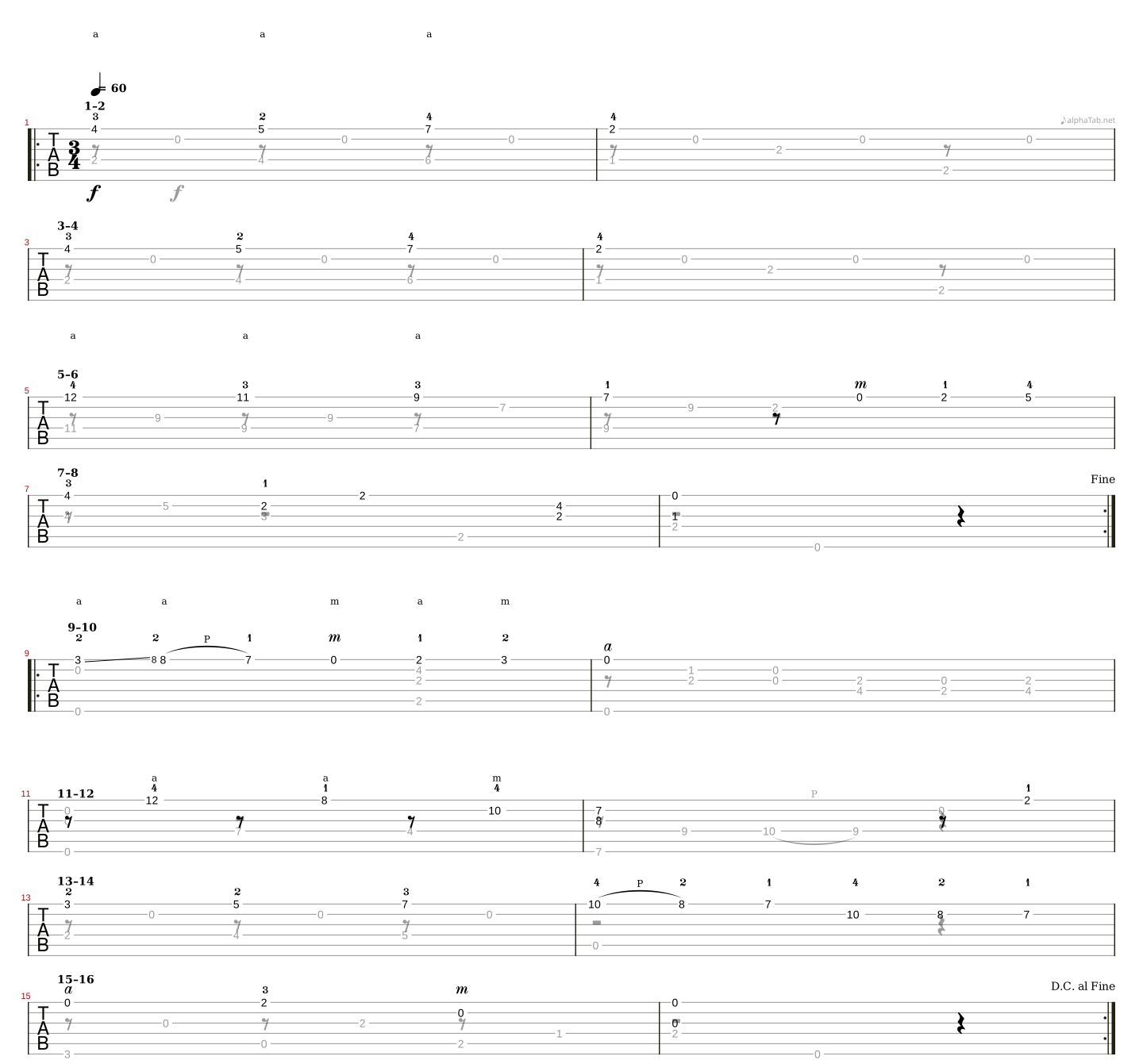
The player and its sounds load when you choose to use them.
Your phrase-by-phrase plan
Work on a short passage. Aim for five clean attempts in a row, then connect two phrases. Bar numbers follow our transcription, including a separately numbered pickup where applicable.
Phrase 1 · bars 1–2
Bars 1–2. Bring out string 1 and soften the open B notes. Hold the F sharp in bar 2 for all three beats.
Phrase 2 · bars 3–4
Bars 3–4. Repeat the same movement. Prepare the shift to fret 12 after bar 4 without shortening the sustained note.
Phrase 3 · bars 5–6
Bars 5–6. Start at fret 12, then descend through 11 and 9. Isolate bar 6: the bass and melody do not move together.
Phrase 4 · bars 7–8
Bars 7–8. Listen to the bass rising by a semitone. Set the small barre at fret 2 without muting the melody; release at the final rest.
Phrase 5 · bars 9–10
Bars 9–10. Slide from fret 3 to 8 on string 1. The grace note precedes the counted note. Pull off from 8 to 7, then bring out the sustained E in bar 10.
Phrase 6 · bars 11–12
Bars 11–12. Let the open strings ring at the start of bar 11, then move up the neck. In bar 12, keep the barre at 7 through the 10–9 pull-off on string 4.
Phrase 7 · bars 13–14
Bars 13–14. Move the melody through frets 3, 5 and 7. In bar 14, pull off from 10 to 8 and continue down without speeding up.
Phrase 8 · bars 15–16
Bars 15–16. Separate bass and melody, then finish both voices together. At the return sign, play bars 1–8 and stop at Fine.
Watch and listen
Choose the recording that matches your current goal. Videos load only when you select them and require an internet connection.
Lesson · This is Classical Guitar
Before bars 1–4, if the melody disappears into the accompaniment.
English commentary. Link and metadata checked for our selection.
Lesson · SiccasGuitars
Before the pull-offs in bars 9 and 14.
English commentary. Link and metadata checked for our selection.
Sources and transcription choices
The notes follow the credited sources. Fingerings, phrase divisions and practice tempos are editorial learning choices. How our transcriptions work.