Capricho Árabe needs both a clear pulse and room for a singing line. Its introduction and later melodic sections place different demands on the hands, so learn them as separate tasks before trying to shape the whole work. Begin by lowering the sixth string to D.
In the introduction, find a reliable sound for the harmonics and count the three-beat bars. Practise the descending slurred pairs slowly, preparing each position before moving. The fast groups do not all contain the same number of notes: use the phrase guide to distinguish six, eight or other written groupings instead of squeezing everything into one familiar pattern.
When the main melody enters, play it alone and remember its direction. Add basses and off-beat chords more quietly, checking which notes continue while another voice moves. A held bass or tied melody note should not disappear simply because the next position needs attention.
Our bar numbers follow the credited source, including its written-out opening repetition. Use those numbers consistently when comparing the guide with a video. Finish a session with one short musical section at a comfortable tempo. Once the rhythm and connections are dependable, explore phrasing and colour without losing the underlying note lengths.
A bass-supported melody travels through different positions and colours. Work on barres, slurs, harmonics and fast note groups. Tune string 6 down to D. The source writes the opening four bars twice, giving this transcription 73 bars. The app uses 60 bpm as a practice reference.
Skills to prepare
- Melody and accompaniment
- Barres and position shifts
- Slurs
- Natural harmonics
- Six-note groups
- Chromatic scales
Before learning the piece
- App checkpoint: bring out bars 15–16’s melody above the chords without cutting off the basses. Practise this skill (French).
- App checkpoint: sound bars 45–46’s chords while staying in position 7. Practise this skill (French).
- App checkpoint: play bar 2’s pairs without replucking their second notes. Practise this skill (French).
- App checkpoint: play bar 43’s four notes per beat evenly for three consecutive attempts. Practise this skill (French).
These checkpoints belong to our learning path. They do not set a deadline for your progress.
Tablature and fingerings
The six lines represent the strings, with high E at the top. Numbers show frets; 0 means an open string. The letters p, i, m and a indicate right-hand fingers.

Read the complete static tab · Download the alphaTex file
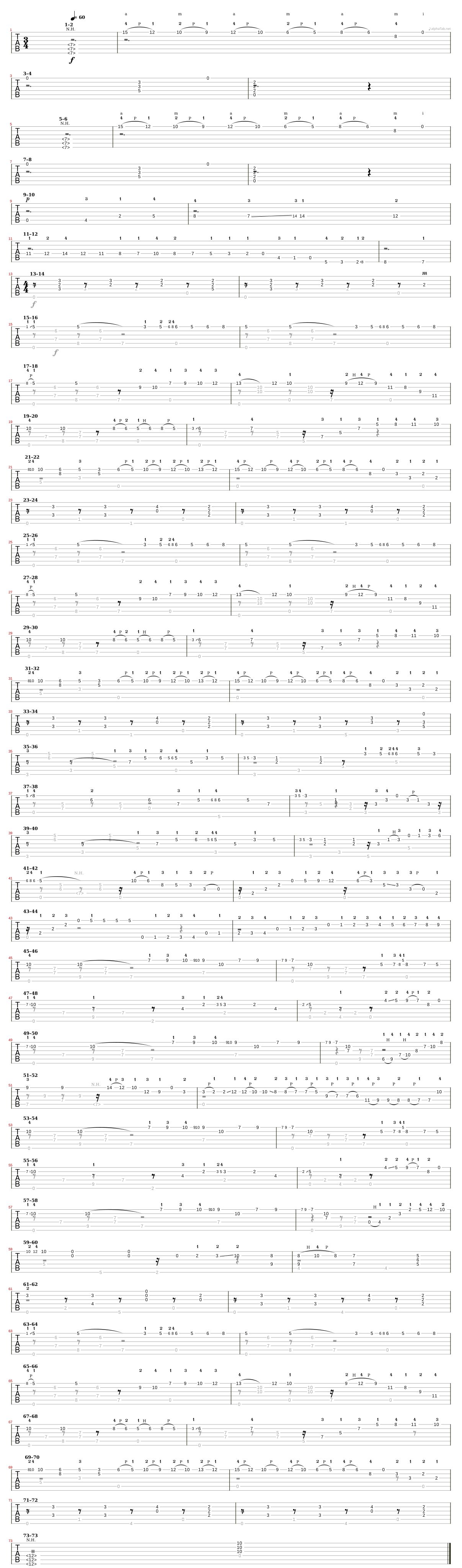
The player and its sounds load when you choose to use them.
Your phrase-by-phrase plan
Work on a short passage. Aim for five clean attempts in a row, then connect two phrases. Bar numbers follow our transcription, including a separately numbered pickup where applicable.
Phrase 1 · bars 1–2
Tune string 6 to D. In bar 1, touch strings 6, 5 and 4 above fret 7 for the harmonics, counting three beats. Practise bar 2’s descent in slurred pairs, preparing each new position.
Phrase 2 · bars 3–4
Hold bar 3’s first note for two beats, then place the chord and final short note. Hold bar 4’s chord for two beats and leave beat three silent.
Phrase 3 · bars 5–6
Bars 5–6 repeat 1–2. Keep the same triple pulse and listen to all three harmonics before preparing the descent.
Phrase 4 · bars 7–8
Bars 7–8 repeat 3–4. Preserve the note lengths, adding freedom to the phrase only after counting steadily.
Phrase 5 · bars 9–10
Play bar 9’s four notes with the thumb; the first lasts a beat and a half. Keep bar 10’s melody on string 4, preparing its 7–14 slide with an even colour.
Phrase 6 · bars 11–12
Bar 11’s first two groups have six notes per beat; its last has eight. Isolate each shift. The short slide reaches fret 8 on string 6. Hold it for two beats in bar 12, then play 7.
Phrase 7 · bars 13–14
Change to four beats per bar. Bass notes fall on the beats and chords between them. Bar 13’s final sonority has three notes; in bar 14, only string 3 at fret 2 answers the final bass.
Phrase 8 · bars 15–16
Bring out bars 15–16’s melody above the chords. Sing it alone before combining all three voices. The beat-two note continues into beat three: do not repluck it.
Phrase 9 · bars 17–18
Prepare string 2 at fret 9, then 10 before bar 17’s first-string ascent. Isolate 9–12–9 on string 1 in bar 18 before the following string changes.
Phrase 10 · bars 19–20
Keep first position through bar 19’s two long notes, then prepare three slurred pairs. Bar 20’s arpeggio starts on beat three with string 5 at fret 5; the upper notes enter just after it.
Phrase 11 · bars 21–22
Separate bar 21’s melody from its two bass notes, practising each slurred pair before joining them. Bar 22 returns to the introduction’s large descent and four final notes. Hold the long bass until its reattack.
Phrase 12 · bars 23–24
Return to the off-beat chords in bars 23–24. Both bars’ third bass is string 6 at fret 1. Prepare it before the answering chord.
Phrase 13 · bars 25–26
Bars 25–26 repeat 15–16. Sing the line alone, then add chords and basses, preserving the tied note at the start of beat three.
Phrase 14 · bars 27–28
Bars 27–28 repeat 17–18. Prepare the ascent from string 2 at fret 9. Slur 9–12–9 on string 1 in bar 28 before changing strings.
Phrase 15 · bars 29–30
Bars 29–30 repeat 19–20. Keep the slurred pairs short and even. Bar 30’s bass begins the quick third-beat group alone.
Phrase 16 · bars 31–32
Bars 31–32 repeat 21–22. Prepare the melody’s shifts separately, then combine the descent with its sustained bass.
Phrase 17 · bars 33–34
Return to the accompaniment in bar 33. Bar 34’s final two basses change to string 6 at fret 5, then string 5 at 3. Hear the chords that answer them.
Phrase 18 · bars 35–36
Bar 35’s melody begins on string 3 at fret 5 beneath the upper chord: keep it audible. Sustain bar 36’s first bass through the ornament, then prepare the shift towards string 1.
Phrase 19 · bars 37–38
Prepare bar 37’s ascent to fret 8 on string 1. Isolate bar 38’s final descending group, whose first and last notes use string 5 at fret 3.
Phrase 20 · bars 39–40
Bar 39 revisits bar 35’s melody with a different final bass. Isolate the eight short notes in bar 40’s second half, preparing the arrival at fret 6 on string 1.
Phrase 21 · bars 41–42
Touch string 4 above fret 7 on bar 41’s second beat for the bass harmonic while sustaining the melody. In bar 42, the bass starts each half-bar and the upper group follows just after it.
Phrase 22 · bars 43–44
Keep four notes per beat in bar 43; the lower ascent follows the repeated notes. Bar 44 has four notes on each of its first three beats, then five on the last. Count that beat separately.
Phrase 23 · bars 45–46
Prepare the barre at 7 in bar 45 and keep basses distinct from the melody. Respect bar 46’s long opening note. Learn the melody before adding its ornaments.
Phrase 24 · bars 47–48
Prepare the shift from position 7 to 2 in bar 47. Hold bar 48’s bass beneath the final notes. Isolate the 4–5 slide and 9–7 slur on string 1.
Phrase 25 · bars 49–50
Return to the major theme and its opening grace note in bar 49. Separate bar 50’s lower group from the ascent into the upper register. Pluck once per slurred pair.
Phrase 26 · bars 51–52
Hold bar 51’s first melody note through each chord. Play string 5’s fret-7 harmonic on beat three. Count six notes per beat in bar 52 and isolate each shift.
Phrase 27 · bars 53–54
Bars 53–54 repeat 45–46. Keep the chords quieter than the melody and prepare ornaments with the following position in mind.
Phrase 28 · bars 55–56
Bars 55–56 repeat 47–48. Prepare the return to position 2. Hold the bass under the slide and slur in bar 56’s second half.
Phrase 29 · bars 57–58
Return to the major theme in bar 57. Begin bar 58’s third-beat ascent with open string 4 slurred to fret 4, then prepare frets 12 and 10 on string 1.
Phrase 30 · bars 59–60
Hold bar 59’s long note before the group rising to fret 10 on string 2. Bar 60’s first three notes share one beat; sustain the bass through the following chords.
Phrase 31 · bars 61–62
Bar 61’s melody begins with the bass; later chords fall between beats. Bar 62’s third bass is string 6 at fret 4, unlike bar 23.
Phrase 32 · bars 63–64
Bars 63–64 return to bars 15–16’s theme. Bring out the melody before adding ornaments and keep the short notes flowing evenly.
Phrase 33 · bars 65–66
Bars 65–66 repeat 17–18. Prepare the ascent from string 2 at fret 9. Slur 9–12–9 on string 1 in bar 66’s second group.
Phrase 34 · bars 67–68
Return to the three slurred pairs in bar 67. Bar 68’s third-beat bass lasts a beat and a half, leaving a half-beat rest before the next bar.
Phrase 35 · bars 69–70
Prepare each slurred pair separately in bar 69. Bar 70’s first bass lasts three beats, then rests for half a beat before its reattack. Preserve this difference from bar 22.
Phrase 36 · bars 71–72
Place bars 71–72’s chords between the beats. The third bass is string 6 at fret 4. Prepare the final chord without adding a bass-line note.
Phrase 37 · bar 73
In bar 73, touch strings 6, 5 and 4 above fret 12 for the three harmonics. After two beats, place a small barre at 10 across the top three strings and play open string 4. Let the sound ring.
Watch and listen
Choose the recording that matches your current goal. Videos load only when you select them and require an internet connection.
Lesson · This is Classical Guitar
Listen to Bradford Werner’s performance and lesson, noticing barres, slurs and shifts. Fingerings and bar numbers may differ from this transcription.
English commentary. Link and metadata checked for our selection.
Lesson · Classical Guitar Corner
Study the introduction with Simon Powis. Count its three beats first and distinguish six-note groups from eight-note groups. This lesson covers the introduction.
English commentary. Link and metadata checked for our selection.
Sources and transcription choices
- Tárrega — Capricho Árabe, Antich y Tena, plate A. y T. 357; Boije 828, pp. 2–5
- Bradford Werner — Capricho Árabe performance, lesson and technical preparation
- Simon Powis — Capricho Árabe introduction: pulse, fast groups, phrasing and colour
The notes follow the credited sources. Fingerings, phrase divisions and practice tempos are editorial learning choices. How our transcriptions work.