This guide follows Improvisación ¡Sola!, the manuscript behind the later arrangement Paquito. Learn its own route through the music: the basses, rests and endings do not always match the posthumous version heard in recordings. Start by locating the repeats and the final jump to the closing chord.
The opening challenge is to sustain the melody through the inner replies. Play a short phrase without accompaniment, then add the other voices more softly. Prepare the next movement while allowing the current melody note to finish its proper length. For a wide ascent, find the destination before practising the complete slide.
The ornaments need a clear attack and a light left-hand response. Isolate each group, then place it between its neighbouring notes. A rest before a shift gives you time to prepare the position; it should not disappear because the hand is eager to arrive.
Several passages slow down in the manuscript. First learn their note values and joins at a steady pace, then allow those changes of timing to breathe in your performance. End a session by anticipating the next repeat or ending before you reach it. Knowing the larger form helps the small technical movements point towards a musical destination.
The 1897 manuscript is titled Improvisación ¡Sola! and became the basis for the posthumous arrangement Paquito. This tablature follows the manuscript: basses, rests, repeats and ending differ from Paquito. Give the marked slowdowns room to breathe. The app’s 60 bpm practice tempo and fingerings are editorial choices.
Skills to prepare
- Sustained melody
- Inner voices
- Slurs
- Slides
- Barres
- Repeats and final return
Before learning the piece
- App checkpoint: place the required chords in positions 3, 5 and 8 three times, then release pressure. Practise this skill (French).
- App checkpoint: play 12–13–12 and 13–15–13 on string 1 three times, with one attack per group. Practise this skill (French).
- App checkpoint: hold a melody note through two quieter inner replies without cutting it off. Practise this skill (French).
These checkpoints belong to our learning path. They do not set a deadline for your progress.
Tablature and fingerings
The six lines represent the strings, with high E at the top. Numbers show frets; 0 means an open string. The letters p, i, m and a indicate right-hand fingers.

Read the complete static tab · Download the alphaTex file
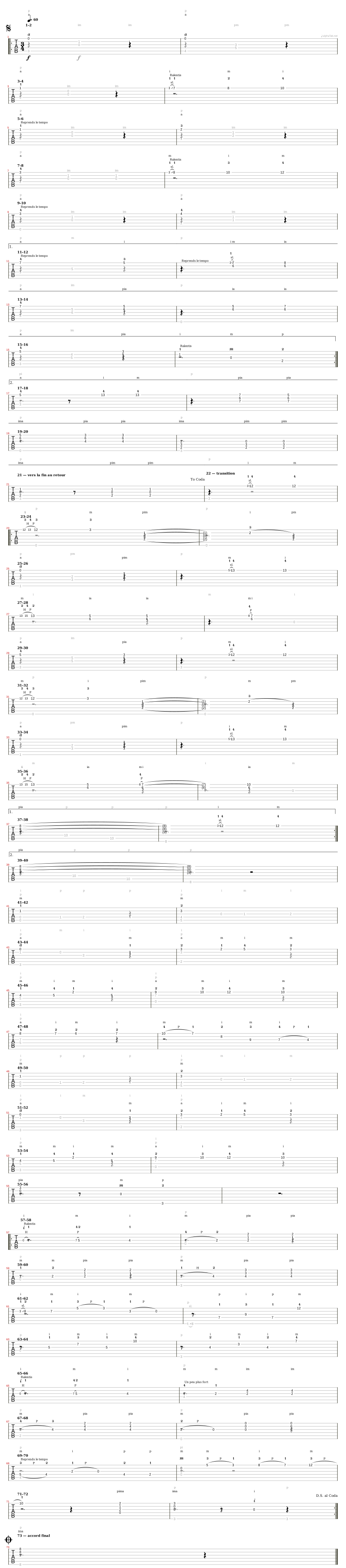
The player and its sounds load when you choose to use them.
Your phrase-by-phrase plan
Work on a short passage. Aim for five clean attempts in a row, then connect two phrases. Bar numbers follow our transcription, including a separately numbered pickup where applicable.
Phrase 1 · bars 1–2
Let bar 1’s open-string melody last two beats. Bar 2’s bass rises one fret and its replies change position. Prepare the shift without rushing.
Phrase 2 · bars 3–4
Hold the melody at fret 1 for two beats in bar 3. Bar 4’s ascent has no bass: slide 3–7, then play 8 and 10 on string 1 while slowing down.
Phrase 3 · bars 5–6
Return to the opening tempo in bar 5. Prepare the bass at fret 1 and melody at 2 in bar 6, keeping the inner replies quieter.
Phrase 4 · bars 7–8
Hold the melody at 3 in bar 7. Bar 8’s unaccompanied ascent slides 3–8, then reaches 10 and 12 on string 1. Slow gradually.
Phrase 5 · bars 9–10
Resume the tempo in bar 9, keeping the open-string attacks relaxed. Bar 10’s melody and third-string note rise one fret; prepare before attacking.
Phrase 6 · bars 11–12
Hold the melody at 7 as the inner note arrives at 5 in bar 11, then descend to 5. Bar 12’s short 3–7 slide precedes the reply at 8.
Phrase 7 · bars 13–14
Prepare position 5 and hold the bass through bar 13’s chords. The bass moves to open string 6 in bar 14; hear the melody rising 5–7.
Phrase 8 · bars 15–16
Hold the bass at fret 3 for two beats in bar 15. Slow bar 16’s descent: string 2 at 1, open string 3, then string 4 at 2. Repeat from 1 once.
Phrase 9 · bars 17–18
Second time, jump from 10 to 17. Observe bar 17’s short rest before reaching fret 13. Hold bar 18’s open bass below both chords.
Phrase 10 · bars 19–20
Keep open string 6 beneath bar 19’s long–short–long rhythm. That rhythm descends into the bass in bar 20. Prepare the chord before shifting.
Phrase 11 · bar 21
Observe bar 21’s short rest between chords. First time, continue to 22. On the final return from 72, jump directly from this bar to 73.
Phrase 12 · bar 22
Play bar 22’s bass, then release it before the wide shift. The short 3–12 slide prepares the two upper notes and launches the next section.
Phrase 13 · bars 23–24
Slur 12–13–12 on string 1 before bar 23’s descent. Do not repluck the three parenthesised notes in bar 24; string 2 then moves to fret 2.
Phrase 14 · bars 25–26
Hold bar 25’s open melody for two beats above the bass at fret 1. Prepare the 5–13 slide on string 1 in bar 26, then repluck the upper note.
Phrase 15 · bars 27–28
Practise bar 27’s 13–15–13 slur separately from the chords. In bar 28, the grace note at 8 descends to 7 while string 2 stays at 6.
Phrase 16 · bars 29–30
Hold the melody at 5, then descend to 3 in bar 29. Release bar 30’s bass before sliding up to fret 12. Keep the movement light.
Phrase 17 · bars 31–32
Bars 31–32 revisit 23–24. Sustain bar 31’s final chord into 32, then bring out string 2’s rise from 1 to 2.
Phrase 18 · bars 33–34
Bars 33–34 revisit 25–26. Hold bar 33’s melody for two beats; prepare bar 34’s wide shift during the first rest.
Phrase 19 · bars 35–36
Bar 35’s 13–15–13 ornament precedes two replies. Sustain the final reply into bar 36, letting it ring before moving to fret 10.
Phrase 20 · bars 37–38
Hold bar 37’s three upper notes over the descending bass. Sustain them for one beat in bar 38, then prepare the slide to 12. Repeat from 23 once.
Phrase 21 · bars 39–40
Second time, jump from 36 to 39. Bar 39 repeats bar 37’s held chord and two bass notes. Sustain it for one beat in bar 40, then observe both rests.
Phrase 22 · bars 41–42
Hold string 2 at fret 1 in bar 41 as string 4 rises 0–1–2–4. Keep bar 42’s bass at 5 through the inner movement.
Phrase 23 · bars 43–44
Hold open string 1 for two beats above bar 43’s inner line. In bar 44, practise the long–very-short 3–2 rhythm before 5 and 3 on string 1.
Phrase 24 · bars 45–46
Distinguish bar 45’s held inner note from the moving line on string 2. Bar 46’s melody rises 9–10–12, then returns to 10 on string 1.
Phrase 25 · bars 47–48
Hold bar 47’s two lower notes for two beats. Play bar 48’s descent alone: slur 10–7 on string 1, then 7–4 on string 3.
Phrase 26 · bars 49–50
Bars 49–50 revisit 41–42. End bar 49’s fourth-string ascent at fret 4. Hold bar 50’s bass at 5 without blocking the inner line.
Phrase 27 · bars 51–52
Bars 51–52 revisit 43–44. Hear bar 51’s inner note rise a fret. Keep the two short opening values of bar 52 distinct.
Phrase 28 · bars 53–54
Bars 53–54 revisit 45–46. Hold bar 53’s inner note on string 3 at fret 5. Prepare bar 54’s peak at 12 without accelerating.
Phrase 29 · bars 55–56
Observe bar 55’s short rest before the third-string reply. The final bass descends onto string 6. Keep all three beats of bar 56 silent.
Phrase 30 · bars 57–58
Slow down bar 57’s two ornaments on string 3: 0–4, then 7–5, ending at 4. Slur 4–2 in bar 58 before the two identical chords.
Phrase 31 · bars 59–60
Play frets 1 and 2 on string 3 with separate attacks in bar 59. In bar 60, slur 3–4 instead, then place the small barre at 3.
Phrase 32 · bars 61–62
Bar 61’s second-string slide prepares the descent. Slur 5–3 on string 1, then 3–0 on string 2. Bar 62’s 5–8 bass slide precedes the upper notes.
Phrase 33 · bars 63–64
Keep open string 4 beneath bar 63’s three short notes and upper note. Repeat that shape above the bass at 3 in bar 64. The upper notes are fretted.
Phrase 34 · bars 65–66
Return to bar 57’s two ornaments in bar 65 and slow down. Play two equal eighth notes before bar 66’s chords, allowing the sound to grow slightly.
Phrase 35 · bars 67–68
Slur 5–4 on string 3 before bar 67’s chords. Slur 2–0 on the same string in bar 68, then let the top three open strings ring.
Phrase 36 · bars 69–70
Resume the tempo in bar 69. Slur 5–4 on string 4, then 2–0 on string 3. Prepare bar 70’s upper pairs: 5–3, 8–7, then 12 into bar 71’s 10.
Phrase 37 · bars 71–72
Do not repluck the arrival at fret 10 from bar 70. Bar 71’s chord enters on beat three. Observe bar 72’s rest and final bass. Repeat 57–72 once, then return to 1.
Phrase 38 · bar 73
After the return and jump from 21, place the barre at 8 in bar 73. Hold the final chord for two beats, then observe the rest. The piece ends here.
Watch and listen
Choose the recording that matches your current goal. Videos load only when you select them and require an internet connection.
Performance · Bolton Guitar Studio
Compare the theme with Paquito. This recording uses the posthumous version; its basses, repeats and rhythms are not an exact model for the ¡Sola! manuscript followed here.
English commentary. Link and metadata checked for our selection.
Sources and transcription choices
- Tárrega — Improvisación ¡Sola!, autograph manuscript FA123, Valencia, 29 June 1897, three pages
- IMSLP — identification of the ¡Sola! autograph manuscript, public domain
- David J. Buch — critical study of ¡Sola! and the 1956 posthumous arrangement Paquito
The notes follow the credited sources. Fingerings, phrase divisions and practice tempos are editorial learning choices. How our transcriptions work.