Rosita combines the forward movement of a polka with wide slides, slurred figures and natural harmonics. Before following the tablature, lower the sixth string to D. That change affects both the bass sound and the way the written fingerings fit the instrument.
Learn the melody alone through one short phrase. The slides should connect destinations that are already familiar, so find each arrival note before adding the movement towards it. When you restore the chords, keep the tune clearly audible and check that the accompaniment does not make the tempo lurch.
The harmonics deserve a brief practice slot of their own. Touch lightly above the indicated fret, pluck and release the touching finger. Then add the note before and after the harmonic. A clear isolated sound is only the first step; it also has to arrive in time within the phrase.
Use the alternative endings to divide the learning into manageable routes. Practise each ending before attempting the full return, and notice where the final pass omits earlier repeats. End a session with a short uninterrupted section. Listen for an even dance pulse through the shifts, with the rests as deliberate as the attacks.
A polka with wide slides, slurs and harmonics. Lower string 6 to D before playing. Learn the melody alone slowly, then add the chords. The app uses 60 bpm as a practice reference.
Skills to prepare
- Slides
- Slurs and held notes
- Natural harmonics
- Barres
- Sixth string tuned to D
Before learning the piece
- App checkpoint: play bar 4’s first slurred pair five times without a second right-hand attack. Practise this skill (French).
- App checkpoint: sound the required strings under barres at 3, 5 and 7 three times each. Practise this skill (French).
- App checkpoint: alternate i and m at four even notes per click for 15 seconds. Practise this skill (French).
These checkpoints belong to our learning path. They do not set a deadline for your progress.
Tablature and fingerings
The six lines represent the strings, with high E at the top. Numbers show frets; 0 means an open string. The letters p, i, m and a indicate right-hand fingers.

Read the complete static tab · Download the alphaTex file
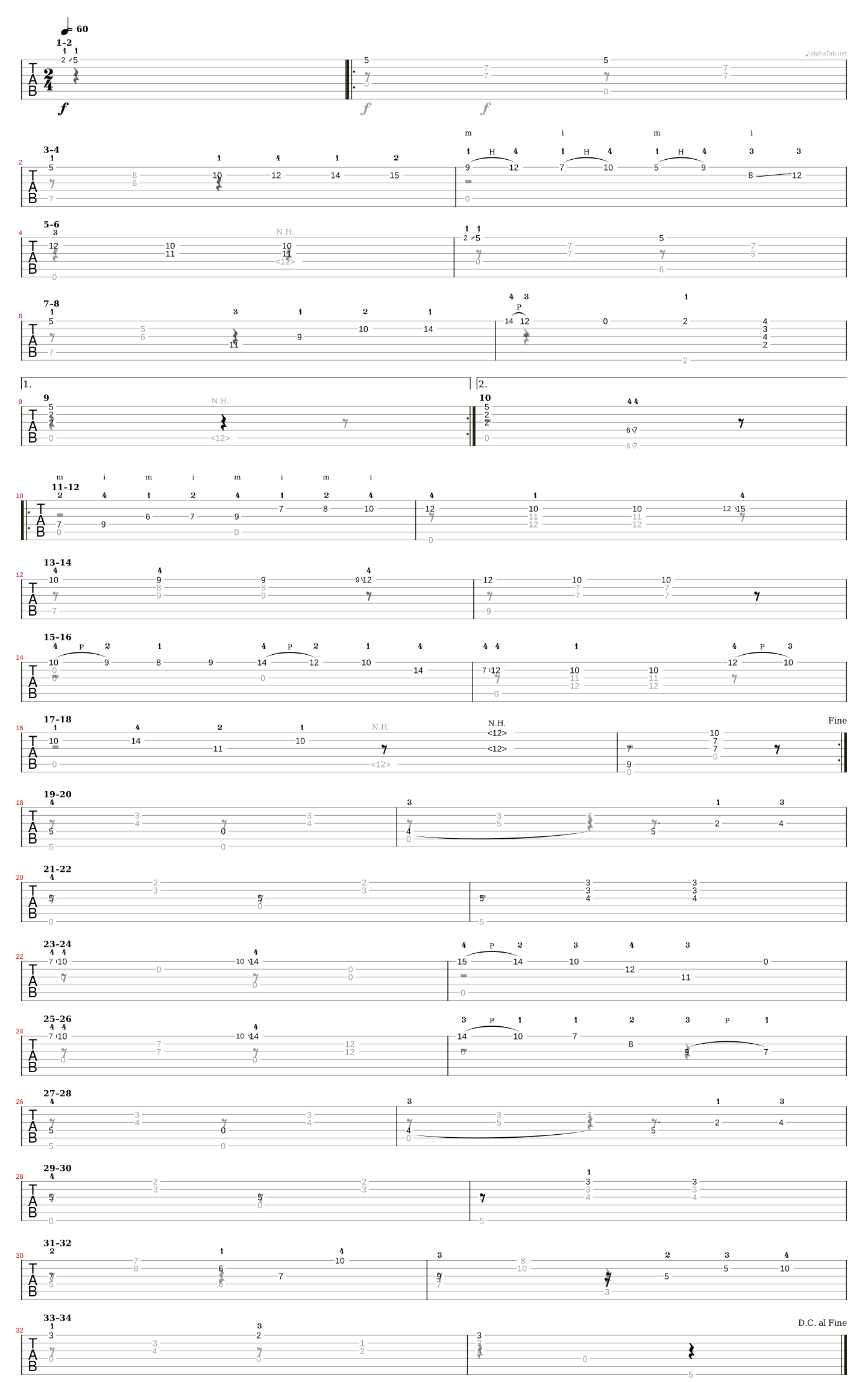
The player and its sounds load when you choose to use them.
Your phrase-by-phrase plan
Work on a short passage. Aim for five clean attempts in a row, then connect two phrases. Bar numbers follow our transcription, including a separately numbered pickup where applicable.
Phrase 1 · bars 1–2
Bars 1–2. Lower only string 6 from E to D. Bar 1 is a one-beat pickup: slide 2–5 on string 1, then place bar 2’s chords.
Phrase 2 · bars 3–4
Bar 3’s ascent follows string 2. Practise bar 4’s three slurred pairs separately. The final slide runs 8–12 on string 2.
Phrase 3 · bars 5–6
In bar 5, touch string 4 above fret 12 for the harmonic. In bar 6, hold string 1 at fret 5 while the lower notes change.
Phrase 4 · bars 7–8
Prepare bar 7’s arpeggio from string 4, fret 11. In bar 8, pull off the grace note from 14 to 12 on string 1. The open string gives time to prepare the final chord.
Phrase 5 · bar 9
Bar 9. First ending: play the harmonic above fret 12 on string 5, then observe the rest. Return to bar 2. Skip this bar on the second pass.
Phrase 6 · bar 10
Bar 10. Second ending: the short slides rise 6–7 on strings 4 and 6. Finish with the rest, then continue to bar 11.
Phrase 7 · bars 11–12
Ascend through eight even notes in bar 11. Prepare position 10 in bar 12; its final slide stays on string 2 and reaches fret 15.
Phrase 8 · bars 13–14
Hold the fifth-string bass beneath bar 13’s two chords. In bar 14, sound the small barre at 7 below the upper notes, then observe the rest.
Phrase 9 · bars 15–16
Isolate bar 15’s two slurred starts and its shifts. Bar 16’s first slide starts at fret 7 on string 2; its final slurred pair descends 12–10 on string 1.
Phrase 10 · bars 17–18
Prepare bar 17’s fret-12 harmonics: string 5, then strings 3 and 1 together. Finish bar 18’s chord and rest. Repeat from 11; on the final return, stop here.
Phrase 11 · bars 19–20
Listen to the two lower notes below bar 19’s chords. In bar 20, string 4 at fret 4 continues into the ascent: do not repluck it.
Phrase 12 · bars 21–22
Keep bar 21’s two chords distinct from the melody. Prepare the barre at 3 in bar 22 and let string 6 at fret 5 ring.
Phrase 13 · bars 23–24
Isolate the slides towards frets 10 and 14 in bar 23. In bar 24, pull off 15–14 on string 1, then prepare the descent’s string crossings.
Phrase 14 · bars 25–26
Bar 25 repeats the wide slides over different chords. Bar 26’s final slurred pair descends 9–7 on string 3.
Phrase 15 · bars 27–28
Bars 27–28. Return to bars 19–20’s material with the same flow and accents. The first tied note in the ascent stays held.
Phrase 16 · bars 29–30
Return to bar 21’s chords in bar 29. In bar 30, a short inner note precedes the upper melody. Let the bass sustain for both beats.
Phrase 17 · bars 31–32
Prepare bar 31’s two neighbouring bass positions. Bar 32’s arpeggio begins at fret 3 on string 5, then rises through strings 3 and 2.
Phrase 18 · bars 33–34
Bars 33–34. Hold the fourth-string bass through bar 33’s two chords. After 34, return to the pickup in bar 1 without taking further repeats. Skip 9, play 10 and finish after 18.
Watch and listen
Choose the recording that matches your current goal. Videos load only when you select them and require an internet connection.
Lesson · This is Classical Guitar
Listen to the polka, then follow the lesson and its shifts. Practising the melody alone helps you learn the route. Fingerings may differ from the app’s choices.
English commentary. Link and metadata checked for our selection.
Sources and transcription choices
- Tárrega — Rosita, Antich y Tena, A. y T. 393; Boije 829, p. 7
- Bradford Werner — Rosita performance and lesson, melody practice and shifts
- Classical Guitar Corner — natural-harmonic notation
The notes follow the credited sources. Fingerings, phrase divisions and practice tempos are editorial learning choices. How our transcriptions work.