This Sueño is the mazurka, not the tremolo study with the same title. Its character comes from the relationship between small ornaments, moving chords and a steady dance pulse. Begin with the main notes so that the decorative figures have a clear place to arrive.
The opening bass and inner line do different jobs. Play them separately to hear where each moves and where a note remains held. When you put them together, keep the bass calm rather than letting a difficult left-hand movement dictate the accent.
Short groups of chords need similar care. Find the chord shapes without rhythm first, then place the three short attacks into their shared beat. Allow the following longer chord to keep its full duration. A group that is technically correct can still disturb the mazurka if it stretches the beat around it.
Our transcription follows the credited Alier edition, with a specific cadence correction documented against the manuscript. Use its written endings and phrase instructions consistently instead of mixing routes from different recordings. Practise the final harmonic and the return separately, then connect them to the preceding phrase. Let the melody remain audible throughout the moving chord shapes.
A mazurka with ornaments, shifting chords and two endings. This transcription follows Alier 5393, with the cadence in bars 7–8 corrected against the 1897 manuscript. Fingerings and the 60 bpm practice tempo are editorial choices. This is not the tremolo study also titled Sueño.
Skills to prepare
- Slurred ornaments
- Slides with multiple notes
- Barres
- Triplet chords
- Natural harmonic
Before learning the piece
- App checkpoint: play bar 4’s 5–7–5 grace-note group three times without replucking either arrival. Practise this skill (French).
- App checkpoint: sound the required chords in positions 3 and 5 three times, then release pressure. Practise this skill (French).
- App checkpoint: keep the melody audible inside bars 15–18’s chords for three slow attempts. Practise this skill (French).
These checkpoints belong to our learning path. They do not set a deadline for your progress.
Tablature and fingerings
The six lines represent the strings, with high E at the top. Numbers show frets; 0 means an open string. The letters p, i, m and a indicate right-hand fingers.

Read the complete static tab · Download the alphaTex file
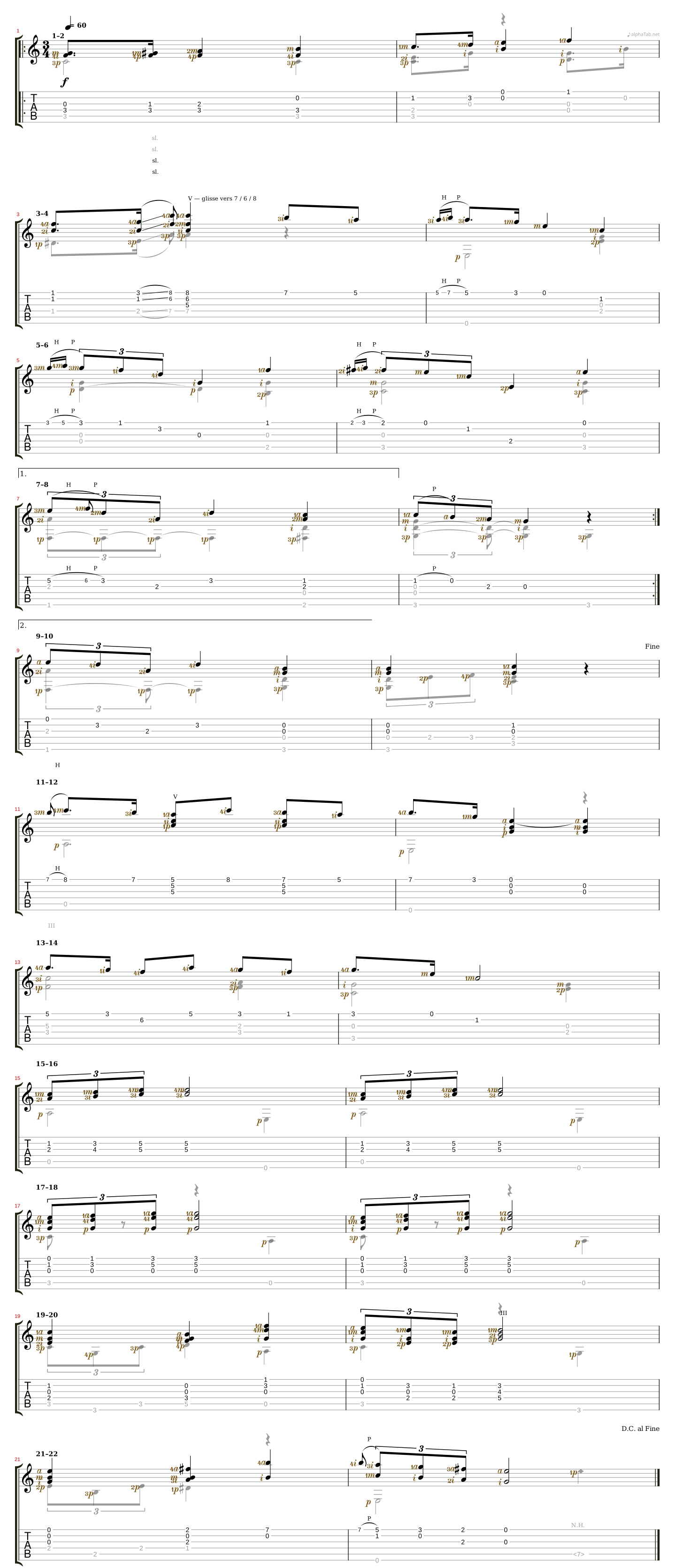
The player and its sounds load when you choose to use them.
Your phrase-by-phrase plan
Work on a short passage. Aim for five clean attempts in a row, then connect two phrases. Bar numbers follow our transcription, including a separately numbered pickup where applicable.
Phrase 1 · bars 1–2
Hold the bass at fret 3 through string 3’s 0–1–2 movement in bar 1. In bar 2, sustain the long notes beneath the short bass replies.
Phrase 2 · bars 3–4
Move all three notes together towards frets 7, 6 and 8 in bar 3, then replay the chord. Slur 5–7–5 on string 1 in bar 4.
Phrase 3 · bars 5–6
In bars 5–6, fit the three opening notes into one beat. The two slurred grace notes come before that group. Keep the bass calm.
Phrase 4 · bars 7–8
Practise 5–6–3 on string 2 in bar 7. Release finger 2 from string 3 to reach fret 3. The bass rises 1–2, then reaches 3 in bar 8. Return to bar 1 after 8.
Phrase 5 · bars 9–10
Bars 9–10. On the second pass, skip 7–8 and play 9–10. Bar 10’s bass rises 0–2–3 on string 4 within beat one; the final beat is silent. Stop here after the final return.
Phrase 6 · bars 11–12
Prepare the small barre at 5 in bar 11 and hammer on the grace note 7–8 on string 1. In bar 12, descend towards open strings without replucking the held high E.
Phrase 7 · bars 13–14
Keep the barre at 3 at the start of bar 13. The melody’s F moves to string 2, fret 6. Return to first position in bar 14 and hold the melody’s C for two beats.
Phrase 8 · bars 15–16
Move both notes together in bars 15–16. Three short chords fill one beat; the final chord lasts two beats. Keep the open bass strings.
Phrase 9 · bars 17–18
Keep string 3 open in every chord in bars 17–18. Move the upper pair together, releasing the bass after its short attack.
Phrase 10 · bars 19–20
Fit bar 19’s three short bass notes into beat one. In bar 20, prepare the barre at 3 after the three short chords. Play the full bar, not just the three-note group.
Phrase 11 · bars 21–22
Prepare the move to fret 7 on string 1 in bar 21. In bar 22, pull off 7–5 and finish descending. Touch string 5 above fret 7 for the harmonic. Return to 1 without repeating again, then finish after 10.
Watch and listen
Choose the recording that matches your current goal. Videos load only when you select them and require an internet connection.
Performance · Per-Olov Kindgren
Listen to the mazurka’s melody and rhythm. Fingerings and editorial details may differ; use the recording as a musical reference.
English commentary. Link and metadata checked for our selection.
Sources and transcription choices
- Tárrega — Sueño, mazurka; Ildefonso Alier, plate 5393, historical edition
- Tárrega — ¡Sueño! Mazurka Conchita, 1897 autograph manuscript; FA123 facsimile
- David J. Buch — critical comparison of bars 7–8, figure 2
The notes follow the credited sources. Fingerings, phrase divisions and practice tempos are editorial learning choices. How our transcriptions work.