This Tango begins with an unusual tuning: lower the sixth string to D and the fifth to G. Check both notes before following the fret numbers. The basses and shapes depend on that tuning, and their sound will be different if the instrument remains in standard tuning.
Start with the octave passages. Play each note separately, then combine them without letting the lower voice hide the upper line. Use the same listening approach when the melody moves in two-note shapes. Prepare the chords slowly before adding ornaments or wide slides.
For a slur or slide, locate the arrival note first, then rebuild the approach. Practise natural harmonics separately with a light touch above the indicated fret, placing each sound back between the notes that surround it. A reliable isolated harmonic still needs a secure musical entrance.
Rasgueado and tambor introduce specific physical gestures. Watch the selected demonstrations because the synthetic player represents these passages with plucked sounds. Learn their rhythm and position in the phrase before comparing the real effect. This guide follows the credited posthumous Alier edition, rather than treating it as interchangeable with the Tango María manuscripts. Keep that source distinction in mind when listening to another performer’s version.
Lower string 6 from E to D and string 5 from A to G. This tablature follows the posthumous Alier I. 5232 A. edition attributed to Tárrega, which differs from the Tango María manuscripts. Learn the octaves first, then the two-note melody and harmonics. Rasgueado uses one sweep of i; tambor uses a thumb gesture against the strings. The app plays these effects as plucked sounds, so compare their physical execution with the videos. Fingerings and 60 bpm are practice choices.
Skills to prepare
- Low strings tuned to D and G
- Octaves
- Thirds
- Slurs and slides
- Natural harmonics
- Rasgueado and tambor
Before learning the piece
- App checkpoint: play two upper notes separately and together three times, without hiding the higher note. Practise this skill (French).
- App checkpoint: play 13–11 and 10–8 on string 1 three times, with one attack per pair. Practise this skill (French).
- App checkpoint: place the barre at 3, sound the top three strings and release. Repeat three times without squeezing harder. Practise this skill (French).
These checkpoints belong to our learning path. They do not set a deadline for your progress.
Tablature and fingerings
The six lines represent the strings, with high E at the top. Numbers show frets; 0 means an open string. The letters p, i, m and a indicate right-hand fingers.

Read the complete static tab · Download the alphaTex file
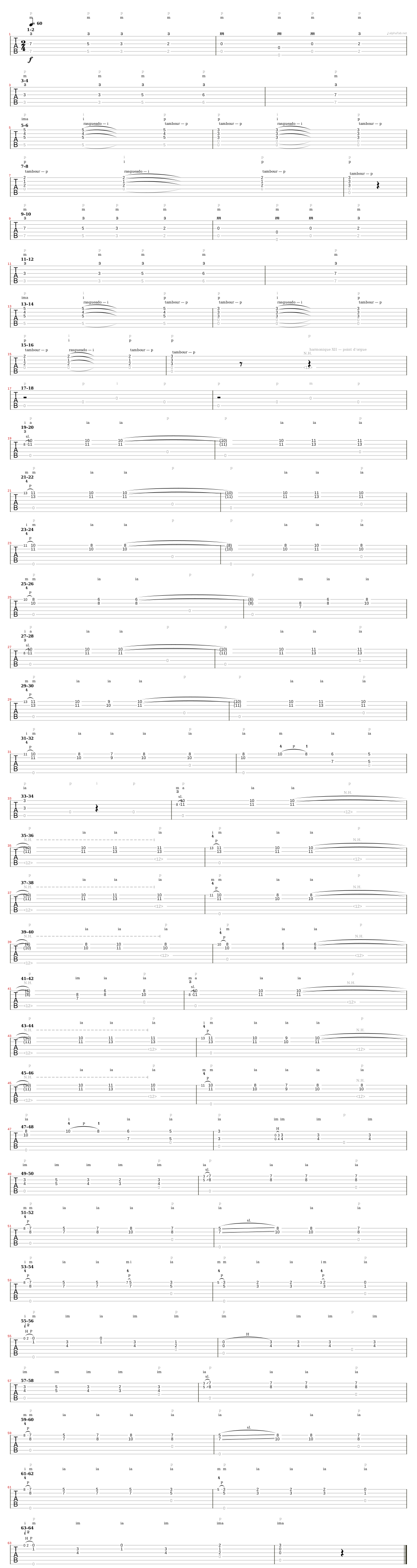
The player and its sounds load when you choose to use them.
Your phrase-by-phrase plan
Work on a short passage. Aim for five clean attempts in a row, then connect two phrases. Bar numbers follow our transcription, including a separately numbered pickup where applicable.
Phrase 1 · bars 1–2
Descend 7–5–3–2 on strings 3 and 5 together in bar 1. Alternate open strings in bar 2, ending at fret 2. Keep the long–very-short–short–short rhythm.
Phrase 2 · bars 3–4
Move both notes up together in bar 3: 3–3–5–6. Hold position 7 for both beats of bar 4, giving the arrival its full length.
Phrase 3 · bars 5–6
Prepare 5–4–5 on the top three strings and a bass at 5 in bar 5. Mute string 4 with the edge of the finger on string 5. Sweep i once for the rasgueado. In bar 6, place the barre at 3; p means one tambor gesture, not five plucks.
Phrase 4 · bars 7–8
Prepare 2–1–2 on the top three strings in bar 7. Do not repluck notes tied after the rasgueado. Return to the barre at 3 in bar 8, then stop the sound at the rest.
Phrase 5 · bars 9–10
Bars 9–10 repeat 1–2’s movements. Strings 5 and 6 are lowered: listen to the open basses before returning to the octaves.
Phrase 6 · bars 11–12
Bars 11–12 repeat 3–4. Sustain all of bar 12, then prepare bar 13’s chord before returning to the percussive gesture.
Phrase 7 · bars 13–14
Bars 13–14 repeat 5–6. Keep chords in place during their continuation. For tambor, gently contact the strings near the bridge with the side of the thumb using a small forearm rotation.
Phrase 8 · bars 15–16
Return to the 2–1–2 chord and its two gestures in bar 15. Stop bar 16’s first chord after half a beat. Touch string 4 above fret 12, pluck with p and lift the touching finger. Let the fermata breathe.
Phrase 9 · bars 17–18
Play only the bass line in bars 17–18: open strings 5–4–3–4. The first sound lasts longer than the second. Repeat the same rhythmic shape exactly.
Phrase 10 · bars 19–20
Bar 19’s short 8–11 slide on string 2 joins fret 10 on string 1. Sustain the final chord into bar 20 without replucking the parenthesised notes.
Phrase 11 · bars 21–22
Slur the grace note 13–11 on string 1 in bar 21. Pluck string 2 separately at the arrival. Let bar 22’s opening chord continue before moving on.
Phrase 12 · bars 23–24
Slur 11–10 on string 1 in bar 23, then lower both notes towards frets 8 and 10. Keep bar 24’s sixth-string bass distinct from the melody.
Phrase 13 · bars 25–26
Slur 10–8 on string 1 in bar 25, then continue downwards. Sustain bar 26’s bass throughout; its short inner reply uses strings 3 and 2.
Phrase 14 · bars 27–28
Bars 27–28 repeat 19–20. Prepare the second-string slide without moving the upper note too early. Let the tied notes cross the barline.
Phrase 15 · bars 29–30
After bar 29’s short 13–11 slur, descend through 10 and 9 on string 1, then return to 10. Hold bar 30’s arrival chord and revisit bar 22’s reply.
Phrase 16 · bars 31–32
Practise bar 31’s three shapes on strings 1 and 2 slowly: 10–11, 8–10, 7–9. Slur 10–8 on string 1 in bar 32, then prepare the lower chords.
Phrase 17 · bars 33–34
Play the small barre at 3 in bar 33, then let only the bass continue. Return to the theme’s slide in bar 34. Its final bass is a harmonic: touch string 4 above fret 12 with finger 4, then lift it.
Phrase 18 · bars 35–36
Bar 35’s two basses are fret-12 harmonics on strings 5 and 4: do not press against the fingerboard. Bar 36’s first bass is open; only the last is a harmonic.
Phrase 19 · bars 37–38
Return to strings 5 and 4’s harmonics in bar 37. Begin bar 38 on open string 6 and finish with string 4’s harmonic, keeping the connected melody above it.
Phrase 20 · bars 39–40
Touch strings 6 and 4 above fret 12 in bar 39. Begin bar 40 with open string 5 and finish with string 4’s harmonic. Prepare the melody’s short slur separately.
Phrase 21 · bars 41–42
Begin bar 41 with string 5’s harmonic; its final bass is open string 4. Return to the theme’s slide in bar 42 and finish with string 4’s harmonic.
Phrase 22 · bars 43–44
Both basses are harmonics on strings 5 and 4 in bar 43; only the last is harmonic in 44. Keep the short 11–10–9 descent distinct from the lower movement.
Phrase 23 · bars 45–46
Sustain bar 45’s upper notes during the first harmonic. Bar 46’s opening bass returns to open string 6. Prepare the chromatic shifts without gripping.
Phrase 24 · bars 47–48
Return to bar 32’s descent in bar 47. In bar 48, leave the barre at 3 for two open strings, then hammer on to string 3 at 4 and string 2 at 3. The next three chords share one beat.
Phrase 25 · bars 49–50
Bar 49’s first three chords share a beat: the position rises, returns and descends one fret. Slide bar 50’s two upper notes to frets 7 and 8 without replucking their arrival.
Phrase 26 · bars 51–52
Bar 51’s short 8–7 slur precedes three equal chords within one beat. In bar 52, slide both notes from frets 5 and 7 to 8 and 10. Repluck only the following chords.
Phrase 27 · bars 53–54
Locate bar 53’s two short slurs on string 1: 8–7 at the start, then 7–5 on beat two. Bar 54 repeats the movement lower: 5–3, then 3–2.
Phrase 28 · bars 55–56
Play 0–2–0 on string 1 with one attack in bar 55, then descend through strings 2 and 3. In bar 56, hammer both open strings onto frets 3 and 4, then play three even chords in one beat.
Phrase 29 · bars 57–58
Bars 57–58 repeat 49–50. Space bar 57’s first three chords equally. Prepare bar 58’s short slide in thirds before repeating the upper chord.
Phrase 30 · bars 59–60
Bars 59–60 repeat 51–52. Distinguish bar 59’s opening slur from bar 60’s two-note slide. Keep the basses softer.
Phrase 31 · bars 61–62
Slur 8–7 in bar 61, then descend without bar 53’s beat-two ornament. Slur 5–3 at the start of bar 62, then continue without bar 54’s later ornament.
Phrase 32 · bars 63–64
Return to 0–2–0 on string 1 in bar 63 and prepare the final 2–1–2 chord. In bar 64, play 0–0–3 on the upper strings with the fifth-string bass. Give it one beat of sound and one beat of silence.
Watch and listen
Choose the recording that matches your current goal. Videos load only when you select them and require an internet connection.
Performance · Tariq Harb
Listen for the theme, rhythm and contrasts. The performer’s variants may differ from our Alier edition.
English commentary. Link and metadata checked for our selection.
Performance · DPJFILMS
Observe the thumb’s tambor gesture before working on bars 5–8 and 13–16.
English commentary. Link and metadata checked for our selection.
Sources and transcription choices
- Tango — Alier I. 5232 A. edition, music pp. 2–3, public domain
- IMSLP — identification of the public-domain Alier edition
- David J. Buch — critical study of variants in the Tango María manuscripts and posthumous edition
- Stefan Apke (2016), comparison of durations and harmonics; CC BY-SA 4.0 engraving, not reproduced
- Douglas Niedt — tambor with the side of the thumb near the bridge
The notes follow the credited sources. Fingerings, phrase divisions and practice tempos are editorial learning choices. How our transcriptions work.