An Andantino study for singing long notes above even triplets. The positions rise as far as a barre at 9. The app uses 60 as a practice tempo.
Skills to prepare
- Even triplets
- Melody and accompaniment
- Sustained bass notes
- Position shifts
- Barres
Before learning the piece
- App checkpoint: play three even notes per click for 20 seconds, five times in a row. Practise this skill.
- App checkpoint: keep the two melody notes in bar 1 louder than the inner notes, five times in a row. Practise this skill.
- App checkpoint: sound the required strings in positions 7 and 9, three times each, without squeezing harder during the shift. Practise this skill.
These checkpoints belong to our learning path. They do not set a deadline for your progress.
Tablature and fingerings
The six lines represent the strings, with high E at the top. Numbers show frets; 0 means an open string. The letters p, i, m and a indicate right-hand fingers.

Read the complete static tab · Download the alphaTex file
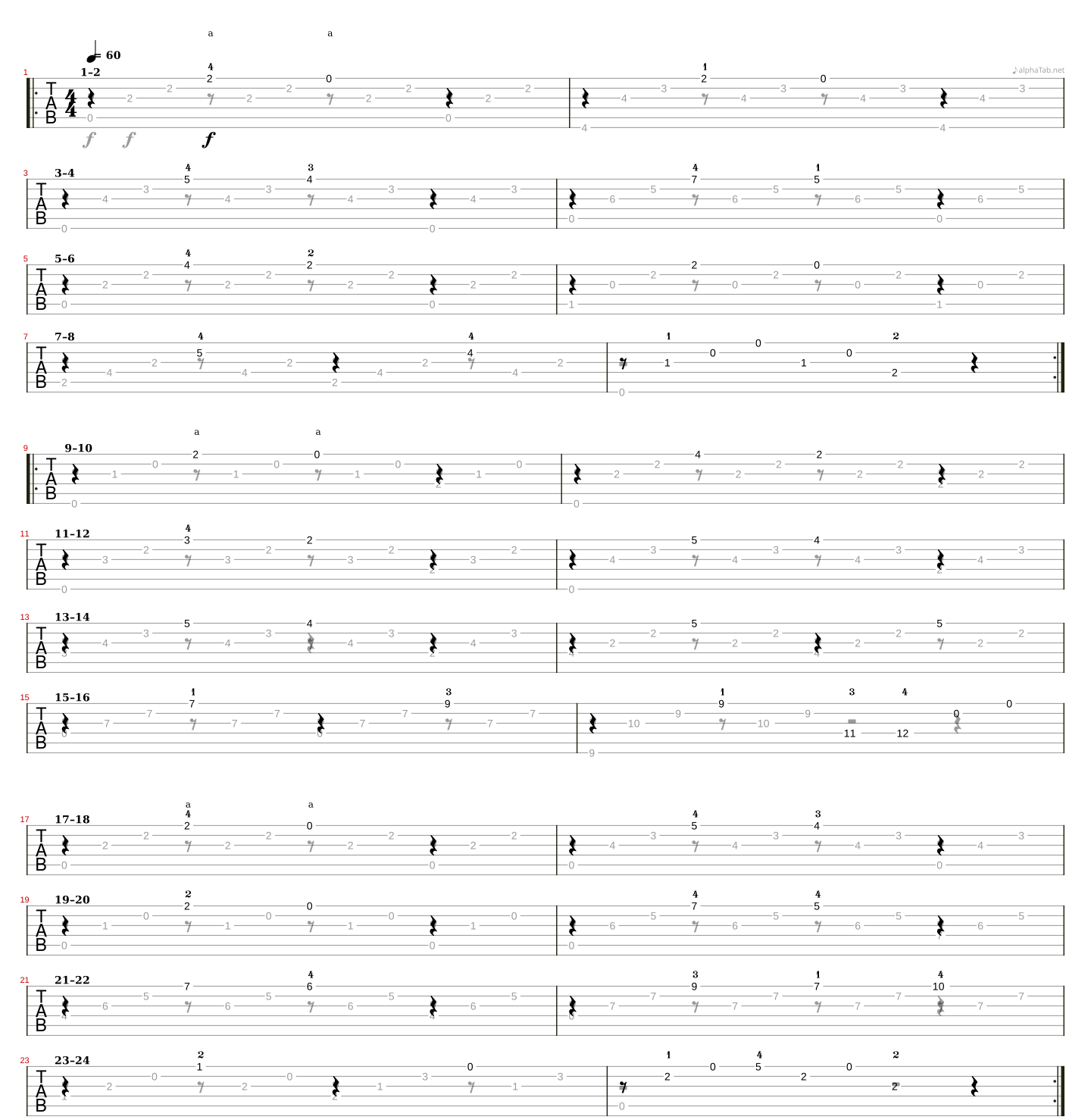
The player and its sounds load when you choose to use them.
Your phrase-by-phrase plan
Work on a short passage. Aim for five clean attempts in a row, then connect two phrases. Bar numbers follow our transcription, including a separately numbered pickup where applicable.
Phrase 1 · bars 1–2
Count three short notes per click. The melody arrives on beats two and three. In bar 2, prepare the bass at fret 4 on string 6 before the treble notes.
Phrase 2 · bars 3–4
In bar 3, stay around frets 3–5. In bar 4, move towards frets 5–7. Prepare the inner notes before adding the melody.
Phrase 3 · bars 5–6
In bar 5, keep the small barre at 2 relaxed. In bar 6, the bass moves to fret 1 on string 5. String 3 returns to open.
Phrase 4 · bars 7–8
In bar 7, hold the bass at fret 2 on string 5 for two beats after each attack. In bar 8, play triplets for the first two beats, then a single note and a rest. Return to bar 1.
Phrase 5 · bars 9–10
In bar 9, keep the open strings soft. In bar 10, prepare the two notes at fret 2 together. Keep the short ascending melody even.
Phrase 6 · bars 11–12
In bar 11, the melody starts at fret 3 on string 1. In bar 12, it rises to fret 5. Prepare both positions without rushing the inner notes.
Phrase 7 · bars 13–14
In bar 13, the first bass lasts two beats and stops on the third. In bar 14, prepare the small barre at 2 and keep the melody at fret 5 above it.
Phrase 8 · bars 15–16
In bar 15, prepare the barre at 7. In bar 16, move to the barre at 9. The last two beats of bar 16 have two notes per beat: stop counting in threes there.
Phrase 9 · bars 17–18
Return to the opening shape in bar 17. In bar 18, move towards frets 3–5 while the bass stays open.
Phrase 10 · bars 19–20
In bar 19, return to first position. In bar 20, prepare frets 5–7; the last bass arrives at fret 7 on string 4.
Phrase 11 · bars 21–22
In bar 21, hold the bass at fret 4 on string 4. In bar 22, prepare the barre at 7, then the melody notes at frets 9, 7 and 10.
Phrase 12 · bars 23–24
In bar 23, distinguish the two bass notes on string 4: fret 1, then fret 2. In bar 24, let the single note finish, then observe the rest. Return to bar 9 on the first pass.
Watch and listen
Choose the recording that matches your current goal. Videos load only when you select them and require an internet connection.
Performance · Classical Guitar Corner
Listen to the whole study, then compare the evenness of the triplets and the melody's volume. Instrumental performance.
English commentary. Link and metadata checked for our selection.
Lesson · This is Classical Guitar
For working on the melody above the accompaniment.
English commentary. Link and metadata checked for our selection.
Sources and transcription choices
- Carcassi — 25 Studies Op. 60, Schott 11425, Boije 94; No.3 on PDF page 4
- Musik- och teaterbiblioteket — Boije catalogue, early Carcassi engraving
- Classical Guitar Corner — Study No.3 and accompanying performance
- Tone production — advice on balancing the voices
The notes follow the credited sources. Fingerings, phrase divisions and practice tempos are editorial learning choices. How our transcriptions work.