A melody in C major for preparing the next note without interrupting the line. The last three bars add an independent bass: a first step towards Tárrega's voices. Play all 40 bars without repeats. The app's practice tempo is 60 quarter notes per minute.
Skills to prepare
- Left-hand preparation
- Reading in first position
Before learning the piece
- App checkpoint: play eight open-string notes at an even volume, three times without tension. Practise this skill.
- App checkpoint: play frets 0–1–3 on string 2 five times without losing the pulse. Practise this skill.
These checkpoints belong to our learning path. They do not set a deadline for your progress.
Tablature and fingerings
The six lines represent the strings, with high E at the top. Numbers show frets; 0 means an open string. The letters p, i, m and a indicate right-hand fingers.

Read the complete static tab · Download the alphaTex file
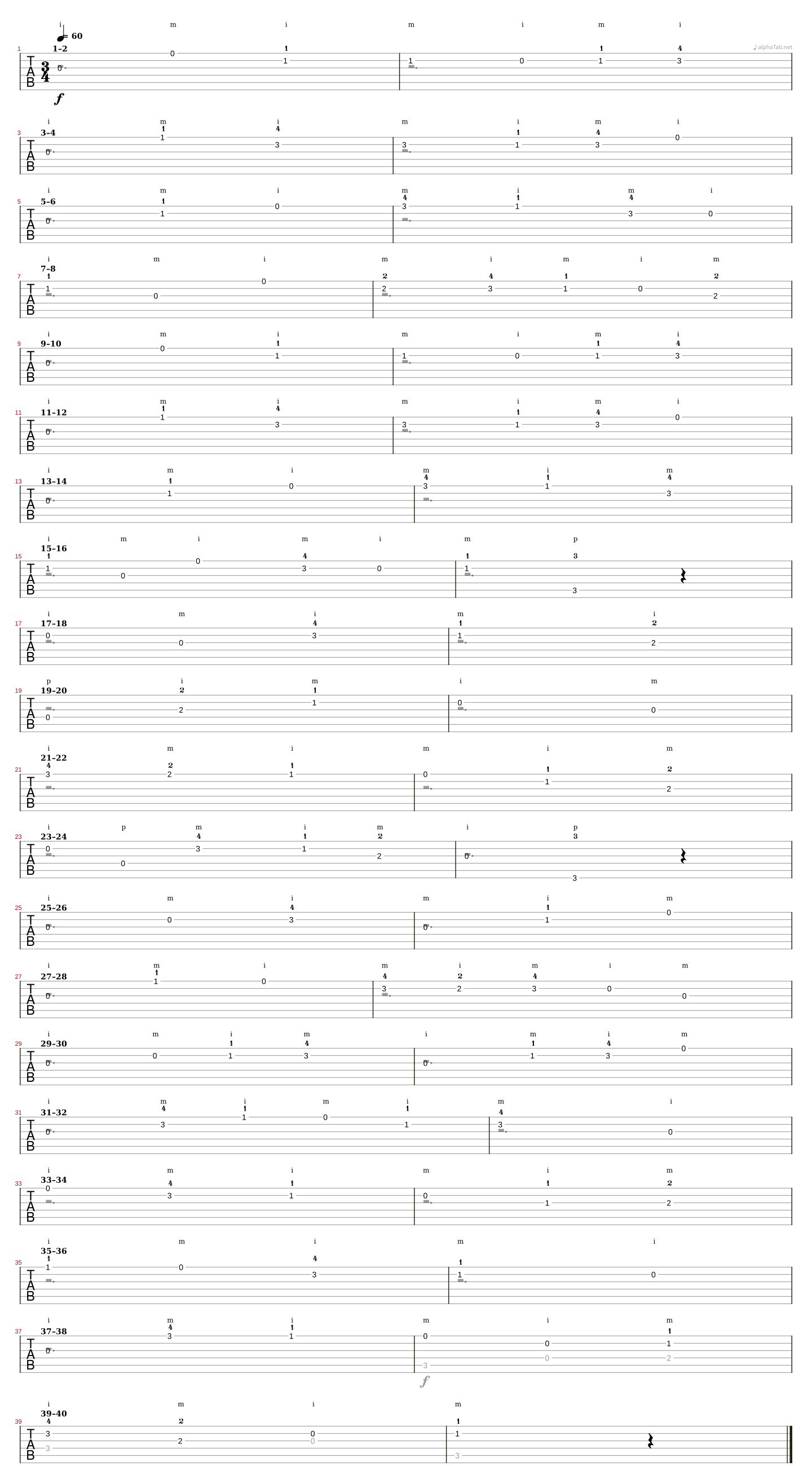
The player and its sounds load when you choose to use them.
Your phrase-by-phrase plan
Work on a short passage. Aim for five clean attempts in a row, then connect two phrases. Bar numbers follow our transcription, including a separately numbered pickup where applicable.
Phrase 1 · bars 1–2
Keep your index finger close to fret 1 on string 2 through the two eighth notes.
Phrase 2 · bars 3–4
Prepare your little finger at fret 3 on string 2 before leaving the open string.
Phrase 3 · bars 5–6
Keep your little finger close to fret 3 as the melody descends.
Phrase 4 · bars 7–8
Prepare your middle finger at fret 2 on string 2 for C sharp in bar 8.
Phrase 5 · bars 9–10
Keep your index finger close to fret 1 on string 2 when the opening pattern returns.
Phrase 6 · bars 11–12
Use only small movements between frets 1 and 3 on string 2.
Phrase 7 · bars 13–14
Prepare your little finger close to fret 3 on string 1 for the highest note in bar 14.
Phrase 8 · bars 15–16
Place the bass at fret 3 on string 5 just before its attack in bar 16.
Phrase 9 · bars 17–18
Keep your middle finger close to fret 2 on string 3 during the long note in bar 18.
Phrase 10 · bars 19–20
Keep your fingers close to the strings during the sustained notes in bars 19–20.
Phrase 11 · bars 21–22
Prepare the change from middle to index finger on string 1, at frets 2 then 1.
Phrase 12 · bars 23–24
Prepare your ring finger at fret 3 on string 6 before the bass in bar 24.
Phrase 13 · bars 25–26
Keep your index finger close to string 2 to return to fret 1 in bar 26.
Phrase 14 · bars 27–28
Prepare your middle finger at fret 2 beneath your little finger at fret 3 on string 2.
Phrase 15 · bars 29–30
Keep your index finger close to fret 1 between the two ascending passages.
Phrase 16 · bars 31–32
Keep your little finger close to fret 3 on string 2 as you return to the open string.
Phrase 17 · bars 33–34
Prepare your index finger at fret 1 on string 3 for G sharp in bar 34.
Phrase 18 · bars 35–36
Keep your index finger at fret 1 on string 2 for both beats of bar 36.
Phrase 19 · bars 37–38
Prepare the C major shape before the three bass notes in bar 38.
Phrase 20 · bars 39–40
Keep your ring finger close to fret 3 on string 5 for the final bass.
Watch and listen
Choose the recording that matches your current goal. Videos load only when you select them and require an internet connection.
Lesson · This is Classical Guitar
Watch the lesson before practising the first phrases; the video includes a performance.
English commentary. Link and metadata checked for our selection.
Sources and transcription choices
- Sor Op. 60 No.2 — Verlag Gitarrefreund, 1915, Boije 1002, p. 14; public domain
- Musik- och teaterbiblioteket — Boije collection catalogue
The notes follow the credited sources. Fingerings, phrase divisions and practice tempos are editorial learning choices. How our transcriptions work.