Scales can help you hear whether the right-hand alternation and left-hand movement stay coordinated across the fretboard. Begin with a short pattern and listen to every string crossing. A note should not arrive late or acquire an unwanted accent simply because the hand is changing strings or positions.
Keep the fingering plan clear before increasing the tempo. Practise a difficult shift as a connection between the last note before moving and the first note after arriving. Locate the destination string and fret, then restore one neighbouring note on each side. This makes the transition easier to examine than a complete scale played repeatedly.
Listen to the duration of the note before the shift. Preparing the next position too early may make the movement feel easier while leaving a gap in the musical line. Use a slower tempo to coordinate the release, travel and arrival without hiding the problem.
After several clear attempts, take the same movement into a phrase from your piece. A scale prepares a general skill, but the actual passage adds its own rhythm and surrounding voices. Record one short comparison and note the position change that still deserves attention in the next session.
What this exercise helps you change
- Uneven i-m alternation
- Audible position shifts
- Thin tone
Your practice steps
1. Choose just one scale
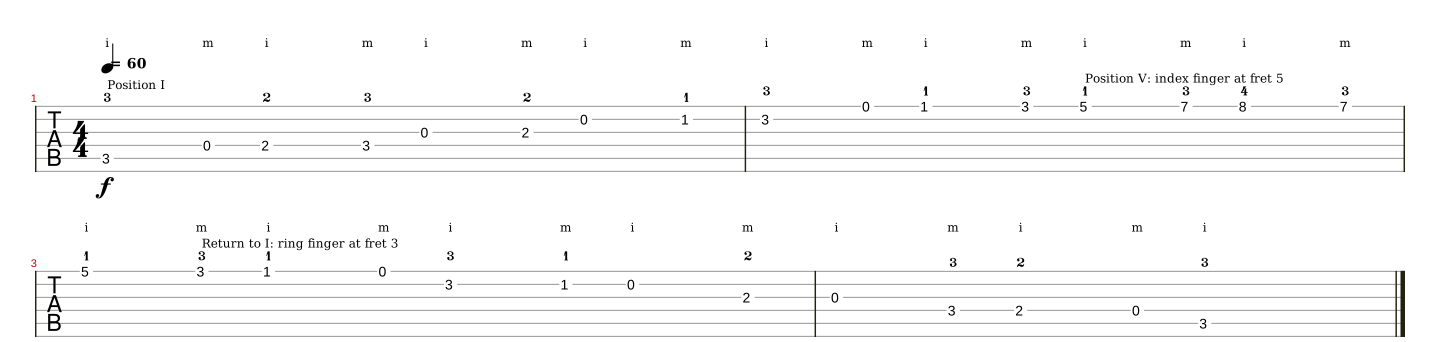
Choose a scale and one goal: tone or shifting. Start with C major over two octaves.
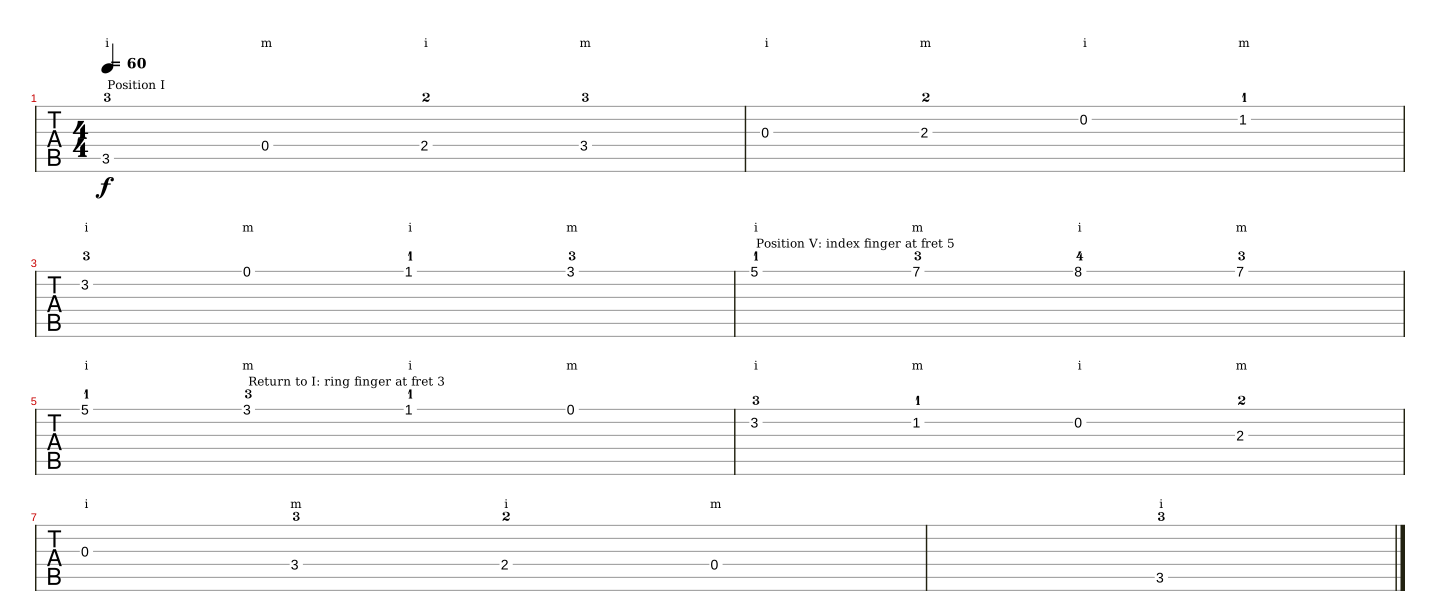
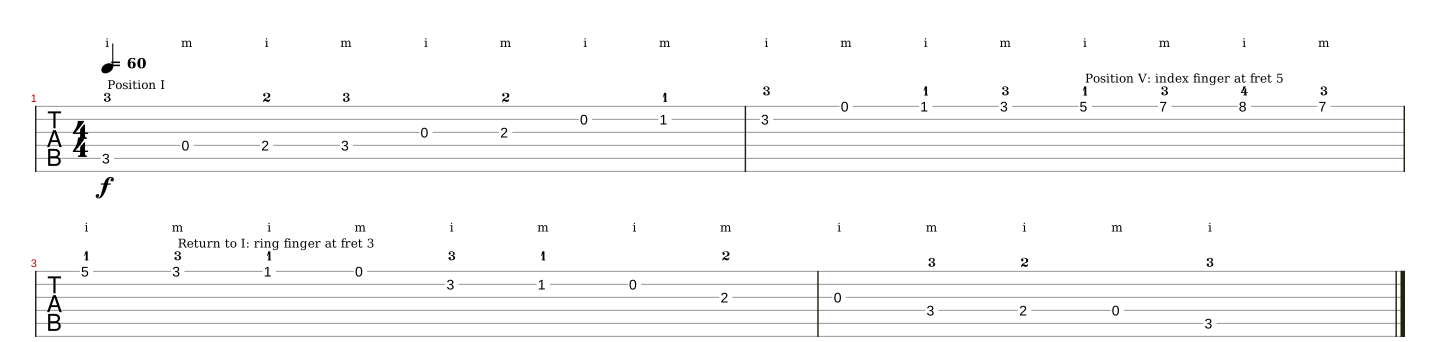
Original app tab, ascending: string 5, fret 3; string 4, frets 0–2–3; string 3, frets 0–2; string 2, frets 0–1–3; string 1, frets 0–1–3–5–7–8. Descend in reverse order without repeating the top note. 0 means an open string. On string 1, prepare the shift from 3 to 5 with your index finger at 5, then your ring finger at 7 and little finger at 8. This fingering is specific to the app.
Your checkpoint: You can follow the same scale in both directions.

Read the complete static tab · Download the alphaTex file
The player and its sounds load when you choose to use them.
Other versions to read
2. Alternate the fingers
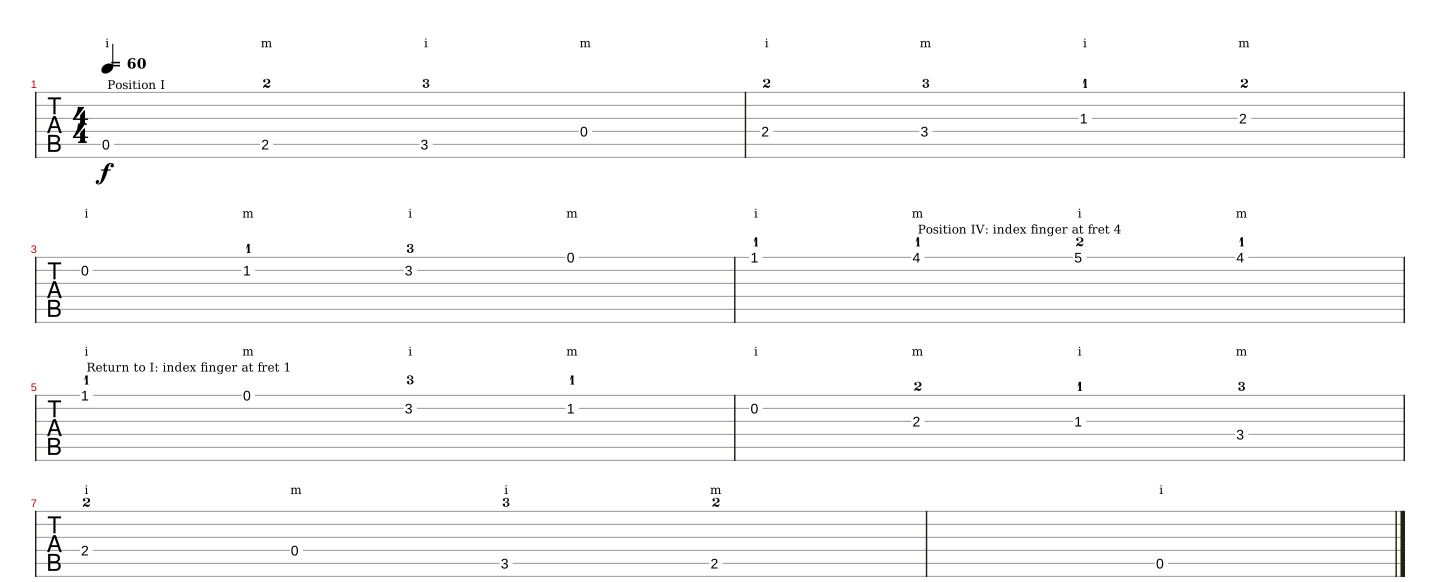
Play i-m, then m-i, finishing each stroke on the neighbouring string. Then repeat with free strokes, without resting there.
The first movement is a rest stroke; the second is a free stroke. Then vary m-a, a-m, i-a and a-i. Niedt also suggests a-m-i for speed.
Your checkpoint: Two consecutive notes are not played by the same finger.
Read the complete static tab · Download the alphaTex file
The player and its sounds load when you choose to use them.
Other versions to read

3. Check each landing
Stop on each note and place the finger just behind the fret. Continue only when the tone is full.
Keep unused fingers close to the fingerboard. Prepare the shift before the next note.
Practice reference: 60 bpm · 1 attack per click.
Your checkpoint: Each note starts without buzzing.
Read the complete static tab · Download the alphaTex file
The player and its sounds load when you choose to use them.
4. Change the rhythm
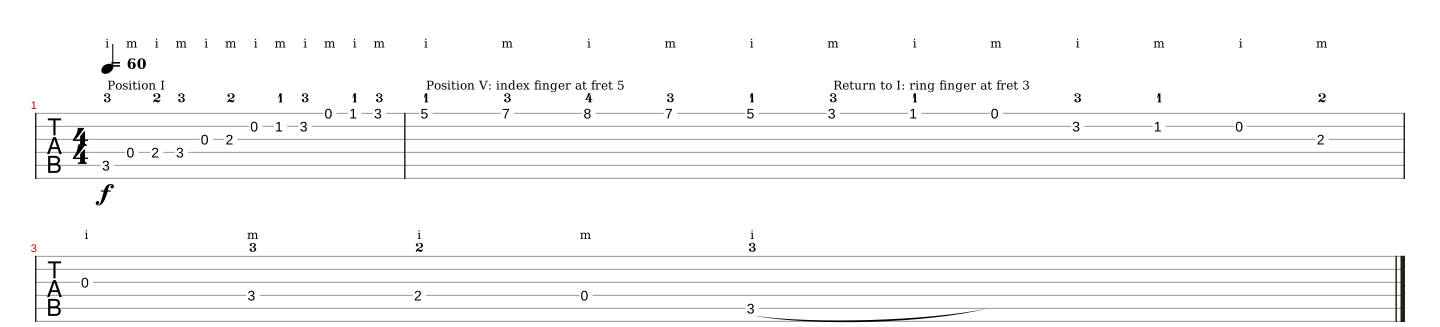
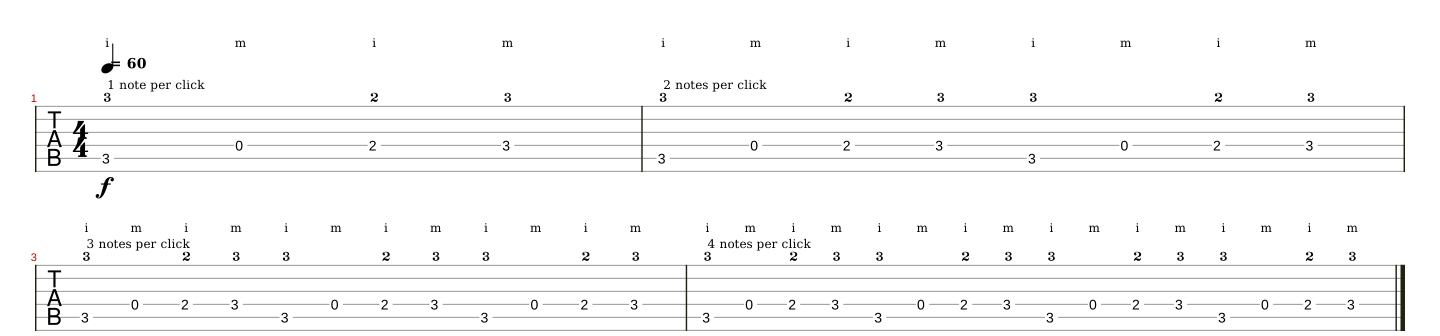
At 60, play one, then two, three and four notes per click. Return to one note per click as soon as the tone deteriorates.
These are quarter notes, eighth notes, triplets and sixteenth notes. The displayed setting starts at one note per click; change the subdivision for each run.
Practice reference: 60 bpm · 1 attack per click.
Your checkpoint: Each group stays even and clean.

Read the complete static tab · Download the alphaTex file
The player and its sounds load when you choose to use them.
Other versions to read
5. Isolate the shift
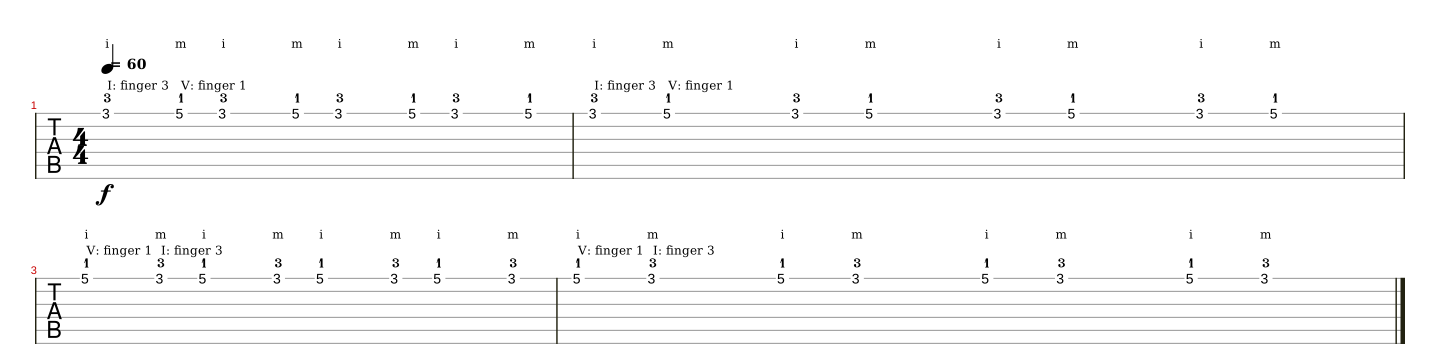
Play long-short, then short-long around the position shift. Slow down until you can no longer hear a gap.
Your checkpoint: The shift becomes inaudible.

Read the complete static tab · Download the alphaTex file
The player and its sounds load when you choose to use them.
6. Listen and make a note
Record a run and listen with your eyes closed. Note the tempo at which the changes remain inaudible.
Increase by 4 bpm after three clean days. Never increase after an imperfect attempt.
Your checkpoint: Neither the string change nor the position shift stands out.
Common difficulties and corrections
You repeat the same finger.
Return to slow i-m alternation and check every stroke before speeding up.
Return to step 2The position shift leaves a gap.
Isolate the shift and alternate long-short, then short-long rhythms.
Return to step 5The groups are uneven.
Return to one note per click at 60, then build the subdivisions back up.
Return to step 4The tone changes with every string.
Go back note by note and even out the tone before continuing.
Return to step 3The left-hand fingers fly away.
Keep unused fingers close to the fingerboard while stopping on each note.
Return to step 3Watch and listen
Choose the recording that matches your current goal. Videos load only when you select them and require an internet connection.
Lesson · This is Classical Guitar
Before working on finger landings.
English commentary. Link and metadata checked for our selection.
Lesson · This is Classical Guitar
Before practising varied rhythms.
English commentary. Link and metadata checked for our selection.
Lesson · This is Classical Guitar
When the scale is clean and you are working on tone.
English commentary. Link and metadata checked for our selection.
Sources and transcription choices
- Classical Guitar Corner — Segovia scales
- Werner — How to practise scales
- Niedt — Scales
- Vieaux — Metronome chart
The notes follow the credited sources. Fingerings, phrase divisions and practice tempos are editorial learning choices. How our transcriptions work.
Apply the skill in a piece
- Marieta
- Pavana
- Rosita
- Sueño — Mazurka
- María
- Mazurka in G
- Las dos hermanitas — Two Waltzes
- Isabel — Waltz
- Paquito — original version ¡Sola!
- Tango — Alier edition
- Capricho Árabe
- Danza Mora
- Estudio en forma de Minuetto
- Sor — Lesson Op. 60 No.1
- Sor — Lesson Op. 60 No.2
- Sor — Lesson Op. 60 No.3
- Tárrega — Prelude in A minor (No. 13, Anido)